Hello! Welcome to the second lesson in our final module, The Future: AI & First-Party Data.
In our previous lesson, you learned how to use generative AI as a creative partner for writing compelling ad copy and blog post ideas. We focused on the art of the prompt—how to brief the AI with context and specific instructions to get high-quality, on-brand text.
Today, we'll apply those same principles to the visual side of marketing. Our learning outcome is to use generative AI to create image concepts for ad creatives. A great headline needs an equally great image, and AI tools can help you generate an almost limitless supply of visual ideas, saving significant time and money compared to traditional photoshoots. We'll explore how to create new images from scratch and, perhaps more practically for a hotel, how to modify your existing photos for specific campaigns.
1. Why Use AI for Ad Creatives? The End of the Creative Bottleneck
As a marketer, you know the constant demand for fresh ad creatives. Campaigns fatigue, seasons change, and new promotions require new visuals. Traditionally, this means expensive and time-consuming photoshoots, limited asset variety, and a slow production process. Generative AI offers a powerful solution to these challenges.
Hacking Midjourney for Insane Ad Creative
To understand the problems AI solves, let's watch this segment from the video "Hacking Midjourney for Insane Ad Creative" by Foreplay. The speaker, Rory Flynn, clearly outlines the traditional pain points for media buyers and how AI changes the game.
Watch from 03:35 to 08:45. Pay close attention to his discussion of the 'creative issue'—the need for new angles, fresh creative, and the high cost and time inefficiency of traditional static images. This sets the stage for why the tools we're about to discuss are so revolutionary.
As you can see, the promise of AI is more productivity, in less time, with higher quality results. It transforms creative production from a bottleneck into a massive testing opportunity.
2. The Prompting Formula for Images
Just as with text generation, the quality of your image output depends entirely on the quality of your input. The key is to be descriptive and use photographic terminology. Vague prompts like "a nice hotel room" will give you generic, uninspired results. A detailed prompt acts as a creative brief for the AI.
Hacking Midjourney for Insane Ad Creative
Let's return to the "Hacking Midjourney" video to learn a powerful formula for writing image prompts. This structure is the foundation for getting predictable, high-quality results.
Watch from 16:58 to 23:53. The speaker breaks down the components of a great prompt, from subject and action to specific camera lenses and lighting. Don't worry about memorizing every term; focus on understanding the structure and the level of detail required.
To help you with this, here is a fantastic visual guide containing dozens of photographic terms you can use in your prompts.
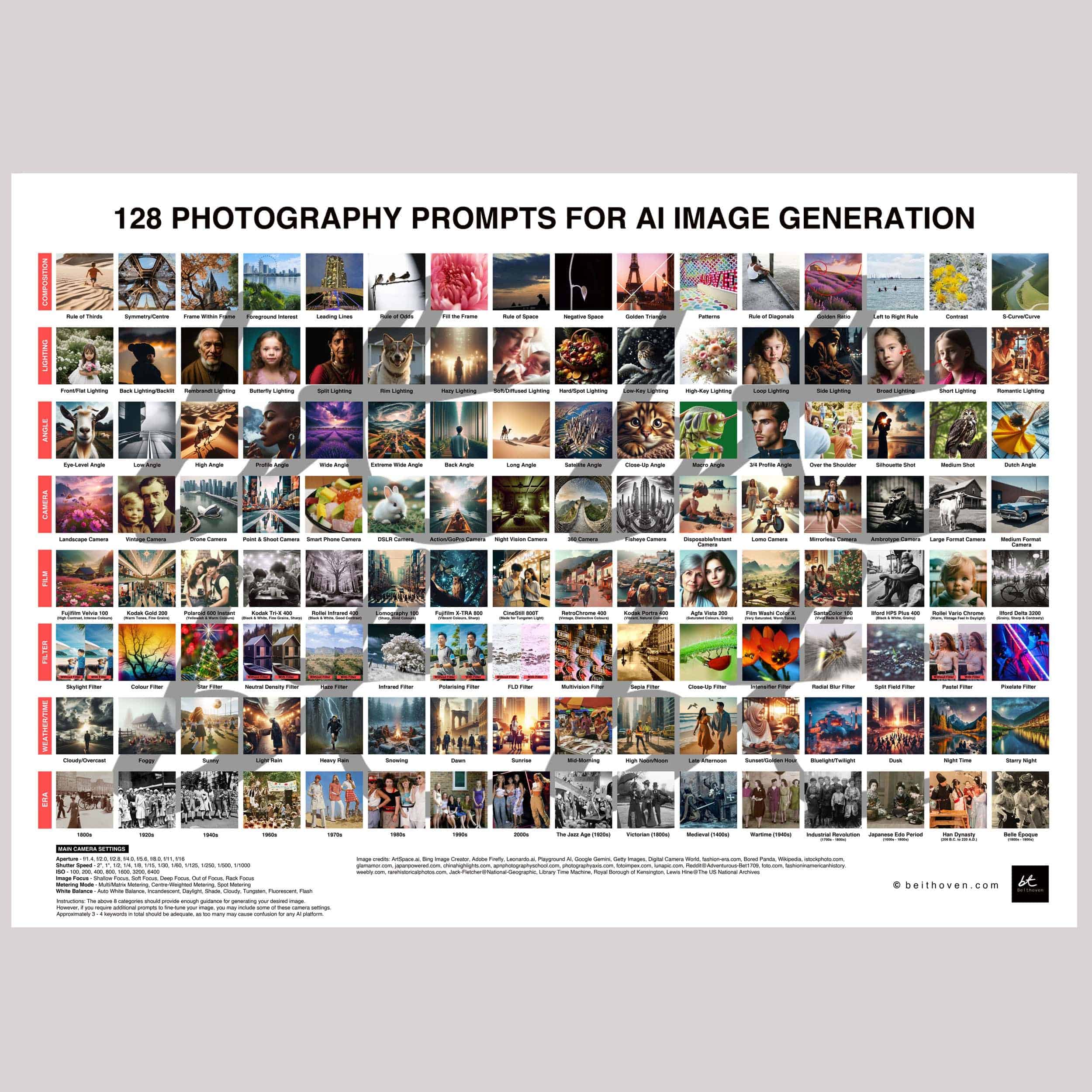
For example, instead of "a hotel lobby", you could write:
Cinematic wide-angle shot of a luxurious hotel lobby, art deco style, with a grand staircase and a crystal chandelier. Golden hour lighting streaming through the tall windows, creating long shadows. The mood is elegant and welcoming. Shot on 35mm film, photorealistic.
This level of detail gives you far more control over the final image.
3. Two Powerful Approaches for Hotel Marketers
You can use these tools in two primary ways: modifying what you already have or creating something entirely new.
Approach 1: Enhancing Your Existing Photos
This is often the most practical and lowest-risk approach for a hotel. You start with your professional photos and use AI to adapt them for specific campaigns. This maintains brand authenticity while adding a layer of timely relevance. Tools like Canva's Magic Studio or Photoshop's Generative Fill are excellent for this.
AI-Powered Hotel Seasonal & Holiday Visuals
This article from Hotel-Online provides perfect, hotel-specific examples of this approach. It shows how to take standard room and lobby photos and instantly prepare them for seasonal marketing.
Read the introduction and then look closely at the five 'before and after' examples for Christmas, Valentine's Day, and other holidays. Notice how simple and direct the prompts are. This is a highly effective way to create a fresh content pipeline without new photoshoots.
The key here is what AI calls "inpainting" (changing something within an image) or "outpainting" (extending the borders of an image).
Canva AI Powered Magic Studio Just Changed Design Forever
Canva's Magic Studio, which is very user-friendly, has powerful tools for this. This video from Howfinity demonstrates two of them.
First, watch from 04:19 to 05:06 to see 'Magic Expand', which is perfect for turning a square photo into a vertical story or a wide banner. Then, watch from 04:57 to 06:00 to see 'Magic Edit', where you can brush over an area and ask the AI to change it, like adding birthday decorations to a hotel room.
Approach 2: Creating New Concepts from Scratch
This approach is for when you want to explore completely new visual ideas that would be difficult or impossible to photograph. You can generate photorealistic scenes that don't exist, allowing you to test creative concepts quickly. Midjourney is particularly powerful for this.

A more advanced technique, called "asset hacking," involves using AI to analyze your existing brand images to learn their style, and then creating entirely new images that match that style.
Hacking Midjourney for Insane Ad Creative
Let's go back to the "Hacking Midjourney" video for a masterclass in this technique. The speaker demonstrates a process to reverse-engineer an image, refine the prompt, and then generate infinite variations that stay on-brand.
Watch from 25:10 to 33:49. Follow the steps: 1) Run an image through the '/describe' function. 2) Refine the prompt with ChatGPT. 3) Use the original image as an 'image prompt' for inspiration. 4) Iterate by changing just one or two elements (like the subject). This is how you can scale creative production while maintaining brand consistency.
Test your understanding!
You have a professional photo of a standard guest room. You want to create an ad creative for a "Work from Hotel" package targeting digital nomads. Using the "enhancing existing photos" approach with a tool like Canva's Magic Edit, what prompt could you use?
Show answer
A good prompt would be: "Transform this hotel room for a remote worker. Add a sleek laptop and a cup of coffee to the desk. Change the view outside the window to an inspiring city skyline. Make the lighting bright and focused on the workspace, with a professional yet comfortable ambiance."
This prompt is effective because it specifies:
- The goal: "for a remote worker"
- Specific objects to add: "laptop," "cup of coffee"
- Environmental changes: "city skyline"
- Lighting and mood: "bright," "professional yet comfortable"
4. Ethics, Risks, and Best Practices
Using generative AI for visuals is incredibly powerful, but it comes with important legal and ethical considerations. It is crucial to be aware of these to protect your brand.
Hacking Midjourney for Insane Ad Creative
This final clip from the "Hacking Midjourney" video covers the essential legal and ethical points you need to know.
Watch carefully from 45:53 to 51:03. The speaker discusses copyright limitations, the risk of a model replicating a trained image, and best practices like reverse image searching and avoiding the use of artist names.
To reinforce these rules specifically for the hotel industry, let's revisit the "Important Tips" section from the Hotel-Online article.
AI-Powered Hotel Seasonal & Holiday Visuals
This section provides clear do's and don'ts for using AI imagery in a hotel marketing context.
Read the 'Important Tips' section at the end of the article. Pay special attention to the 'DON'T' list, especially points like not using AI images in your official website gallery or for booking-related content. This helps maintain guest trust.
Conclusion
You've now seen how generative AI can become your in-house art director, enabling you to produce a vast array of high-quality, on-brand image concepts for your ad campaigns.
Key Takeaways:
- Prompting is the core skill: Use descriptive, photographic language to guide the AI, combining elements like subject, environment, lighting, and camera style.
- Start by enhancing: The most practical application for hotels is often modifying your existing, professional photos to fit seasonal or thematic campaigns.
- Create to innovate: Use text-to-image generation to brainstorm and test completely new visual concepts that would be too costly or difficult to shoot.
- Use AI responsibly: Be aware of copyright limitations, avoid replicating other artists' work, and be strategic about where you use AI-generated visuals to maintain guest trust.
What's Next?
We've now covered using AI to generate both the words and the visuals for your marketing. In the next lesson, we'll shift our focus to using AI for guest interaction. You will learn how to design a simple chatbot conversation flow to answer common questions and qualify leads, turning AI into a 24/7 front-desk assistant.