Hello! Welcome to the third lesson in our final module, The Future: AI & First-Party Data.
In our last two lessons, we explored how generative AI can act as a powerful creative assistant, helping you generate compelling ad copy and striking visual concepts. We've seen how to brief AI to produce content that is on-brand and effective.
Today, we shift from using AI to create static content to using it for dynamic, real-time guest interactions. Our learning outcome is to design a simple chatbot conversation flow to answer common questions and qualify leads. Think of this as designing a script for a 24/7 digital front-desk agent who can free up your staff, provide instant service to guests, and ensure you never miss a potential booking inquiry.
1. Understanding Chatbots and Conversation Flows
Before we design a flow, let's clarify what we're building. A chatbot is a program that simulates human conversation. The "conversation flow" is the blueprint or map that guides this conversation. It defines what the bot says, how it understands user responses, and what paths it takes based on the user's input.
Hotel chatbots & Conversational AI: A comprehensive guide
This guide from Coaxsoft provides an excellent overview of chatbots specifically for the hotel industry. It explains how they work and the different types you'll encounter.
Read the sections 'What is a hotel chatbot?', 'How do hotel chatbots work?', and 'Types of hotel chatbots'. Focus on understanding the difference between a simple rule-based chatbot (which follows a strict decision tree, like a phone menu) and an AI-driven one (which uses natural language processing to understand more complex queries). For this lesson, we'll be designing flows that can be used by either type, but it's good to know the distinction.
The core process of any chatbot conversation looks like this:
- User Input: A guest asks a question (e.g., "What time is check-out?").
- Intent Detection: The bot identifies what the guest wants (the intent is to get information about check-out time).
- Knowledge Retrieval/Action: The bot accesses its knowledge base or performs an action.
- Response: The bot provides the answer ("Check-out is at 11:00 AM.").
Our job is to design the logic that connects these steps.
2. Designing a Flow to Answer Common Questions
The most immediate value a chatbot can provide is answering the repetitive questions your front desk staff handle every day. This is the foundation of a good chatbot flow.
As a hotelier, you already know what these questions are:
- What are your check-in and check-out times?
- Do you have parking? Is it free?
- Are you pet-friendly?
- What are the pool and gym hours?
- Do you offer free Wi-Fi?
- Can I book a table at your restaurant?
The first step in designing a flow is to map these out visually. You can use a simple whiteboard, a piece of paper, or a digital tool to create a flowchart.
How To Map Out Your Chat Bot's Flow with BotMock.com
To see what this mapping process looks like in practice, watch this short introductory clip from Bot Academy. It demonstrates how to visually build out conversational branches. The specific tool isn't important; focus on the concept of creating a decision tree based on user choices.
Watch from the beginning to 06:15. Notice how they start with a welcome message and then offer buttons ('Show me your products,' 'One-on-one coaching'). Each button leads down a different path. This is the fundamental principle of designing a conversation flow.
For your hotel, a simple FAQ flow might start with a welcome message and then offer buttons for common categories like "Hotel Amenities," "Policies," and "Dining." Clicking "Hotel Amenities" could then lead to further options like "Pool & Gym" or "Parking."
3. Designing a Flow to Qualify Leads
Beyond answering simple questions, a chatbot can be a powerful tool for your business goals, particularly in qualifying leads. A "lead" in a hotel context could be a potential guest wanting to book a room, a corporate planner inquiring about event space, or someone looking to make a group dining reservation.
A chatbot can qualify them by asking a series of questions to determine their needs and intent before passing them to a human.
Conversational AI for Lead Qualification: Complete Guide
This guide on Conversational AI for Lead Qualification explains the strategy behind using a bot for this purpose. It introduces concepts that are key to designing an effective flow.
Read the sections 'Why AI for Lead Qualification', 'AI Lead Scoring Models', and 'Intent Detection & Classification'. Focus on the BANT framework (Budget, Authority, Need, Timeline) as a mental model for the kinds of questions your bot should ask. For a hotel guest, this might translate to: Need: 'How many guests? Any specific room type?' Timeline: 'What are your check-in and check-out dates?' Budget: (optional) 'Are you looking for a specific price range?'
The Lead Qualification Flowchart
Here's how a lead qualification flow for a room booking might look:
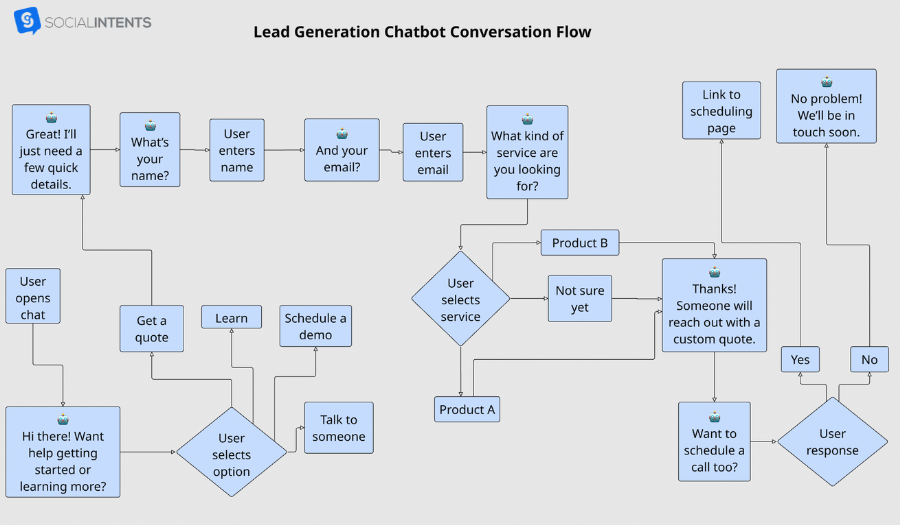
Applying this to your hotel, the flow could be:
- Welcome Message: "Welcome to The Grand Hotel! How can I help you today?"
- Initial Options (Buttons):
[Make a booking][Ask a question] - User clicks
[Make a booking]. - Bot asks about Dates: "Great! What are your desired check-in and check-out dates?"
- Bot asks about Guests: "And how many adults and children will be staying?"
- Check Availability (Integration): The bot checks your booking engine.
- Present Options or Handoff:
- If available: "We have several rooms available for those dates. Would you like me to transfer you to our secure booking page?"
- If unavailable: "Unfortunately, we are fully booked for those dates. Can I help you find alternative dates?"
- For complex requests (e.g., >5 rooms): "For group bookings, it's best to speak with our reservations manager. Can I have your name and email so they can reach out to you?" This is called a human handoff.
This structured process ensures that by the time a human staff member gets involved, they already have all the basic information needed, saving time for both the guest and your team.
Test your understanding!
Imagine a potential guest wants to book your hotel's ballroom for a wedding reception. Design a short, 3-step chatbot conversation flow to qualify this lead. What are the first three questions you would have the bot ask after the user indicates they are interested in an event?
Show answer
A good 3-step qualification flow would be:
- Question 1 (Need/Timeline): "That's wonderful! What is the estimated date of your wedding reception?" (This immediately qualifies if the date is feasible).
- Question 2 (Need): "And approximately how many guests are you expecting?" (This determines if the ballroom is a suitable size and helps with initial pricing).
- Question 3 (Handoff/Authority): "Thank you. To provide you with a detailed quote, our events manager will need to get in touch. What is the best name and email address for them to use?"
This flow quickly gathers the most critical information (date, size) before efficiently capturing contact details for a human expert to take over.
Conclusion
You've now learned the fundamental principles of designing a chatbot conversation flow. This is less about coding and more about strategic thinking—mapping out the customer journey in a conversational format.
Key Takeaways:
- A conversation flow is a decision tree that guides a user through a series of questions and options.
- Start with FAQs: The easiest and most valuable first step is to automate answers to the common, repetitive questions your front desk receives.
- Qualify leads systematically: Use a structured set of questions (based on concepts like Need, Timeline, and Budget) to identify high-intent guests and gather key information.
- Plan for the human handoff: Know when the bot should stop and pass the conversation to a human expert. This is critical for handling complex requests and closing valuable bookings.
What's Next?
While AI tools like chatbots offer incredible opportunities, they also come with risks and limitations. In our next lesson, we will explain the limitations and risks of using AI-generated marketing content. This will equip you with the critical awareness needed to implement these new technologies responsibly and effectively.