Hello! Welcome to the final lesson in our module on Advanced Automation & Personalization for Hotels.
In our previous lesson, we connected the dots between your internal customer data and your paid advertising platforms. You learned how to sync segmented lists—like 'Hot Leads' or 'VIP Guests'—from your CRM to Google and Meta Ads. This is a powerful technique, but it comes with significant responsibility. The first-party data you use is personal, and you need permission to use it for marketing.
Today’s lesson addresses that responsibility head-on. Our learning outcome is to implement privacy compliance (GDPR consent) in automation workflows. We will explore the principles of the General Data Protection Regulation (GDPR) and translate them into practical steps for your hotel's marketing automation. This isn't just about avoiding fines; it's about building trust and ensuring you're communicating with guests who genuinely want to hear from you.
1. GDPR Foundations for Hotel Marketers
The GDPR is a comprehensive data privacy law from the European Union, but its reach is global. If you collect data from or market to any EU citizen, even one visiting your hotel's website from abroad, you must comply. For marketers, the most important "lawful basis" for processing personal data (like sending an email) is consent.
However, not all consent is created equal. GDPR sets a high standard.
GDPR Compliance - Essential Tips for Hotels
To understand what this means in a hotel context, let's review some essential tips from an industry guide by HotelMinder.
Please read points 3 ('Communicate Clearly About Data Collection'), 4 ('Collect Only Necessary Guest Information'), and 5 ('Obtain Explicit Consent from Guests'). Focus on how consent must be an explicit action (no pre-ticked boxes) and that you must be transparent about why you're collecting the data.
From that reading, three key principles emerge for your automation strategy:
- Explicit & Granular Consent: Guests must actively opt-in to marketing. You cannot use pre-checked boxes. Furthermore, if you have different types of marketing (e.g., a weekly newsletter vs. special offers for the spa), you should ideally get separate consent for each.
- Data Minimization: Only ask for the information you truly need for the stated purpose. A newsletter sign-up only requires an email address. Asking for a phone number and date of birth in the same form would be excessive.
- Transparency: You must clearly state what the guest is signing up for. "Enter your email to get our guide to local attractions and our weekly newsletter with exclusive offers." is much better than a vague "Subscribe".
2. Capturing and Managing Consent in Your Systems
Knowing the principles is one thing; implementing them is another. This is where your marketing automation platform or CRM becomes your central tool for compliance.
How to Capture Consent
The best practice for capturing provable consent is the double opt-in method.
- Initial Sign-up: A guest fills out a form on your website (e.g., for a newsletter).
- Confirmation Email: Your automation system immediately sends an email asking them to confirm their subscription by clicking a link.
- Consent Recorded: Only when they click that link is their consent officially recorded in your system.
This process ensures the email address is correct and provides clear proof that the owner of that email address consented to receive marketing.
How to Manage Consent
Consent isn't a "set it and forget it" checkbox. It's a status that must be stored and managed for each contact.
How a hotel CRM helps comply with the new data ...
This article from Hotelinking explains how a CRM is perfectly suited for this task. It acts as a central repository for guest data and their consent status.
Please read the sections on 'Information centralization' and 'Consent management'. Notice how the article describes storing consent as a specific 'property' in the CRM, which can then be used for segmentation.
As the article highlights, you should store consent as a specific data point in your contact records. For example, you might have properties like:
marketing_consent_newsletter: TRUE/FALSEconsent_date: 2024-10-26consent_source: "Website Footer Signup Form"
This level of detail allows you to prove when and how consent was given and to segment your audience precisely for compliant campaigns.
3. Building Compliance into Your Automation Workflows
Once you are capturing and storing consent, you must use it to control your automations. Every marketing automation workflow should begin with a condition that checks the contact's consent status.
Let's look at what this looks like visually.
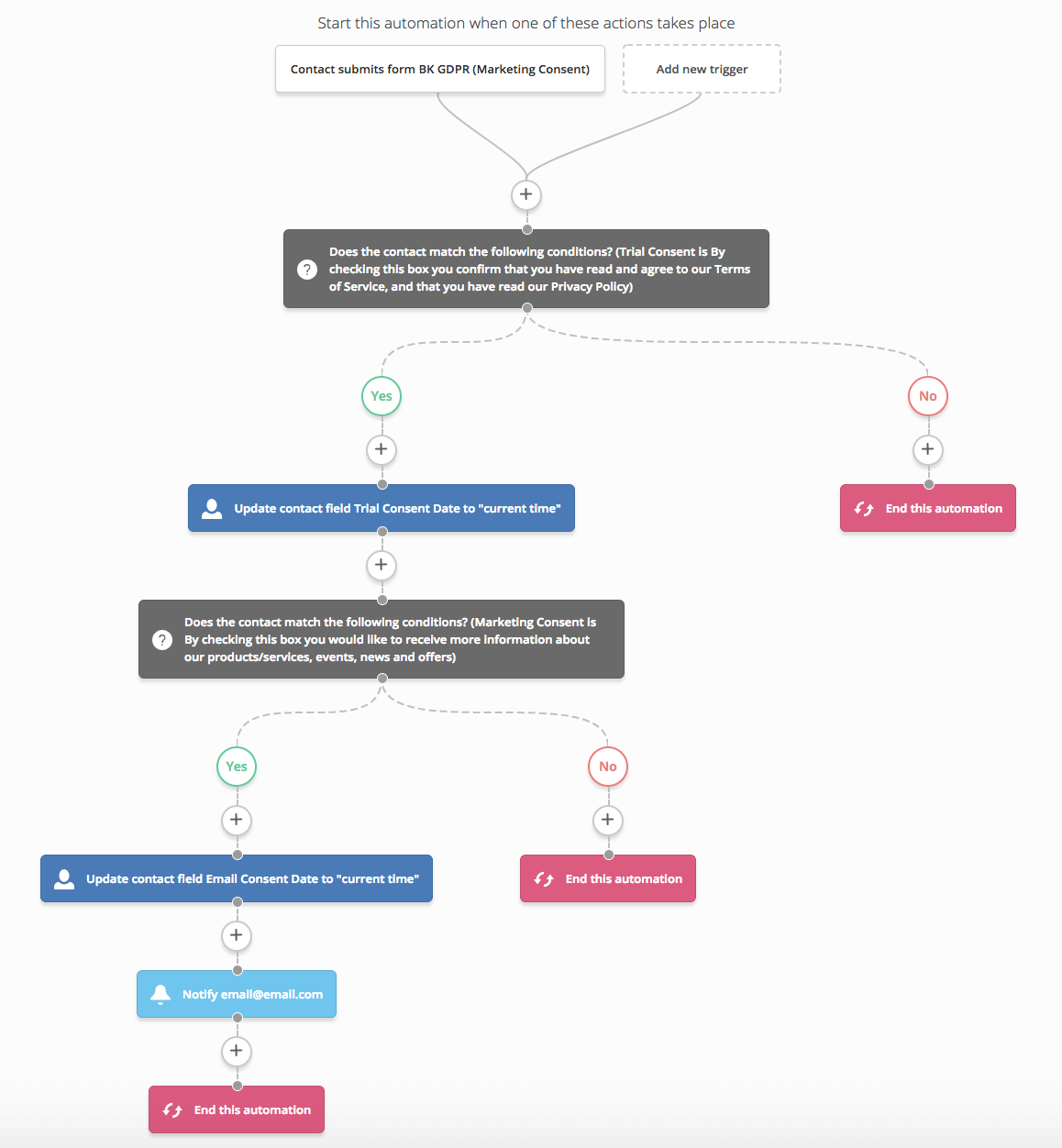
As you can see, the consent check is a simple but critical branching point in the logic.
Let's apply this to a few hotel scenarios:
-
Welcome Sequence: The trigger is a newsletter signup form submission.
- Action: Send double opt-in confirmation email.
- Trigger 2: Contact clicks confirmation link.
- Action: Set
marketing_consent_newsletterto TRUE andconsent_dateto today. - Action: Add contact to the "Welcome Sequence".
-
Abandoned Booking Sequence: This is a common point of confusion.
- Transactional Email: If a guest provides their email during checkout but doesn't finish, you can generally send them one transactional email under the "legitimate interest" clause (e.g., "Having trouble with your booking? Here's a link to complete it."). This is seen as customer service, not marketing.
- Marketing Sequence: To add this person to a multi-email nurture sequence or your general newsletter, you need explicit marketing consent. Your checkout page must include a separate, unticked checkbox for this (e.g., "Yes, send me future offers and news from our hotel.").
The Right to Withdraw Consent
A key part of GDPR is the right for individuals to easily withdraw their consent. In marketing automation, this has two main forms:
- Unsubscribe: Every marketing email must contain a clear unsubscribe link. Your automation platform will manage this, automatically updating the contact's profile to reflect they've opted out. Your workflows should respect this status and not send further emails.
- Right to Erasure (Right to be Forgotten): A person can request that you delete all personal data you hold on them. This is often a manual process, and it's why having all your data centralized in one CRM is so important.
How a hotel CRM helps comply with the new data ...
The 'Right to be Forgotten' is a powerful individual right under GDPR. Let's briefly revisit the Hotelinking article to see why a CRM is vital for this.
Read the short section 'Right to the erasure of information'. This reinforces why having all guest data in one place is essential for fulfilling deletion requests promptly.
Test your understanding!
A potential guest visits your hotel website and starts the booking process. On the checkout page, they enter their email address but do NOT check the optional box that says "I'd like to receive marketing emails with news and special offers." They then abandon the booking.
What can your automated system legally do?
A) Add them to your main weekly marketing newsletter.
B) Send them a single, automated email asking if they had trouble completing their booking and providing a link to resume.
C) Both A and B.
D) Do nothing, as they didn't give any consent.
Show answer
The best answer is B. You can likely send a single transactional email related to their incomplete booking under the principle of "legitimate interest," as it directly relates to a process they initiated. However, you cannot add them to your marketing newsletter (A) because they did not give explicit consent for that purpose.
Conclusion
Congratulations on completing this module on advanced automation! By understanding and implementing privacy compliance, you are not only adhering to the law but also building a more sustainable and trustworthy marketing program.
Key Takeaways:
- GDPR compliance for marketing automation hinges on obtaining explicit, granular, and freely given consent.
- Your CRM or automation platform is your core tool for recording and managing consent status as a specific property for each contact (e.g.,
marketing_consent = TRUE). - All marketing automation workflows must include conditional logic that checks for consent before sending communications.
- You must provide clear, accessible ways for guests to withdraw consent (unsubscribe) and honor requests for data deletion (the right to be forgotten).
- Viewing compliance as a way to build trust transforms it from a legal hurdle into a strategic advantage.
What's Next?
This lesson concludes our deep dive into automation and personalization. You've learned to map the guest journey, design lead nurturing flows, score leads, sync data to ad platforms, and now, to do it all in a compliant way.
In our final module, The Future: AI & First-Party Data, we'll build on everything we've learned. The valuable, consent-based first-party data you now know how to collect is the fuel for modern AI-powered marketing. In our next lesson, we will explore how to use AI-powered tools to generate ideas for ad copy and blog posts, helping you communicate more effectively with your engaged and qualified audience.