Hello! Welcome to the first lesson in our module on Google Ads.
In our last module, we mastered Meta Ads, from campaign structure to interpreting results. We learned that Meta is powerful for generating demand by putting offers in front of relevant audiences. Now, we shift gears to Google Search, which is all about capturing existing demand. Instead of finding people, we're going to let people find us at the exact moment they're looking for a hotel.
This lesson tackles the foundational skill for all search advertising: conducting keyword research for hotel-related queries using Google Keyword Planner. You'll learn how to uncover the specific words and phrases potential guests type into Google when they're planning a trip, giving you the power to place your hotel directly in their path.
1. The Core of Search: Understanding User Intent
Before we open any tools, we need to understand the psychology behind a Google search. Unlike social media, where users are passively scrolling, a search starts with a specific need or question. This is called search intent. Your success on Google depends on matching your ads to the right intent.
There are four main types of search intent. Let's watch a section of a video that breaks them down clearly.
Google Ads Keyword Research: Step-by-Step Tutorial (2025)
This video from Grow My Ads provides an excellent explanation of the different categories of search intent. Understanding this framework is crucial before you start your research.
Watch from 01:53 to 05:34. Focus on the definitions of Informational, Navigational, Commercial, and Transactional intent.
Let's translate this directly to a hotel context:
- Informational: The user is exploring. They aren't ready to book yet.
- Examples: "what to do in london", "best time to visit scotland", "family friendly activities new york"
- Navigational: The user wants to go to a specific website.
- Examples: "hilton hotels website", "your hotel name", "marriott bonvoy login"
- Commercial: The user is comparing options and is close to making a decision. This is a high-value area for advertisers.
- Examples: "best hotels in downtown chicago", "luxury hotel vs boutique hotel", "hotels with indoor pools near me"
- Transactional: The user is ready to buy or book. This is the most valuable intent.
- Examples: "book hotel room paris", "hotel near eiffel tower tonight", "grand hyatt new york reservations"
For your Google Ads search campaigns, your primary focus will be on capturing Commercial and Transactional intent. These are the searches that indicate someone is actively looking to spend money on a hotel stay.
2. Your Toolkit: An Introduction to Google Keyword Planner
Now that we know what we're looking for, let's explore the tool we'll use to find it. Google Keyword Planner is a free tool inside Google Ads designed to help you discover new keywords, see how many people are searching for them, and estimate how much it might cost to target them.
First, here's how you access the tool within your Google Ads account.
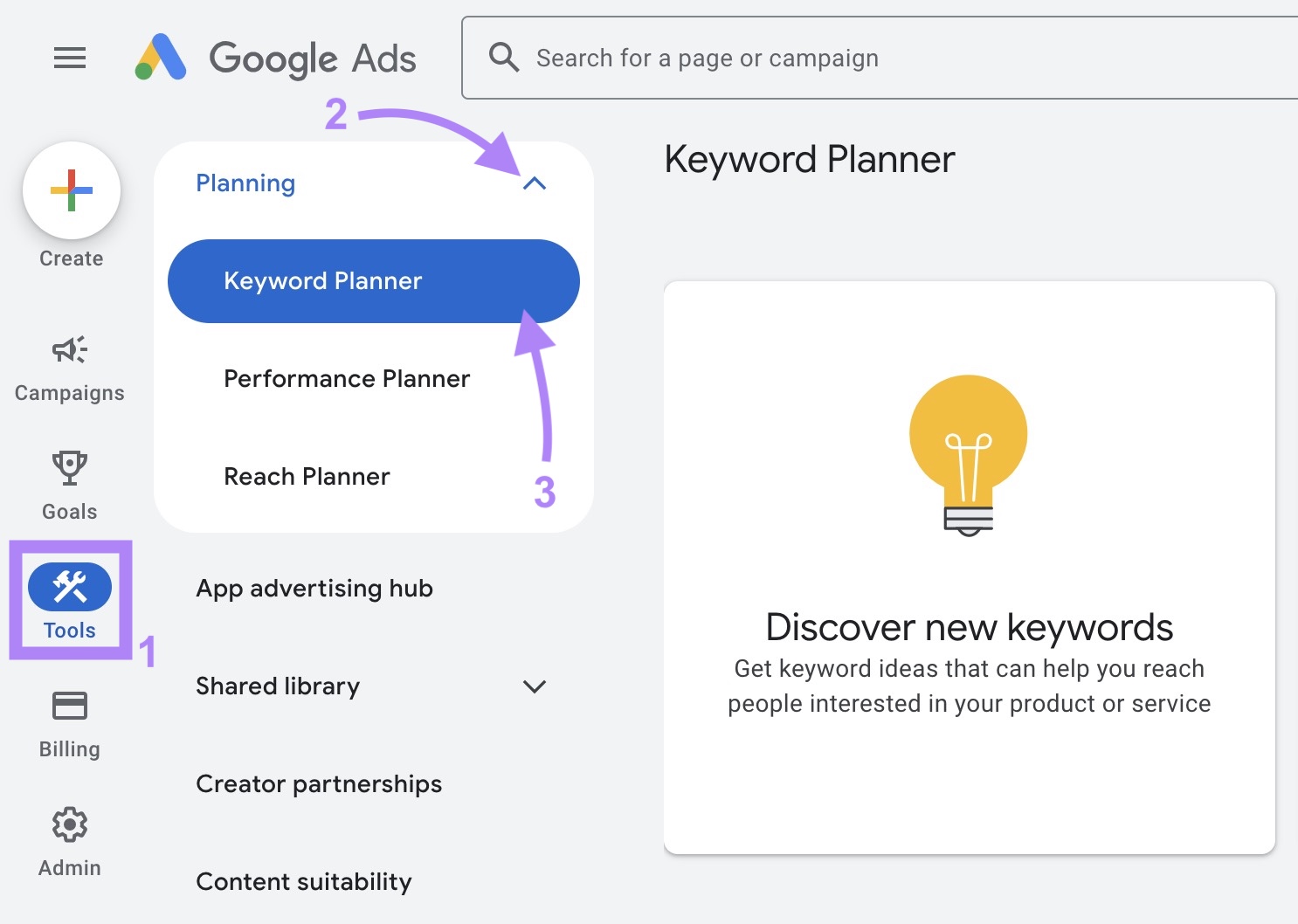
Once you click it, you'll see two main options.

This official guide from Google Ads Help provides a good written overview of the tool's capabilities. You don't need to read it all now, but it's a useful reference.
Use Keyword Planner - Google Ads Help
This is the official Google help document for the Keyword Planner. It's a handy resource to have for reference.
Briefly scan the 'Benefits' and 'Discover new keywords' sections. This will reinforce what you're about to see in the video demonstration.
3. Practical Keyword Research for a Hotel
Theory is great, but keyword research is a hands-on process. We're now going to walk through the exact steps of finding high-intent keywords for a hotel.
The following video provides an excellent, step-by-step demonstration. Although the example is for holiday villas, the process is identical for a hotel.
How to do Google Ads Keyword Research in 2025
In this tutorial, Aaron Young from Define Digital Academy gives a clear, practical walkthrough of the Keyword Planner. Pay close attention to how he starts with initial ideas and then refines the results.
Watch from 04:33 to 09:43. Follow along as he moves from initial seed keywords to a refined list of suggestions, and notice the key data columns he analyzes.
Let's apply that process to a hypothetical example: You run a 4-star boutique hotel in Edinburgh with a popular cocktail bar.
Step 1: Brainstorm Your "Seed" Keywords
Start with the most obvious terms related to your business. Don't overthink it.
boutique hotel edinburghluxury hotel edinburghhotel in edinburgh city centreedinburgh hotel with cocktail bar
Enter these into the "Discover new keywords" field. You can also add your hotel's website URL to help Google find relevant terms.
Step 2: Analyze the Keyword Ideas
Google will return a list of hundreds or thousands of keyword ideas. Here's how to interpret the most important columns:
- Keyword: The search term itself.
- Avg. monthly searches: An estimate of how many times this keyword is searched per month in your target location. This indicates the potential audience size.
- Competition: How many other advertisers are bidding on this keyword (Low, Medium, High). High competition often means higher costs.
- Top of page bid (low and high range): An estimate of the Cost Per Click (CPC) you'd need to pay to appear on the first page of results. This helps you gauge potential budget needs.
Step 3: Refine and Group Your Keywords
This is where strategy comes in. Use the "Refine keywords" panel on the left to group ideas into themes. For our Edinburgh hotel, Google might suggest categories like:
- By Location:
near royal mile,new town,old town - By Amenity:
with parking,with a view,with restaurant - By Hotel Type:
4 star,5 star,romantic
This process helps you discover new ad group ideas. For example, you might see enough search volume for "hotels in edinburgh with a cocktail bar" to justify creating a dedicated ad group with ads that specifically mention your bar.
Step 4: Identify Negative Keywords
As you research, you'll also find terms you don't want to show up for. These are called negative keywords. For our boutique hotel, terms like cheap hotel edinburgh or youth hostel edinburgh would be excellent negative keywords to add to your campaigns. This prevents you from wasting money on clicks from people looking for something you don't offer.
Test your understanding!
You are doing keyword research for a family-friendly resort hotel in Orlando that has a large water park. In the Keyword Planner, you see the following terms. Which ones represent high commercial/transactional intent, and which would you consider adding as a negative keyword?
orlando weather in julybest family hotels orlandoreviews for disney worldorlando hotel with water parkjobs at orlando hotels
Show answer
-
High Intent Keywords:
best family hotels orlando(Commercial Intent - user is comparing options)orlando hotel with water park(Strong Commercial/Transactional Intent - user is looking for a specific feature they are willing to pay for)
-
Negative Keyword:
jobs at orlando hotels(Irrelevant Intent - user is a job seeker, not a potential guest).reviews for disney worldandorlando weather in julyare informational and you likely wouldn't bid on them, butjobsis a term you would actively exclude to avoid wasted ad spend.
Conclusion
Keyword research is part art, part science. It's the process of getting inside your potential guest's head to understand their needs and vocabulary at the very moment they are looking to book. Mastering this skill is the first and most critical step to building profitable Google Ads campaigns.
Key Takeaways:
- Google Search advertising is about capturing intent. Your goal is to target users with high commercial and transactional intent.
- Google Keyword Planner is your primary tool for discovering keywords, analyzing their search volume, and estimating their cost.
- The research process involves starting with seed keywords, analyzing the suggestions, and refining them into logical themes for your campaigns.
- An equally important part of research is identifying negative keywords to prevent wasted ad spend on irrelevant clicks.
What's Next?
Now that you have a list of valuable keywords, what do you do with them? Simply adding them to a campaign isn't enough. You need to tell Google how closely a user's search must match your keyword for your ad to be shown. In our next lesson, we will explore this crucial concept by learning how to distinguish between and strategically apply broad, phrase, and exact match keywords.