Hello! Welcome to the final lesson in our module on Meta Ads Optimization & Analysis.
In our last lesson, we explored how to set up and evaluate Advantage+ campaigns. We saw how these AI-driven campaigns require us to shift our focus from manual tweaks to high-level business metrics like ROAS and cost per booking. That was the perfect introduction to today's topic.
This lesson is all about answering the most important question for any marketing effort: "Is it actually working?" We will move beyond simply reading numbers in Ads Manager and learn how to interpret campaign results in the context of your hotel's specific business goals. By the end of this lesson, you'll be able to translate ad metrics into a meaningful story that informs strategic decisions for your hotel.
1. The Mindset Shift: Are You a Hunter or a Farmer?
Before we dive into any metrics, let's establish the right mindset for analysis. Many marketers operate as "hunters," fixated on short-term performance. They ask, "What was my ROAS today? Did this ad get a booking right now?" This approach can lead to panic and short-sighted decisions.
A more powerful approach is to think like a "farmer." A farmer focuses on long-term growth and the overall health of the system. They ask, "Did this campaign make my business stronger? Did it increase the total amount of profit? Is growth easier to maintain than it was before?"
To adopt this "farmer" mindset, let's watch a short clip that introduces this concept and the most important metric for a business owner.
The NEW BEST Facebook Ads Campaign Structure for 2026
In this video, marketing expert Charley T distinguishes between short-term 'hunting' and long-term 'farming.' This is a crucial mental model for interpreting results.
Watch from 01:48 to 04:24. Focus on the core ideas of 'profit volume' (revenue minus ad spend) and the difference between a 'hunter' (performance marketer) and a 'farmer' (growth marketer).
As Charley T explained, the ultimate measure of success isn't just a high ROAS on a single ad, but the total profit volume your campaigns generate for the hotel. This mindset shift is the foundation for meaningful analysis.
2. Structuring Your Analysis: Primary vs. Storytelling Metrics
Now that we have the right mindset, we need a framework to organize the data in Ads Manager. It's easy to get lost in dozens of columns. A highly effective method is to separate your metrics into two categories:
- Primary Metrics: These tell you WHAT is happening at a business level. Are you winning or losing?
- Storytelling Metrics: These help you understand WHY it's happening. They provide the narrative behind your primary metrics.
Let's watch a video that breaks down this framework and provides a great starting point for customizing your Ads Manager columns.
How to Analyze Facebook Ads Data the Right Way (The 2026 Guide)
Digital marketer Dara Denney provides an excellent, practical walkthrough of her Ads Manager column setup, which is built around this Primary vs. Storytelling framework.
Watch from 00:56 to 09:43 and again from 10:46 to 13:00. Pay close attention to how she defines Primary KPIs (Amount Spent, Purchases, CPA, ROAS) and the secondary 'storytelling' metrics that explain performance.
Building on that framework, let's define the key metrics specifically for a hotel context.
Your Hotel's Primary Metrics (The "What")
These are the numbers that directly reflect business success. They should be the first thing you look at.
- Return on Ad Spend (ROAS):
Revenue from Bookings ÷ Ad Spend. For every dollar you spend, how many dollars in booking revenue do you get back? A ROAS of 5:1 ($5 back for every $1 spent) is often considered strong. - Cost Per Acquisition (CPA) / Cost Per Booking:
Total Ad Spend ÷ Number of Bookings. This tells you your cost to acquire a direct booking. This is crucial for profitability. - Total Booking Revenue: The top-line revenue generated by your campaigns.
- Direct Booking Rate: The percentage of bookings that come directly through your site versus Online Travel Agencies (OTAs). Since direct bookings avoid high commission fees, campaigns that boost this rate are highly valuable, even if their ROAS seems comparable to other channels.
Your Hotel's Storytelling Metrics (The "Why")
If your primary metrics are good, these tell you why. If they're bad, these help you diagnose the problem.
- Audience & Cost Metrics:
- CPM (Cost Per 1,000 Impressions): The cost to show your ad 1,000 times. A high CPM means it's expensive to reach your target audience.
- Frequency: The average number of times each person saw your ad. High frequency can lead to ad fatigue, especially in a small retargeting audience (e.g., people who abandoned a booking).
- Engagement Metrics:
- Unique Outbound CTR (Click-Through Rate): The percentage of individual people who saw your ad and clicked the link to your website. This is a purer measure of your ad's ability to attract interest.
- CPC (Cost Per Click): How much you pay for each click to your website.
- Creative Metrics (for video):
- Hook Rate (3-second plays / Impressions): What percentage of people watched the first 3 seconds? This shows if your opening is effective.
- Hold Rate (ThruPlays / Impressions): What percentage watched at least 15 seconds? This shows if your video is engaging.
This article provides more detail on the specific metrics that are vital for hotel marketing.
How to Measure ROI on Hotel Digital Marketing Campaigns
The article 'How to Measure ROI on Hotel Digital Marketing Campaigns' offers hotel-specific benchmarks and context for many of the metrics we've discussed.
Read the section titled 'Key Metrics for Measuring Hotel Marketing ROI'. This will give you industry benchmarks for metrics like Conversion Rate, Direct Booking Rate, CAC, and ROAS.
3. A Practical Analysis of a Hotel Campaign
Let's put this all together. Imagine you've been running a Meta campaign for a month to promote a "Weekend Getaway" package. You open Ads Manager and see a dashboard like this.
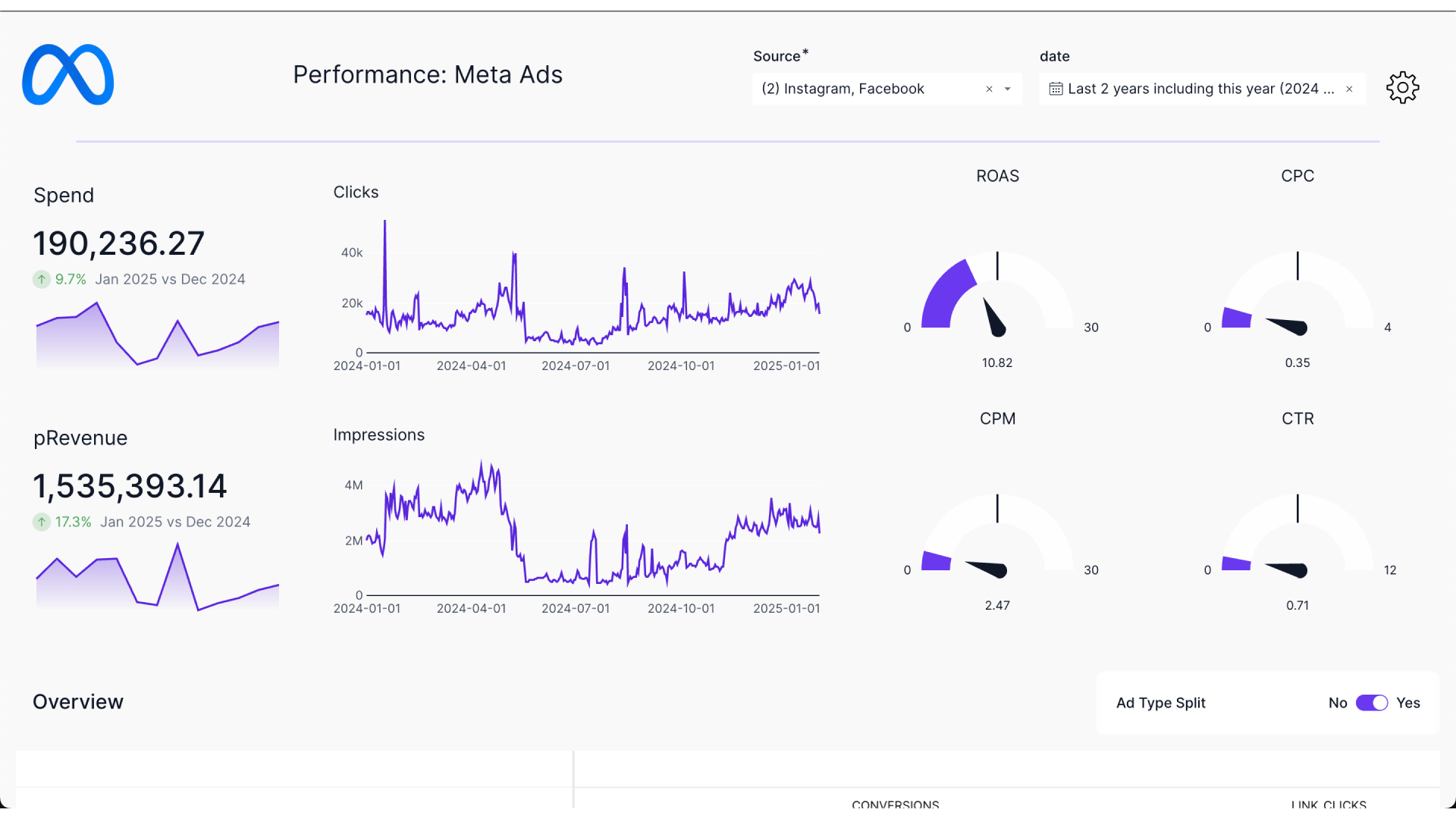
Here is a step-by-step process for interpreting these results:
Step 1: Start with the Business Goal (The Farmer's View)
Before looking at individual ad metrics, look at the big picture.
- Overall ROAS and Profit: Is the campaign profitable? If your ROAS is 6.25 (as in the image), that's a strong return. Your
Profit Volume = pRevenue - Spend. Is that number positive and meaningful for the hotel? - Connect to Hotel KPIs: How does this performance impact the hotel's health? A successful campaign should contribute positively to core hospitality metrics like ADR (Average Daily Rate) and RevPAR (Revenue Per Available Room). If your campaign is driving lots of low-priced bookings, it might fill rooms but hurt your RevPAR. Your goal is to drive profitable occupancy.
This connection between marketing and revenue management is what separates good marketers from great ones.
Social Media Ads ROI for Hotels: Guide
This article from Switch Hotel Solutions clearly explains how marketing campaigns should align with overall hotel revenue strategy.
First, read the section 'Key Metrics for Measuring Hotel Social Media Ad ROI' for a breakdown of revenue, engagement, and retention metrics. Then, read 'Combined Marketing and Revenue Management' to understand how ad campaigns should sync with pricing strategies to maximize ADR and RevPAR.
Step 2: Use Storytelling Metrics to Understand Performance
Now, dig into the "why."
- If ROAS is high: What's the story? A low CPC and high CTR (as in the image) suggest your ads are compelling and efficiently driving traffic. This indicates a good match between your creative, your offer, and your audience.
- If ROAS is low: Where is the problem?
- High CPC / Low CTR? Your ad creative or copy isn't resonating. People see it but don't click. Action: Test new images, videos, or headlines.
- Low CPC / High CTR, but low ROAS? Your ad is working great, but you're losing people on your website. They click but don't book. Action: Investigate your landing page. Is the offer clear? Is the booking process too complicated?
- High CPM? It's expensive to reach your audience. This can happen in competitive markets. Action: Evaluate if the audience is still profitable despite the high cost. If not, you may need to broaden your targeting or find a different angle.
Step 3: Analyze the Creatives
This is where you find your most valuable insights for future campaigns. In Ads Manager, go to the "Ads" tab within your campaign.
- Sort by "Amount Spent." The ad Meta spent the most on is usually the one it predicts will scale best.
- Analyze the winner. Don't just look at its ROAS. Ask why it worked. Was it a video tour of the suite? A user-generated photo from a guest? An image of the pool? A text-heavy ad explaining the package details?
- Identify trends. Look at your top 3-5 ads. Do they share common themes (e.g., they all feature people relaxing, or they all use a question in the first line of copy)? These qualitative insights are gold. They tell you what kind of creative to make next.
Test your understanding!
You run a campaign for your hotel. After a month, you see these results for two different ads:
- Ad A (Video Tour): High CTR (5%), but very low ROAS (1.5:1).
- Ad B (Static Image of Offer): Lower CTR (1.5%), but a very high ROAS (8:1).
How would you interpret this situation, and what would be your next step?
Show answer
-
Interpretation:
- Ad A (Video Tour): The video is very engaging and captures people's attention (high CTR), but it's not attracting people who are ready to book, or the landing page isn't converting the traffic it sends. It might be great for building awareness but poor for driving immediate sales.
- Ad B (Static Image): The ad is less "clickable" overall, but the people who do click are highly qualified and convert at a high rate (high ROAS). It's effectively self-selecting an audience with strong purchase intent.
-
Next Step: The immediate business goal is profitable bookings, so Ad B is the clear winner. The next step is to analyze Ad B's creative and copy to understand why it's working so well and create new variations based on it. You could also use the engaging video from Ad A in a separate retargeting campaign, showing it to people who have already visited your booking page to remind them of the experience they could have.
Conclusion
Interpreting campaign results is a skill that blends data analysis with business acumen. It's about moving from a "hunter" who chases daily metrics to a "farmer" who cultivates long-term, profitable growth for the hotel.
Key Takeaways:
- Focus on Profit Volume: Your main goal is to increase the amount of money the business makes, not just to achieve a high ROAS on a single ad.
- Use a Two-Tiered Framework: Separate your metrics into Primary (the "what" - ROAS, CPA, Revenue) and Storytelling (the "why" - CTR, CPC, Frequency) to create a clear narrative.
- Connect to Hotel KPIs: Always interpret ad performance in the context of core business metrics like Direct Booking Rate, ADR, and RevPAR.
- Analyze, Don't Just Report: Your role is to turn data into a story that leads to a decision: scale what works, or diagnose and fix what doesn't.
What's Next?
This lesson concludes our module on Meta Ads. You've learned how to structure campaigns, optimize them, troubleshoot issues, leverage automation, and—most importantly—measure success in a way that matters to the business.
In our next module, we'll switch platforms and enter the world of Google Ads. We will start with a foundational skill: conducting keyword research for hotel-related queries. We'll move from the audience-first approach of Meta to the intent-driven landscape of search, where you capture demand as it happens.