Hello! Welcome back to our module on Meta Ads Optimization & Analysis.
In our last lesson, we developed a systematic framework for troubleshooting common ad delivery issues. We learned how to diagnose problems related to bids, budgets, and audiences when managing campaigns manually. This understanding of manual controls provides the perfect foundation for today's topic.
Meta is increasingly shifting towards automation, and its most powerful tool in this area is the Advantage+ campaign. This lesson will equip you to set up and evaluate Meta Advantage+ campaigns for conversion-focused objectives, such as driving direct bookings for your hotel. We'll explore how to hand over the optimization levers to Meta's AI, when to trust it, and how to measure its success in a way that aligns with your business goals.
1. What are Advantage+ Campaigns?
Advantage+ Sales Campaigns (often abbreviated as ASC) represent a significant shift from manual campaign management. Instead of you meticulously defining audiences, setting placements, and managing ad set budgets, you provide the goal, budget, and creative assets, and Meta's AI handles the rest.
The core idea is to leverage machine learning to find the most efficient path to your objective (e.g., a booking) across Meta's entire user base, rather than being limited by the specific audiences you define.
To understand what makes Advantage+ campaigns different under the hood, it's helpful to see how their machine learning model works.
Introducing the new sales campaign solution, Advantage+ Shopping Campaign!
This official video from Meta for Business, though slightly dated in its interface, perfectly explains the fundamental difference in the machine learning process between a manual sales campaign and an Advantage+ campaign.
Please watch the section from 01:03 to 04:21. Focus on how the Advantage+ model pre-analyzes historical conversion data in your ad account before the campaign even starts. This is the key to its speed and efficiency.
As the video explained, the key difference is that Advantage+ campaigns start with a strong hypothesis about who your best customers are based on your account's past data. This allows them to bypass much of the initial, unstable "Learning Phase" we discussed in the last lesson.
The New Advantage+ Structure
It's important to note that Meta has recently changed how you create these campaigns. It's no longer a simple A or B choice at the beginning. Instead, you "activate" an Advantage+ campaign by using a specific combination of settings.
Facebook Ads Tutorial: Meta Just Changed EVERYTHING (New Campaign Structure Revealed)
This HubSpot Marketing video provides an excellent, up-to-date overview of how the campaign creation process has evolved. It clarifies that you trigger an Advantage+ campaign through your setup choices.
Watch from 01:08 to 03:12. Pay close attention to the specific criteria that turn a standard 'Sales' campaign into an Advantage+ campaign: broad targeting, optimized placements, and campaign-level budgets.
2. How to Set Up an Advantage+ Campaign for a Hotel
Let's walk through the process of setting up an Advantage+ campaign with the goal of generating direct bookings.
Step 1: Choose the "Sales" Objective
In Ads Manager, click "+ Create". When you choose "Sales" as your objective, Meta will default to the streamlined Advantage+ setup.

Step 2: Configure Campaign Settings
- Budget: Set your budget at the campaign level. This is known as Advantage+ campaign budget (formerly Campaign Budget Optimization or CBO). This allows Meta to flexibly allocate your budget to the best-performing creatives and audiences in real-time.
- Conversion Event: Ensure your conversion event is set to "Purchase" and that your Meta Pixel is selected. Your goal is to get bookings, so you must optimize for the final, most valuable action.
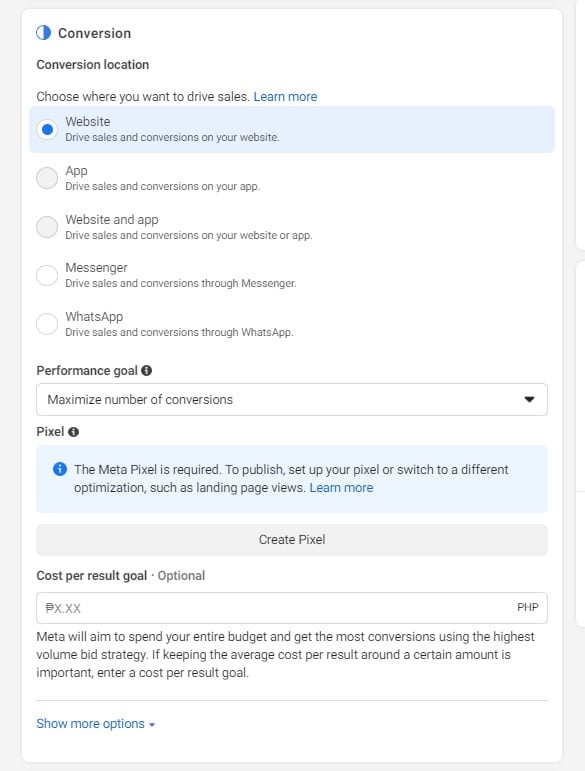
Step 3: Define Your "Audience" (with a twist)
This is where ASC differs most from manual campaigns. You are not setting a restrictive audience. Instead, you provide "suggestions" or "signals" to guide the AI.
- Location, Age, Gender: Set these as you normally would (e.g., target countries you receive guests from).
- Detailed Targeting: You can provide some interests (e.g., "Luxury travel," "Booking.com") as suggestions, but the AI is free to go beyond them.
- Exclusions are Critical: This is the most important part of audience setup for a hotelier. You need to prevent wasting money on people who are not relevant prospects. You should exclude custom audiences of:
- Recent Bookers: People who made a purchase in the last 30-90 days.
- Current Guests: If you maintain such lists.
- Staff/Internal Lists.
The HubSpot video you watched earlier explains how to use these exclusions effectively.
Step 4: Provide Strong, Diverse Creatives
This is your most important job in an ASC setup. Since you're giving up control over targeting, you must give the AI a rich library of ads to test. For a hotel, this means uploading multiple variations of:
- High-quality images of rooms, the exterior, the pool, and the restaurant.
- Short video tours or testimonials.
- Ads highlighting specific offers (e.g., "Book 3 Nights, Get 1 Free").
- Ads focusing on different value propositions (e.g., "Perfect for Romantic Getaways" vs. "Your Ideal Family Vacation").
Meta recommends uploading as many creatives as possible (up to 150 per campaign) to give the algorithm maximum flexibility.
For a step-by-step summary, review the guide in the following article.
Understanding Meta’s Advantage+ Sales Campaigns [2026 Guide]
This guide from Bïrch provides a clear, concise checklist for creating an Advantage+ campaign. It neatly summarizes the steps we've just discussed.
Scroll down to the 'FAQs' section and read the answer to the question 'How can I create an Advantage+ shopping campaign?' This 10-step list is a great practical reference.
3. How to Evaluate Advantage+ Campaign Performance
Evaluating an ASC requires a shift in mindset. You're no longer diagnosing issues at the ad set level. Instead, you're assessing the overall efficiency of the campaign in achieving a business goal.
The perfect example of this comes from a real-world hotel group.
Palladium Hotel Group - case study
This case study from Meta features the Palladium Hotel Group and provides direct, relevant insights into how a hospitality business can use and evaluate Advantage+ campaigns.
Please read the full case study. It's short and very impactful. Pay close attention to: The Goal: To increase direct online bookings. The Test: They A/B tested a standard Advantage+ campaign against one where they tried to manually help the AI with 'bid multipliers'. The Results: The standard, fully automated Advantage+ campaign performed significantly better.
The Palladium Hotel Group's experience is a powerful lesson. They found that trying to "outsmart" or "help" the automation actually hurt performance. The Advantage+ campaign, left to its own devices, delivered:
- 2x more purchases (bookings)
- 50% lower cost per purchase
- 84% higher return on ad spend (ROAS)
This tells us that when evaluating ASC, you should focus on these top-level business metrics:
- Return on Ad Spend (ROAS): Are you generating more booking revenue than you're spending on ads?
- Cost Per Purchase (CPA): What is your average cost to acquire a direct booking?
- Purchase Volume: How many bookings is the campaign generating?
You should spend less time worrying about which micro-audience is performing best and more time analyzing which creatives are driving the best results.
4. When to Use Advantage+ vs. Manual Campaigns
Advantage+ is powerful, but it's not the only tool you should use. The smartest strategy often involves a hybrid approach.
Understanding Meta’s Advantage+ Sales Campaigns [2026 Guide]
This section of the Bïrch article offers a brilliant comparison, outlining the specific scenarios where each campaign type excels.
Read the sections 'Advantage+ sales campaigns vs. manual Meta shopping ads' and the section with real-world insights from media buyers that follows it. Focus on the bullet points under 'Choose Advantage+ when:' and 'Stick with manual when:'.
Here's a summary tailored for a hotel:
| Campaign Type | Best Use Case for a Hotel |
|---|---|
| Advantage+ Sales Campaign | Broad Prospecting: Reaching new potential guests at scale who have never heard of your hotel. Ideal for finding new customers efficiently. |
| Manual Sales Campaign | Strategic Retargeting: Targeting a very specific audience, like "people who visited the booking page for the honeymoon suite but didn't book." Here, you need full control. |
| Niche Promotions: Promoting a specific, high-value service like a wedding venue package to a hand-picked audience of recently engaged people. | |
| Controlled Testing: Manually testing specific messaging or landing pages with a small, defined audience before scaling with Advantage+. |
Test your understanding!
You have two marketing objectives for the upcoming quarter:
- Increase the total number of direct bookings from travelers in Germany and France who have never stayed with you before.
- Promote a new "Weekend Spa Package" specifically to people who have visited your website's spa page in the last 30 days.
Which campaign type (Advantage+ or Manual) would you choose for each objective, and why?
Show answer
-
Objective 1 (New Bookings from Germany/France): This is a perfect use case for an Advantage+ Sales Campaign. The goal is broad prospecting to find new customers at scale. ASC's AI is designed to efficiently explore large audiences (like entire countries) to find individuals most likely to book.
-
Objective 2 (Retargeting for Spa Package): This requires a Manual Sales Campaign. The audience is very specific and strategic (website visitors of a particular page). You need precise control to ensure your spa package ads are only shown to this small, high-intent group. Using Advantage+ here would be inefficient as its strength lies in broad exploration, not hyper-targeted retargeting.
Conclusion
Mastering Advantage+ campaigns is about understanding what to control and what to let go of. You control the business objective, the budget, and the creative inputs. You then trust Meta's AI to handle the complex task of finding the right person at the right time.
Key Takeaways:
- Advantage+ is activated, not just selected: It's triggered by using the "Sales" objective with a campaign-level budget and broad targeting.
- Your job shifts from audience manager to creative director: Success in ASC depends heavily on providing a diverse library of high-quality ad creatives for the AI to test.
- Evaluation focuses on business outcomes: Measure success with high-level metrics like ROAS and cost per booking, not ad set performance. The Palladium Hotel case study proved that trusting the automation yields better results.
- Use a hybrid strategy: Combine the scaling power of Advantage+ for prospecting with the precision of manual campaigns for strategic retargeting and niche promotions.
What's Next?
This lesson focused on a specific, powerful campaign type. In our next and final lesson for this module, we will zoom out to a more universal skill: Interpreting campaign results in the context of business goals for a hotel. We'll learn how to translate ad metrics into a meaningful story that answers the most important question: "Is our marketing working?"