Hello! Welcome back to our module on Google Ads Search Campaigns.
In our last lesson, we focused on the "what" – using Google Keyword Planner to find the specific words and phrases potential guests use when searching for a hotel. We learned how to uncover high-intent keywords that signal someone is ready to book.
Today, we're focusing on the "how." Simply having a list of keywords isn't enough; you need to control how Google uses them. This lesson is all about keyword match types, the rules you give Google to determine which searches can trigger your ads. Mastering this will give you precise control over your budget, improve your ad relevance, and ultimately drive more profitable bookings for your hotel.
By the end of this 60-minute lesson, you will be able to distinguish between and strategically apply broad, phrase, and exact match keywords.
1. The Core Concept: Balancing Reach and Relevance
At its heart, choosing a keyword match type is a strategic trade-off between reach (how many people see your ad) and relevance (how closely their search matches your keyword).
- Broad Match: Maximizes reach, but risks lower relevance.
- Phrase Match: A balance between reach and relevance.
- Exact Match: Maximizes relevance, but has the most limited reach.
This diagram provides a great visual summary of this fundamental trade-off.

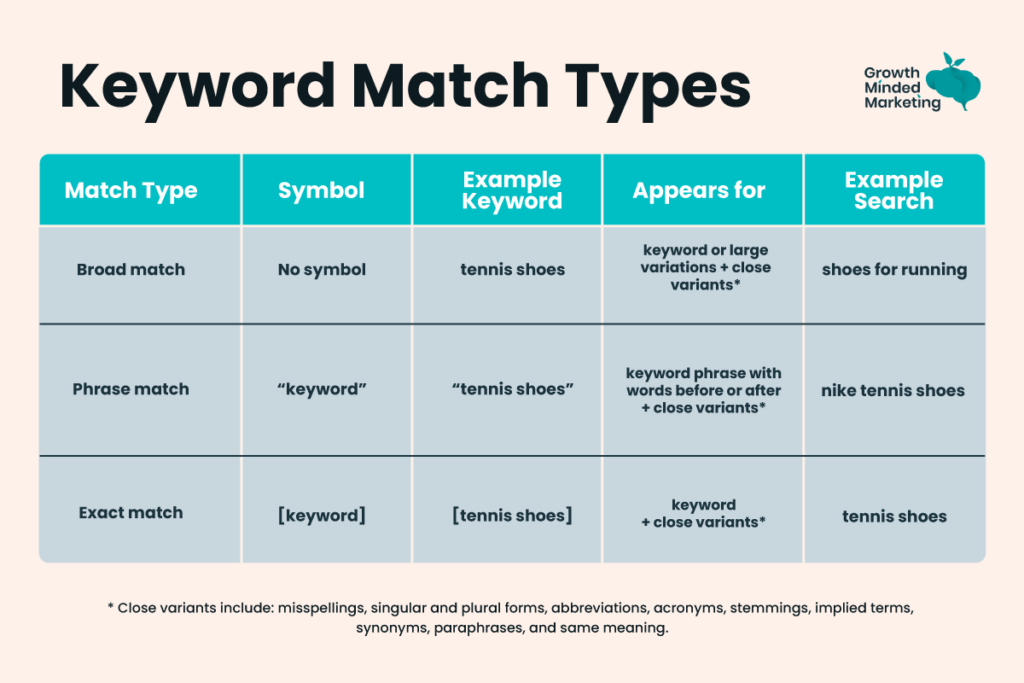
To add a keyword to your campaign, you use specific syntax:
- Broad Match:
hotel london(no symbols) - Phrase Match:
"hotel london"(quotation marks) - Exact Match:
[hotel london](square brackets)
This table gives a quick overview of how each type functions.
2. A Foundational Look at Each Match Type
Let's begin with a clear, straightforward explanation of how these match types are designed to work.
How To Choose The RIGHT Google Ads Keyword Match Type
This video from Google Ads expert Ben Heath provides an excellent foundational breakdown of the three match types. He explains the purpose and syntax for each one with clear examples.
Watch from 00:53 to 06:24. As you watch, focus on the level of control each match type gives you and the syntax used (or not used) for each.
As the video explains:
-
Broad Match gives Google the most freedom. Your ad can show for searches that are related to your keyword, including synonyms and topics Google deems relevant. This is the default setting and carries the highest risk of attracting irrelevant traffic. For a hotel, the keyword
luxury hotel pariscould trigger your ad for searches like "jobs at luxury hotels in paris" or "history of the Ritz Paris." -
Phrase Match offers a balance of flexibility and control. Your ad will appear for searches that include the meaning of your keyword phrase. The search can have extra words before or after it. For example, the keyword
"hotel near eiffel tower"could show for "best hotel near eiffel tower with a view" or "book a cheap hotel near eiffel tower." -
Exact Match gives you the most control. Your ad is meant to show only for searches that have the same meaning or intent as your keyword. For example,
[family hotel with pool london]is intended to only capture users searching for precisely that, filtering out those looking for a business hotel or a romantic getaway.
3. The Modern Reality: How Google Actually Interprets Match Types
Now for a crucial update that's key to running ads in 2026 and beyond. The lines between these match types have blurred. Google's AI now focuses more on the meaning and intent behind a search, rather than just the words themselves. This means even exact match is not as "exact" as it used to be.
Google Ads Keyword Match Types Explained [Updated for Google Ads in 2022]
The theory is a good start, but in practice, things have changed. This video from Aaron Young explains the modern reality of how Google's intent-based matching has made all match types broader.
Please watch these three segments: 00:00 - 00:51 (Introduction to the changes) 01:43 - 03:33 (How exact and phrase match work now) 05:49 - 07:36 (A real-world example of 'exact' match triggering competitor brand names) This is a critical concept for managing a modern Google Ads account.
The key takeaway is that you can no longer set an exact match keyword and assume it will only trigger for that exact phrase. Google might show your ad for synonyms ([pet friendly hotel] might trigger for "dog friendly hotel") or even competitor brands if it thinks the user's intent is the same.
This doesn't make match types useless—far from it. It simply means that active monitoring is more important than ever.
4. A Strategic Framework for Your Hotel
So, how do you apply this knowledge to your hotel's campaigns? The best approach is a structured one that starts with control and expands carefully.
Start with Exact Match [...]
For your most valuable, high-intent keywords—what we call "money terms"—start with exact match. These are the keywords you discovered in the last lesson that have clear transactional intent.
- Example:
[boutique hotel edinburgh city centre]or[hotel with rooftop pool nyc]. - Why: This gives you the most control over your budget and targets users who know exactly what they want. It typically yields the highest Return On Ad Spend (ROAS).
Expand with Phrase Match "..."
Once you have data showing which exact match keywords are performing well, use phrase match to discover new, relevant searches.
- Example: If
[hotel near grand central station]is a winner, you can add"hotel near grand central station"to a separate ad group. This might capture valuable searches like "best family hotel near grand central station" or "4 star hotel near grand central station." - Why: It allows you to find new, profitable search terms while maintaining a good degree of relevance.
Use Broad Match with Extreme Caution
Broad match is best thought of as a research tool, not a long-term targeting strategy, especially when you're starting out.
- Example: You could run a very small, limited-budget campaign with broad match keywords like
edinburgh hotelfor a few weeks. - Why: The goal is not to get bookings from this campaign, but to mine the search terms report (which we'll cover in detail later) for new, specific keyword ideas that you can then add as phrase or exact match to your main campaigns.
Test your understanding!
You run a luxury spa resort in the countryside. You want to attract guests for weekend spa packages. Which match type would be most appropriate for each of the following keywords, and why?
weekend spa break[luxury spa resort with golf course]"couples spa package"
Show answer
weekend spa break(Broad Match): This is a very general term. You would use it with extreme caution in a research-focused campaign with a small budget to discover what longer, more specific searches people are making.[luxury spa resort with golf course](Exact Match): This is the best choice. The search is extremely specific and shows high intent from a user looking for exactly what you offer. This should be a core keyword for a high-value campaign."couples spa package"(Phrase Match): This is a good middle ground. It targets users looking for a specific type of package but allows for variations like "best couples spa package deals" or "romantic couples spa package uk". It's great for capturing an audience with strong commercial intent.
5. Your Secret Weapon: Negative Keywords
Given that all match types are now broader, your ability to control costs and improve relevance heavily depends on negative keywords. These are terms you add to your campaign to prevent your ad from showing.
The following resources provide excellent hotel-specific examples of how to think about this strategically.
Hotel Search Engine Marketing: Drive Direct Bookings
First, this article from Prostay discusses the pitfalls of bidding on overly broad terms and the importance of negative keywords in a hotel context.
From the Prostay article, please read the section 'Keyword Strategy for Hotels' to see how match types fit into a broader strategy. Then, pay close attention to the sections on 'Bidding on overly broad keywords' and 'Neglecting negative keywords'.
Keyword Match Types Explained: Broad, Phrase, and Exact
Next, this article reinforces the power of negative keywords with another perfect example for a hotel.
Read the section titled 'Negative Match Keywords: The Secret Weapon'. The luxury hotel example is directly applicable to what we're discussing.
As the articles highlight, if you run a luxury hotel and are bidding on "hotel in London", you must add negative keywords like -cheap, -budget, -hostel, and -deals. This single action prevents you from wasting money on clicks from users whose needs you cannot meet.
Conclusion
You now understand the essential framework for controlling your Google Ads. Match types are the dials you turn to manage the trade-off between reaching a wide audience and targeting the most relevant guests.
Key Takeaways:
- Keyword match types control how closely a user's search must match your keyword for an ad to show. The three types are Broad, Phrase (
"..."), and Exact ([...]). - The core trade-off is Reach vs. Relevance. Broad has the most reach, while Exact has the most relevance.
- Google's modern AI focuses on meaning and intent, making all match types broader than their original definitions.
- A strong strategy is to start with Exact match for high-intent terms, then expand with Phrase match to discover new opportunities. Use Broad match sparingly as a research tool.
- Negative keywords are essential for controlling costs and filtering out irrelevant traffic, especially when using Phrase and Broad match.
What's Next?
You know how to find keywords and how to control them with match types. The next step is to build the campaigns themselves. In our next lesson, we will learn how to structure search campaigns with tightly themed ad groups, using the keywords you've researched. This structure is the foundation upon which all successful Google Ads accounts are built.