Hello and welcome back!
In our last lesson, we explored the critical shift toward first-party data and how privacy changes are reshaping the digital marketing landscape. We established that building direct relationships with guests and owning your data is the key to a sustainable strategy.
Today, we'll connect that concept directly to the engine room of paid advertising. We're going to answer the question: when you launch a campaign on Google or Meta, what actually determines if your ad is shown and how much you pay? This lesson addresses the learning outcome: Explain how auction-based ad buying and ad ranking work on major platforms like Google and Meta.
Given your experience running Meta ads, you've seen the results of this system firsthand. Our goal today is to pull back the curtain on the underlying mechanics. Understanding this is not just theoretical; it's the strategic foundation for building and optimizing every paid ad campaign for your hotel.
1. The Core Concept: More Than Just the Highest Bidder
Imagine you have one billboard on a busy highway and ten hotels want to advertise on it. How do you choose? If you just give it to the highest bidder, you might end up with a low-quality, irrelevant ad that annoys drivers. Soon, people might ignore the billboard altogether, and its value would plummet.
Ad platforms like Google and Meta face this exact problem, but at the scale of billions of users and millions of advertisers. Their primary asset is their users' attention and experience. If they show bad, irrelevant ads, users will stop using their platforms.
To solve this, they created a sophisticated ad auction system. It's designed not just to maximize their revenue, but to maximize value for everyone:
- The User: Sees relevant, helpful ads.
- The Advertiser: Reaches an interested audience and pays a fair price.
- The Platform: Keeps users happy and earns revenue.
This means that the highest bid doesn't always win. Instead, the winner is the ad that provides the most overall value, which is a combination of bid and quality. Let's see how this works on Google first.
2. The Google Ads Auction: Quality is King
When someone searches on Google for a term like "boutique hotel with rooftop pool," an auction happens in milliseconds to decide which ads appear and in what order. Google's system for this is based on a concept called Ad Rank.
To start, let's get familiar with the key components of the Google Ads auction.
How Much Do Google Ads Cost in 2025? Pricing Guide ...
The article 'How Much Do Google Ads Cost in 2025?' from Trusted Web Services has an excellent section that breaks down the auction mechanics. This will introduce you to the core formula.
Please read the section titled 'The Auction Mechanics'. Focus on the definitions of Quality Score, Ad Rank, and the formula for your actual Cost Per Click (CPC).
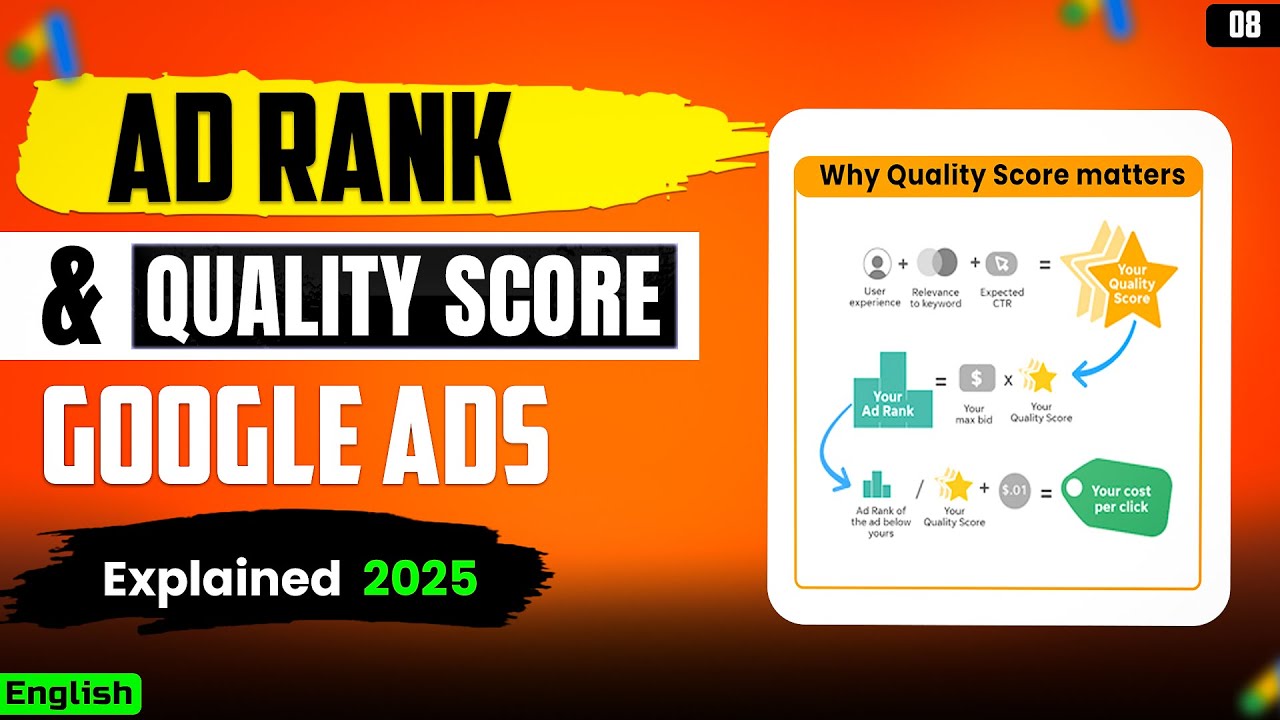
As the article explained, the two main ingredients are your Maximum Bid (the most you're willing to pay for a click) and your Quality Score.
Ad Rank = Maximum Bid × Quality Score
The ad with the highest Ad Rank wins the top position.
This image provides a great visual summary of how the components fit together:
Deconstructing Quality Score
Quality Score is Google's rating (from 1 to 10) of the overall quality of your ad. It's the "secret sauce" that rewards good advertisers. A high Quality Score can help you win a higher ad position at a lower cost. It's based on three main factors:
- Expected Click-Through Rate (CTR): How likely is your ad to be clicked when shown? This is based on your ad's historical performance.
- Ad Relevance: Does your ad text relate directly to the user's search query? If someone searches for "pet-friendly hotel," your ad should mention that you welcome pets.
- Landing Page Experience: When a user clicks your ad, what happens next? Your landing page should be relevant, load quickly, be easy to navigate (especially on mobile), and make it simple for the user to do what they came for (e.g., check rates and book).
The Bottom Line: Higher Quality = Lower Costs
Here's the most important part: you don't pay your maximum bid. The actual amount you pay per click (your CPC) is determined by the Ad Rank of the advertiser below you.
Your CPC = (Ad Rank of advertiser below you / Your Quality Score) + $0.01
Let's apply this to a hotel scenario. Two hotels are bidding on the keyword "luxury spa hotel London."
| Advertiser | Max Bid | Quality Score | Ad Rank (Bid x QS) |
|---|---|---|---|
| Competitor Hotel | $8.00 | 4 | 32 |
| Your Hotel | $6.00 | 8 | 48 |
Even though your bid is lower, your hotel wins the higher ad position because your higher Quality Score gives you a better Ad Rank.
Now, let's calculate what you actually pay:
Your CPC = (Competitor's Ad Rank / Your Quality Score) + $0.01
Your CPC = (32 / 8) + $0.01 = $4.01
You won a better position while paying almost $2 less per click than your maximum bid, all thanks to your high Quality Score. This is the financial reward for creating relevant ads and a great user experience.
3. The Meta Ads Auction: Balancing Bid with User Value
Meta's auction for Facebook and Instagram ads operates on a similar principle but uses a different formula to calculate the winner. Since you have experience with Meta Ads, you'll know that the platform's goal is to show people content they find engaging, and this applies to ads as well.
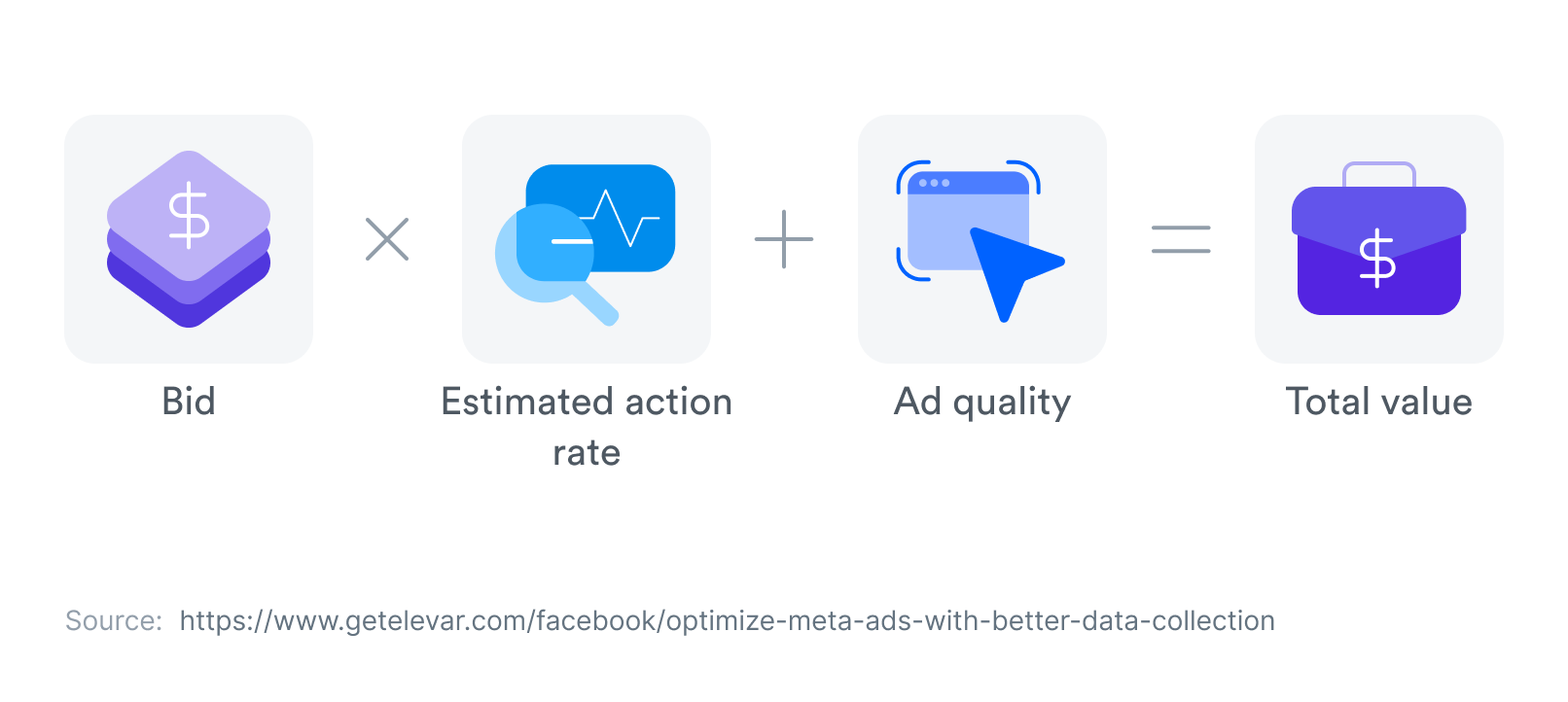
This image shows Meta's formula for determining an ad's worth in the auction:
Let's break down these components.
How Facebook Ads Algorithm ACTUALLY Works
The video 'How Facebook Ads Algorithm ACTUALLY Works' provides a clear walkthrough of this formula from an advertiser's perspective.
Please watch from the beginning to 05:42. The first part (00:00 - 04:32) explains the roles of the advertiser's bid and the 'relevance and quality score'. The second part (04:32 - 05:42) focuses on the 'estimated action rate'.
As the video and image explain, the auction winner is the ad with the highest Total Value, calculated as:
Total Value = (Advertiser Bid × Estimated Action Rate) + Ad Quality
- Advertiser Bid: How much you're willing to pay. As with Google, you can let Meta bid for you automatically (most common) or set manual bids.
- Estimated Action Rate (eAR): This is Meta's prediction of how likely a specific person is to take the action your campaign is optimizing for (e.g., click, watch a video, or book a room). This is where Meta's powerful machine learning comes into play, analyzing user behavior to find the people most likely to convert for your ad.
- Ad Quality: This is Meta's measure of the quality of your ad. It includes feedback from users who see or hide your ad, as well as assessments of low-quality attributes like clickbait or engagement bait. A positive user experience is crucial.
For a deeper dive into improving these factors, this short read is helpful.
What Can We Learn From How The Meta Ads Auction Works
The article 'What Can We Learn From How The Meta Ads Auction Works' from Bind Media provides practical advice on how to influence your performance in the auction.
Read the sections 'Deciphering the equation', 'Why does the Meta auction work like this?', 'How do you improve the Estimated Action Rate?', and 'How do you improve your Advertiser Score?'. Notice how the advice all comes back to creating a better experience for the user.
The "Creative Theory" in Practice
Since you've run campaigns, you know that targeting options have become broader. The video you just watched introduces a key strategic concept that explains how modern media buyers adapt: the Creative Theory.
How Facebook Ads Algorithm ACTUALLY Works
Let's continue with the same video to understand the shift in strategy from targeting to creative.
Please watch from 07:36 to 11:47. This segment explains the older 'Pocket Theory' and the more current 'Creative Theory', highlighting why the ad creative itself has become the most important lever for targeting.
The key takeaway here is that as advertiser control over detailed targeting decreases, the ad creative itself becomes the primary tool for targeting. A video showing a family enjoying your hotel pool will naturally attract families. An ad showcasing a sophisticated cocktail bar and live jazz will attract a different audience. You "target" people by creating ads that resonate with them, and Meta's algorithm finds more people like those who respond positively. Your job is to feed the machine with high-quality, varied creative assets.
Test your understanding!
You are running a Meta campaign to promote wedding packages at your hotel. You have two ads:
- Ad A: A static image of your hotel's exterior with the text "Book your wedding with us."
- Ad B: A short, beautiful video showcasing a real wedding in your event space, with smiling guests, elegant decor, and happy testimonials.
Even if you set the same bid for both, why is Ad B almost certain to perform better in the Meta auction? Refer to the components of the "Total Value" formula.
Show answer
Ad B will likely generate a much higher Total Value.
- Higher Estimated Action Rate: The engaging video is more likely to make a user stop, watch, and click to learn more, so Meta will predict a higher probability of action.
- Higher Ad Quality: Users are more likely to react positively to the video (likes, shares, comments) and less likely to hide it, boosting its quality score. The static ad might be perceived as boring or generic, leading to negative feedback.
Because of these two factors, Ad B's Total Value will be significantly higher, causing Meta's algorithm to show it more often and to a more relevant audience.
4. Seeing the Auction in Action: Google's Auction Insights Report
Understanding the theory is great, but how do you see the results in a real account? Google Ads provides a powerful tool called the Auction Insights Report that lets you compare your performance directly against your competitors in the ad auction.
This report shows you who you're competing against and how you stack up on key metrics.
Google Ads Auction Insights Report: Everything You Need to Know
The video 'Google Ads Auction Insights Report: Everything You Need to Know' from Grow My Ads is an excellent tour of this report. We'll focus on the key metrics.
Please watch the segment from 01:57 to 07:41. This will walk you through the most important columns in the report: Impression Share, Overlap Rate, Position Above Rate, Top of Page Rate, and Absolute Top of Page Rate.
Here's how to interpret those metrics for your hotel:
- Impression Share: What percentage of the time was your ad shown when it was eligible to? If your Impression Share is 30%, it means your competitors were shown the other 70% of the time, likely due to their higher Ad Rank or your budget limitations.
- Overlap Rate: How often did your ad and a competitor's ad show up in the same auction? A high overlap rate with Booking.com means you're constantly fighting them for the same searches.
- Position Above Rate: When both of your ads were shown, how often did your competitor's ad appear in a higher position than yours? This is a direct indicator of who has a better Ad Rank. If an OTA has an 80% Position Above Rate on your hotel's brand name, they are winning the auction against you 8 out of 10 times.
- Absolute Top of Page Rate: How often was the ad in the very first position? This tells you who is most aggressively bidding and has the highest Ad Rank to dominate the top spot.
This report transforms the auction from an abstract concept into a tangible competitive analysis tool, allowing you to see exactly where you stand against other hotels and major OTAs.
Key Takeaways
- It's a Value Exchange: Ad auctions on Google and Meta reward quality and relevance, not just high bids. The goal is to create a win-win-win for the user, the advertiser, and the platform.
- Google's Formula: Ad Rank is king, calculated as
Max Bid × Quality Score. Improving your Quality Score (through ad relevance and landing page experience) is the most effective way to lower your costs and improve your ranking. - Meta's Formula: Total Value rules, calculated as
(Bid × eAR) + Ad Quality. Success depends on feeding Meta's algorithm engaging creatives that generate high Estimated Action Rates and positive user feedback. - Monitor the Battlefield: Tools like the Google Ads Auction Insights report provide concrete data on your performance within the auction, helping you understand your competitive landscape and make smarter strategic decisions.
What's Next?
You now have a solid strategic understanding of how paid advertising platforms decide which ads to show. You know that quality, relevance, and user experience are not just buzzwords—they are concrete factors that directly impact your ad spend and success.
In our next lesson, we will move from strategy to implementation. We'll begin Module 2, "Technical Implementation: GA4 & Meta Tracking," by taking the very first practical step in building your data foundation: Setting up a new Google Analytics 4 property and configuring its data stream. This will be the central hub for measuring the success of the campaigns we'll build later.