Hello! Welcome back to the course.
In our last lesson, we explored the technical infrastructure of modern marketing—the measurement stack. You learned how Google Tag Manager (GTM) acts as a control center to deploy tracking codes, how Google Analytics 4 (GA4) serves as the destination for analysis, and how server-side tagging is the modern solution for improving data accuracy and privacy.
Now that we understand how data is collected, we need to focus on what data is being collected and why the entire digital landscape is shifting around it. Today's lesson will address the learning outcome: Differentiate between first-party and third-party data and explain the impact of privacy changes on tracking.
This topic is at the heart of your goal to master marketing for 2026 and beyond. Your practical experience with Meta ads has likely relied heavily on the very tracking methods that are now undergoing fundamental changes. Understanding this shift is the first step to building a resilient and effective marketing strategy for your hotel.
1. First-Party vs. Third-Party: The Data and the Cookie
At the center of this conversation is the "cookie," a small piece of data a website stores on your browser. For years, marketers have used different types of cookies to understand and reach potential customers.
To start, let's clarify the different "flavors" of cookies and see why one type, in particular, has become a major privacy concern.
Google Third-Party Cookie Removal: What Marketers Should Do NOW
The video 'Google Third-Party Cookie Removal' from HubSpot Marketing provides a great introduction to what cookies are and, most importantly, distinguishes between session, persistent, and third-party (or 'tracking') cookies.
Please watch from the beginning until 01:34. Pay close attention to the definition of the three cookie types and why third-party cookies are labeled the 'creepy cookies'.
As the video explained, the key issue is with third-party cookies, which are set by a domain other than the one you are visiting. These cookies can track your activity across multiple websites, building a detailed profile of your interests, demographics, and browsing habits. This is how an ad for a hotel you looked at on a booking site can "follow" you onto a news website or social media feed.
This brings us to the data itself. The way data is collected determines its classification and its value.
What is First-Party Data? Reach Your Audience Without Third-Party Cookies
Now, let's watch a clear explanation of the different data types from the video 'What is First-Party Data?' by WebFX. This will help you understand the fundamental differences.
Watch the sections defining first-party data (00:54 - 01:31) and the comparison between first-, second-, and third-party data (02:39 - 04:15). This will also introduce you to the concept of 'zero-party data'.
To summarize and apply this to your hotel:
- First-Party Data: Information you collect directly from your audience. This is your most valuable asset.
- Example: A guest's email address provided during booking on your hotel's website, their stay history from your CRM, or the fact they viewed the "spa services" page.
- Zero-Party Data: A subset of first-party data that a customer intentionally and proactively shares with you.
- Example: A guest filling out a pre-stay survey and indicating their preference for a "quiet room" or that they are celebrating an "anniversary."
- Second-Party Data: Someone else's first-party data that you acquire through a direct partnership.
- Example: A local conference organizer sharing their attendee list with you (with consent) for a special room block offer.
- Third-Party Data: Data collected by an entity that does not have a direct relationship with the user, often aggregated from many sources and sold.
- Example: Purchasing a list from a data broker of "people who have shown interest in luxury travel in your region."
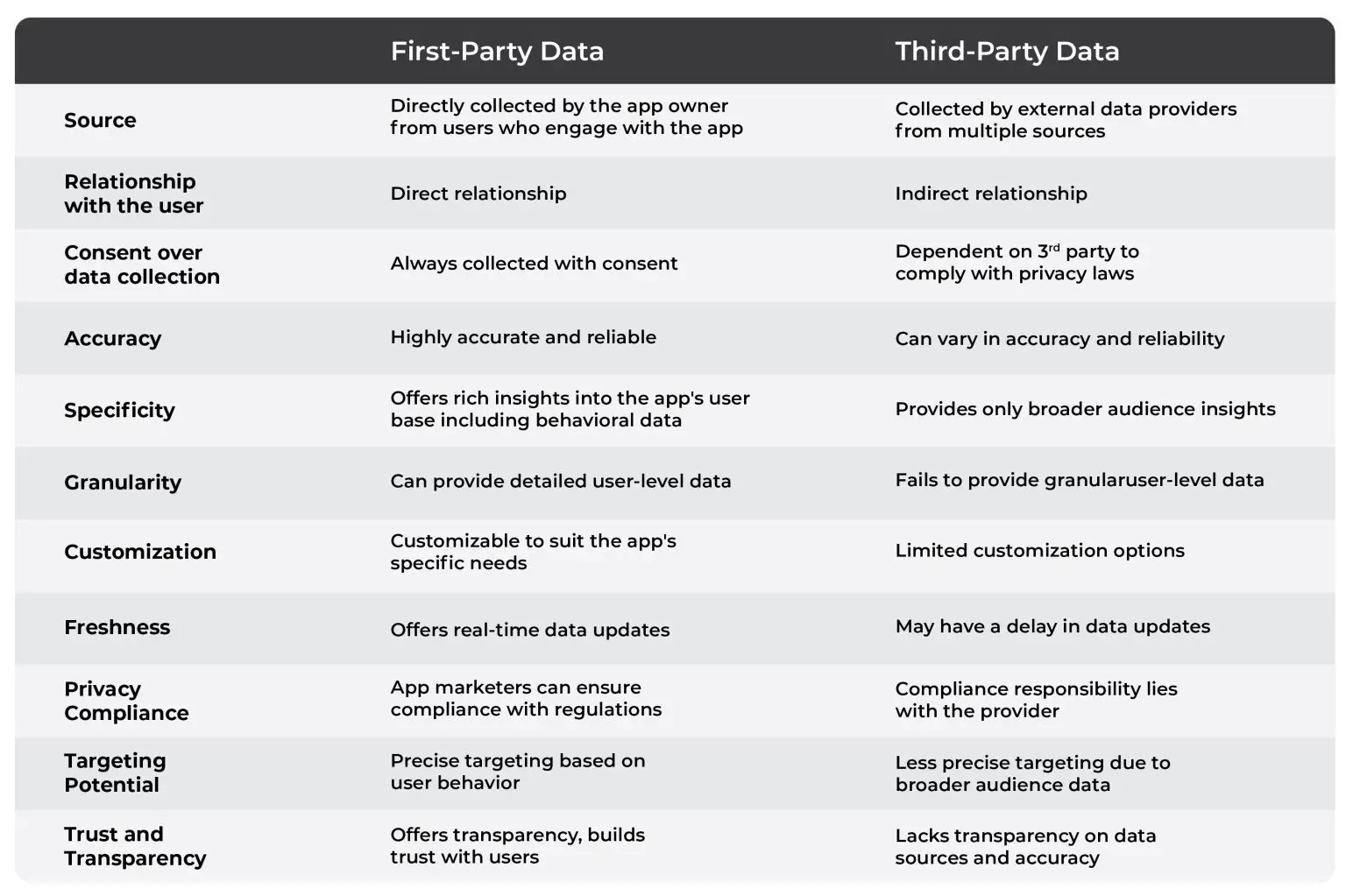
The following table provides a clear visual breakdown of the key differences.
2. The Cookie Crumbles: Privacy Changes and Their Impact
So, why is this distinction suddenly so critical? Driven by user demand for privacy and regulations like GDPR in Europe, tech companies are fundamentally changing how tracking works. Apple's Safari and Mozilla's Firefox have been blocking third-party cookies for years. The final, and most significant, move is Google's plan to phase them out in Chrome, the world's most popular browser.
While Google has delayed the final phase-out multiple times (the most recent announcement was in July 2024), the direction is irreversible. The era of ubiquitous cross-site tracking via third-party cookies is ending.
This shift has direct consequences for digital advertising, especially for businesses like hotels that often have a long and complex customer journey.
Navigating the Cookie-Less Future: A Hotelier's Guide
For a detailed perspective tailored specifically to you, please read the article 'Navigating the Cookie-Less Future: A Hotelier's Guide' from RateGain. It perfectly outlines the challenges and opportunities for the hospitality industry.
Please read the sections titled 'The Cookie Conundrum: A Hotelier’s Perspective' and 'The Impact on Hoteliers'. Focus on how hotels have historically used this data and what challenges the phase-out creates.
As the article highlights, the key impacts for your hotel are:
- Difficulty in Retargeting: Your ability to show ads to users who visited your site but didn't book (e.g., someone who viewed the "Honeymoon Suite") will be significantly reduced.
- Inaccurate Measurement & Attribution: It will become harder to know which ads are truly driving bookings when you can't connect the dots across a user's journey on different websites.
- Less Granular Audience Targeting: Building audiences based on broad, cross-site behavior (e.g., targeting users who have visited competitor hotel sites) will become less effective.
Test your understanding!
A potential guest from another country researches flights, then visits three different hotel websites in your city, including yours. A few days later, while reading an international news site, they see a banner ad for your hotel.
- What type of data/cookie was most likely used to show them that banner ad?
- Why is this specific advertising tactic becoming less reliable?
Show answer
- This is a classic example of third-party data enabled by third-party cookies. A cookie from an ad network tracked their visit to your site and then identified them on the news site to show a retargeting ad.
- This tactic is becoming less reliable because browsers like Safari, Firefox, and soon Chrome are blocking third-party cookies, breaking the chain of tracking between your website and the news website.
3. The Path Forward: A First-Party Data Strategy
This shift isn't a doomsday scenario; it's a call to build a more sustainable and trust-based marketing strategy. The solution is to shift your focus from renting third-party data to owning your first-party data.
This means focusing on building direct relationships with your potential and current guests.
Navigating the Cookie-Less Future: A Hotelier's Guide
The same RateGain article provides an excellent roadmap for how hoteliers can adapt. It offers concrete strategies for data collection and highlights the new technologies that make it possible.
Please read the following sections: 'Building a Strong Foundation: First-Party Data' and the strategies listed below it. 'Alternative Tracking Methods'. 'Long-Term Strategies For Small Businesses'. Focus on the practical tips for collecting data and notice how the 'Alternative Tracking Methods' (like Server-Side Tracking and Enhanced Conversions) are the technical solutions to the problems we're discussing. This directly connects to our previous lesson.
The article lays out a clear plan. For your hotel, this means prioritizing actions like:
- Incentivizing Direct Bookings: Offer a small perk (e.g., a free welcome drink, late check-out) for booking directly on your website instead of through an online travel agent (OTA). This gives you their email and full booking details.
- Building Your Email List: Use a sign-up form on your site. Offer value in exchange for an email address, such as a downloadable city guide, a "first to know" list for special offers, or entry into a contest.
- Leveraging Technology: This is where our last lesson becomes critical. Implementing server-side tagging makes your data collection more robust against browser restrictions. Using features like Google's Enhanced Conversions and the Meta Conversions API (which we'll discuss more later) allows you to use hashed, privacy-safe first-party data (like email addresses) to measure conversions accurately without relying on third-party cookies.
Key Takeaways
- The Data Dichotomy: First-party data is collected by you, from your audience, with their consent. Third-party data is collected by others and is less accurate and fraught with privacy issues.
- The Privacy Pivot: The digital ad industry is moving away from third-party cookies due to privacy concerns. This impacts key marketing tactics like retargeting and attribution.
- The Strategic Response: The future of effective marketing lies in a robust first-party data strategy. This involves building direct relationships with guests and using modern, privacy-centric technologies (like server-side tagging) to collect and leverage that data effectively.
What's Next?
You now understand the different types of data and the seismic shift happening in the privacy landscape. This knowledge is the foundation for everything that follows.
In our next lesson, we'll dive into the mechanics of advertising platforms themselves. The learning outcome will be: Explain how auction-based ad buying and ad ranking work on major platforms like Google and Meta. You'll see how the high-quality first-party data you collect is used to create powerful audiences for these very auctions.