Hello! Welcome back to your course on mastering digital marketing.
In our first lesson, we established a strategic map for your marketing efforts by linking the marketing funnel to the hotel customer journey. We saw how to guide a potential guest from initial awareness to a final booking and beyond.
Today, we'll learn how to read the "GPS" for that map. We'll explore the essential metrics that tell you if your advertising campaigns are on the right track. Your goal for this lesson is to analyze the relationships between four key advertising metrics: Click-Through Rate (CTR), Cost Per Click (CPC), Cost Per Acquisition (CPA), and Return on Ad Spend (ROAS).
Understanding these metrics and how they influence one another is fundamental. It's the language of paid advertising on platforms like Meta and Google, and mastering it will allow you to move from simply running ads to strategically optimizing them for maximum profitability.
Your Roadmap: From Clicks to Revenue
Think of the journey a customer takes with your ad as a mini-funnel. Many people see your ad (impressions), a smaller group clicks it, an even smaller group books a room (conversions), and those bookings generate revenue. Each step has a corresponding metric that measures its efficiency.
This flowchart provides a great visual summary of how these metrics connect. We will use it as our guide for this lesson.
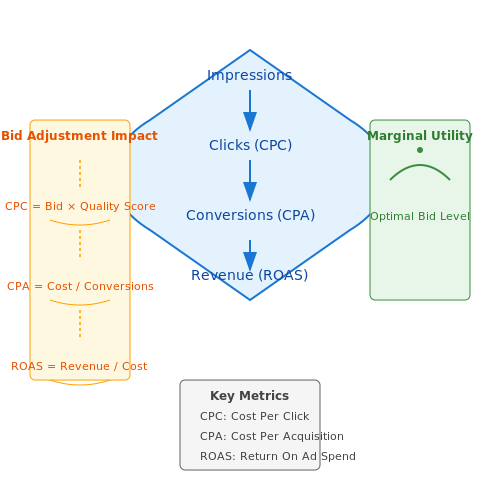
As you can see, the metrics flow into one another. A change in one has a ripple effect on the others. Let's break them down step-by-step.
1. Attracting Attention: CTR and CPC
This is the top of your ad funnel, corresponding to the Awareness and Consideration stages we discussed previously. Your goal here is to grab the attention of your target audience and persuade them to click.
-
Click-Through Rate (CTR): This is the percentage of people who click your ad after seeing it. It's a primary measure of your ad's relevance and creative appeal. Is your ad copy compelling? Is your imagery eye-catching? A high CTR says "yes."
- Formula:
(Total Clicks / Total Impressions) * 100
- Formula:
-
Cost Per Click (CPC): This is simply the price you pay for each click on your ad.
- Formula:
Total Ad Spend / Total Clicks
- Formula:
To start, let's watch a quick overview of these metrics.
Digital Marketing Metrics & KPI's Explained (With Examples)
The video 'Digital Marketing Metrics & KPI's Explained' provides clear definitions for many of the core metrics we're discussing today. This segment focuses on the metrics at the top of the ad funnel.
Please watch from 09:01 to 12:33. Focus on the definitions of Impressions, CTR, and CPC. Note the important distinction between all clicks and 'link clicks'.
Analyzing the Relationship
CTR and CPC are closely linked. Ad platforms like Google and Meta want to show users relevant ads. If your ad has a high CTR, the platform sees it as high-quality and relevant. As a reward, they may give your ad better placement and even lower your CPC.
Conversely, a low CTR signals that your ad isn't resonating. People are seeing it but not clicking. This can lead to higher CPCs as the platform needs more incentive to show a less-relevant ad.
Hotel Context: Imagine you're running two Meta ads for your hotel's weekend package.
- Ad A: A generic photo of your hotel exterior. (Low CTR)
- Ad B: A vibrant video of guests enjoying the pool, restaurant, and a beautiful room. (High CTR)
Ad B will likely achieve a lower CPC because its high CTR signals to Meta that it's a more engaging and relevant ad for the target audience.
2. Driving Action: CPA
Once a user clicks your ad, you've brought them to your website. Now, the goal shifts to Conversion—in your case, a direct booking. This is where Cost Per Acquisition comes in.
- Cost Per Acquisition (CPA): This is your total cost to acquire one paying customer (or one booking). It is arguably one of the most important metrics for measuring the efficiency of a campaign designed to drive sales.
- Formula:
Total Ad Spend / Total Conversions (Bookings)
- Formula:
Let's get a formal definition of CPA.
Digital Marketing Metrics & KPI's Explained (With Examples)
This segment from the same video defines Cost Per Acquisition (CPA) and gives simple examples of how it's calculated.
Watch from 01:33 to 02:16 to solidify your understanding of CPA.
Analyzing the Relationship
This is where digital marketing strategy gets interesting. A high CTR and low CPC are great, but they don't guarantee success. If those clicks don't turn into bookings, your campaign is still failing.
The following video segment is perhaps the most important of this lesson. It explains why you must look at these metrics together to diagnose problems.
Digital Marketing Metrics & KPI's Explained (With Examples)
This clip explains the crucial mistake of viewing metrics in isolation and demonstrates how analyzing them together helps you pinpoint bottlenecks in your marketing funnel.
Watch carefully from 12:33 to 15:01. The video provides a perfect example of what to investigate when you have a high CTR but poor conversion performance, leading to a high CPA.
As the video explained, if you have a high CTR but a high CPA, the problem is not your ad creative; it's what happens after the click. The issue likely lies with:
- Audience-Message Mismatch: Your ad targets the wrong people (e.g., budget travelers for a luxury suite ad) who are curious but can't afford to book.
- Landing Page Experience: Your ad promises one thing, but the landing page doesn't deliver. For example, your ad promotes a "20% Off Summer Sale," but the click leads to your standard booking page with no mention of the discount.
- Website Friction: Your website is slow, not mobile-friendly, or your booking engine is complicated and causes users to abandon the process.
3. Measuring Profitability: ROAS
Finally, we arrive at the most important business-level metric: Return on Ad Spend. While CPA measures efficiency, ROAS measures profitability.
- Return on Ad Spend (ROAS): This metric tells you how much revenue you earn for every dollar you spend on advertising. A 5:1 ROAS means you generated $5 in revenue for every $1 you spent.
- Formula:
Total Revenue from Ads / Total Ad Spend
- Formula:
The article below provides a hotel-specific definition of ROAS and its importance.
Top Digital Marketing KPIs for Hotels and How To Track ...
The article 'Top Digital Marketing KPIs for Hotels' clearly defines ROAS and CPA within a hospitality context, providing benchmarks that are useful for setting goals.
Please read section 4, 'Return on Ad Spend (ROAS)', and section 5, 'Cost Per Acquisition (CPA)'. Pay attention to the formulas and the benchmark guidance for each.
Analyzing the Relationship
ROAS and CPA are two sides of the same profitability coin. A lower CPA directly leads to a higher ROAS, assuming the average booking value stays the same.
Hotel Context:
-
You spend $1,000 on a Google Ads campaign.
-
The average revenue from a booking made through this campaign is $500.
-
Scenario 1: You get 20 bookings.
- CPA = $1,000 / 20 = $50
- Total Revenue = 20 * $500 = $10,000
- ROAS = $10,000 / $1,000 = 10:1
-
Scenario 2: You optimize your landing page and now get 25 bookings with the same ad spend.
- CPA = $1,000 / 25 = $40 (Your CPA went down!)
- Total Revenue = 25 * $500 = $12,500
- ROAS = $12,500 / $1,000 = 12.5:1 (Your ROAS went up!)
By lowering your CPA, you directly increased your ROAS.
Test your understanding!
You are running a Meta ad campaign for your hotel's new "Work from Hotel" package.
- Ad Spend: $500
- Impressions: 50,000
- Clicks: 1,000
- Bookings: 10
- Revenue per booking: $300
Calculate your campaign's CTR, CPC, CPA, and ROAS.
Show answer
- CTR: (1,000 Clicks / 50,000 Impressions) * 100 = 2%
- CPC: $500 Spend / 1,000 Clicks = $0.50
- CPA: $500 Spend / 10 Bookings = $50
- ROAS: (10 Bookings * $300 Revenue) / $500 Spend = $3,000 / $500 = 6:1
A Practical Framework for Analysis
So, how do you use these relationships to make decisions? The key is to not look at metrics in isolation but to follow a diagnostic hierarchy. The following article presents this perfectly for a hotel context.
KPIs in Hospitality: ROAS vs CPA vs Conversion Rate - Digisap
This article, 'KPIs in Hospitality', outlines a strategic hierarchy for analyzing your metrics. It explains which KPIs to prioritize and how to use them to diagnose campaign performance.
Read the sections 'Which KPI to Prioritize? An Objective and Stage-Based Approach' and 'Integrating KPIs for a Cohesive Strategy'. Focus on the troubleshooting logic: if ROAS is low, investigate CPA. If CPA is high, investigate Conversion Rate, CPC, and CTR.
Based on the article, here is a simple troubleshooting guide for your campaigns:
-
Start with Profitability (ROAS): Is my ROAS meeting my goal (e.g., 5:1 or higher)?
- If YES, consider scaling the campaign.
- If NO, move to step 2.
-
Check Acquisition Efficiency (CPA): Is my CPA too high?
- If NO (meaning CPA is fine but ROAS is low), your average booking value might be too low. You might be attracting guests booking your cheapest rooms.
- If YES, move to step 3.
-
Diagnose the "Why" (Conversion Rate, CPC, CTR): Why is my CPA high?
- Check your website's Conversion Rate (
(Bookings / Clicks) * 100). If it's low, the problem is on your website or landing page. Your message isn't converting clicks into bookings. - Check your CPC. If it's too high, you might be overpaying for traffic. Move to the next point.
- Check your CTR. If your CTR is low, it's driving up your CPC and negatively impacting your whole funnel. The problem is your ad creative, copy, or audience targeting. Start by testing new ads.
- Check your website's Conversion Rate (
This structured approach allows you to pinpoint the weakest link in your funnel and focus your optimization efforts where they will have the most impact.
Key Takeaways
- Interconnected System: CTR, CPC, CPA, and ROAS are not just numbers on a dashboard; they tell the story of your campaign's performance from initial ad impression to final revenue.
- Hierarchy of Metrics: ROAS is your ultimate measure of profitability. CPA measures acquisition efficiency. CTR and CPC are diagnostic metrics that help you understand the performance of your ads themselves.
- Troubleshooting Logic: Use the diagnostic flow (ROAS → CPA → Conversion Rate/CPC → CTR) to efficiently identify and fix problems in your advertising campaigns.
- Context is King: A "good" metric is always relative to your goals and the other metrics in the funnel. A great CTR is meaningless if it leads to zero bookings.
What's Next?
We've learned how to measure campaign performance, but this raises a critical question: what should your CPA and ROAS targets be? How much is a new guest actually worth to your hotel? In our next lesson, we will answer this by exploring the strategic importance of Lifetime Value (LTV) and Customer Acquisition Cost (CAC) in hospitality marketing. This will empower you to set intelligent budgets and goals for all your future campaigns.