Hello! Welcome to the first lesson in your course, "Mastering Digital Marketing for 2026 and Beyond."
This initial module, "Strategic Marketing & Measurement Foundations," is all about building the strategic bedrock for your future campaigns. Before we dive into the technical details of setting up Meta and Google ads, it's crucial to understand the 'why' behind the 'what'.
Today, we'll focus on a fundamental concept that underpins all successful marketing: the relationship between the customer journey and the marketing funnel. Your goal for this lesson is to be able to map this funnel specifically to a hotel's customer journey, from the first spark of travel inspiration right through to post-stay engagement. Since you're a hotelier, this lesson will translate abstract marketing theory into a practical framework you can apply directly to your business.
Let's begin by defining these two core concepts.
The Customer's Path vs. The Marketer's Map
It's helpful to think of the customer journey and the marketing funnel as two sides of the same coin.
- The Customer Journey is the path a guest takes from their perspective. It's often complex and non-linear, involving multiple touchpoints—from seeing a friend's vacation photo on Instagram to reading reviews on TripAdvisor and finally clicking "Book Now" on your website.
- The Marketing Funnel is the model businesses use to understand and influence that journey. It provides a structured way to guide potential customers from initial awareness to becoming loyal, repeat guests.
To get a clear understanding of these concepts, please watch the following video from the Google Career Certificates channel. It provides an excellent overview.
The Customer Journey & the Marketing Funnel | Google Digital Marketing & E-commerce Certificate
This video defines the customer journey from the customer's point of view and then introduces the marketing funnel as a business's framework for guiding customers through that journey.
Please watch from 05:57 to 14:29. Pay close attention to: The definition of 'customer journey' and 'touchpoints'. The four stages of the marketing funnel: Awareness, Consideration, Conversion, and Loyalty. The explanation of how the two concepts complement each other.
As the video explained, while a customer's journey might loop back and forth between stages, the funnel gives us, as marketers, a clear, linear framework to structure our activities.
The Hotel Customer Journey: From Dream to Memory
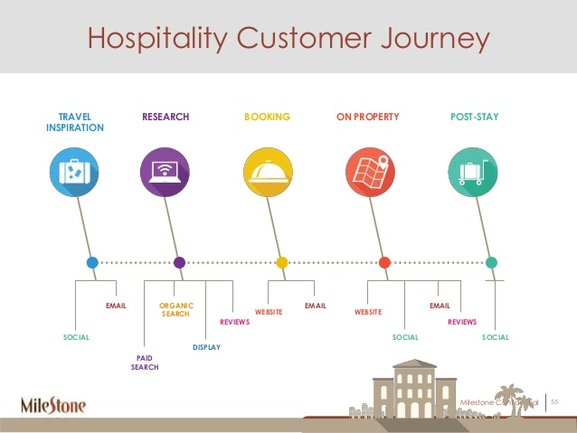
Now, let's apply this framework directly to the hospitality industry. The journey of a hotel guest has unique stages that we can map our marketing funnel onto.
To ground our discussion in a hotel-specific context, please read the introductory sections of the following article.
How Hotels Enhance Customer Experience (CX) by Mapping and Optimizing the Customer Journey
This article, 'How Hotels Enhance Customer Experience...', breaks down the guest journey into distinct, relevant stages for the hospitality industry.
Please read the sections titled '1. Defining the Hotel Customer Journey' and '2. Key Stages in the Hotel Customer Journey'. Focus on how they define the pre-arrival, on-property, and post-stay continuum.
The article lays out a clear path: Awareness and Booking, On-Property Experience, and Post-Stay Engagement. We can align these with the classic marketing funnel stages to create a powerful strategic map for your hotel.
Let's break down each stage with specific marketing tactics you can use.
Stage 1: Awareness (Top of Funnel - TOFU)
- Guest's Mindset: "I want to take a city break," or "We need to find a venue for our company retreat." They are in the dreaming and discovery phase.
- Your Goal: To introduce your hotel as a desirable option and capture their initial attention. You're not aiming for an immediate booking, but to plant a seed.
Marketing Tactics for Awareness:
- Social Media Marketing: Run Meta ad campaigns with the "Awareness" or "Reach" objective. Use beautiful, aspirational videos and images of your hotel and its surroundings. You could target users with interests like 'luxury travel', 'boutique hotels', or those who follow travel influencers.
- Content Marketing: Write blog posts on your hotel's website about local attractions, e.g., "The Ultimate Guide to Downtown Restaurants" or "A 3-Day Itinerary for Exploring [Your City]". This positions you as a local expert.
- Search Engine Presence: Optimize your website for broad search terms (SEO) and run Google Ads for keywords like "hotel in [city name]" or "resort with a pool".
- Influencer Collaborations: Partner with travel bloggers or Instagrammers to showcase the experience at your hotel.
Stage 2: Consideration (Middle of Funnel - MOFU)
- Guest's Mindset: "I've narrowed it down to a few hotels. Which one has the best amenities? What do other guests say? Which one offers the best value?"
- Your Goal: To persuade the potential guest that your hotel is the superior choice by providing helpful information and building trust.
Marketing Tactics for Consideration:
- Retargeting Ads: Since you have experience with Meta ads, this is a powerful tactic. Create a Custom Audience of people who visited your website but didn't book. Run ads showing them specific room types they viewed or highlighting a unique feature like your spa or rooftop bar.
- Showcasing Social Proof: Feature guest testimonials and user-generated content prominently on your website and in your social media feeds. According to TripAdvisor, 81% of travelers rely on reviews, making this critical.
- In-depth Website Content: This is where virtual tours, high-resolution photo galleries, detailed room descriptions, and FAQ pages become essential.
- Email Nurturing: If a user starts the booking process and provides their email but doesn't complete it, you can send them an automated email with helpful links or a reminder.
Stage 3: Booking / Conversion (Bottom of Funnel - BOFU)
- Guest's Mindset: "I've made my decision. I'm ready to book now."
- Your Goal: To make the booking process as seamless, trustworthy, and frictionless as possible.
Marketing Tactics for Conversion:
- Optimized Booking Engine: Ensure your booking platform is fast, mobile-friendly, and requires minimal clicks. A complicated process is a major reason for booking abandonment.
- Clear Calls-to-Action (CTAs): Use prominent buttons with clear text like "Book Now" or "Check Availability."
- Urgency & Scarcity: Displaying messages like "Only 2 rooms left at this price!" can encourage immediate action.
- Direct Booking Incentives: Offer exclusive perks for guests who book directly on your website instead of through an Online Travel Agency (OTA). This could be complimentary breakfast, a room upgrade, or late check-out. This is a crucial strategy for improving profitability.
Stage 4: Post-Stay (Loyalty & Advocacy)
- Guest's Mindset: "That was a wonderful stay. I'd love to come back," or "My friends are looking for a hotel; I should tell them about this place."
- Your Goal: To turn a satisfied guest into a loyal, repeat customer and a vocal brand advocate.
Marketing Tactics for Loyalty & Advocacy:
- Post-Stay Email Automation: Send a personalized thank-you email a day or two after check-out. In this email, you can invite them to leave a review on TripAdvisor or Google.
- Loyalty Programs: Encourage guests to join a loyalty program where they can earn points or receive exclusive offers.
- Targeted Re-Engagement Campaigns: Create segmented email lists of past guests. You can send them special "welcome back" offers on their booking anniversary or promote seasonal packages you know they'd enjoy based on their last stay.
- Social Engagement: Encourage guests to share their memories using a specific hashtag and feature their posts on your own channels (with permission).
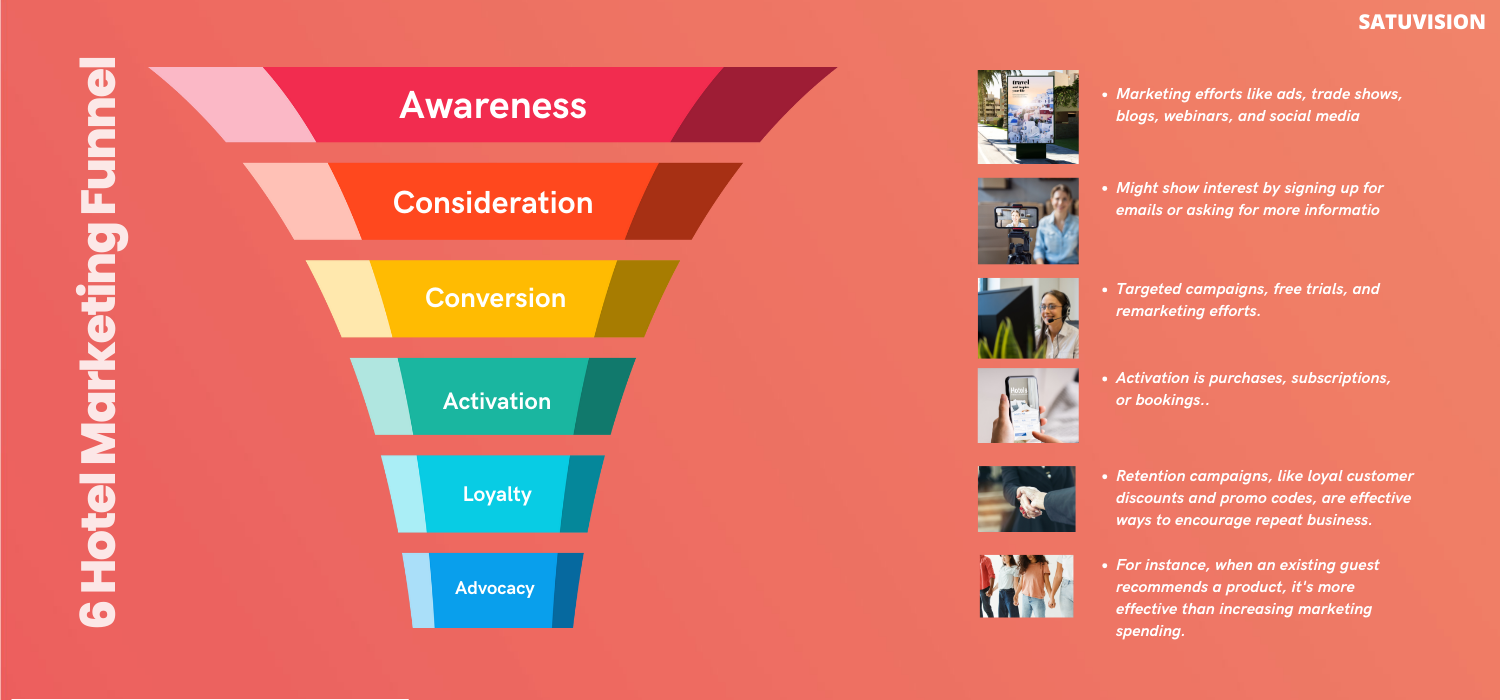
For a consolidated view of these tactics across the funnel, the article "How to Execute a Full-Funnel Marketing Campaign for Hospitality & Travel" offers an excellent summary.
How to Build a Full-Funnel Marketing Strategy for Hospitality & Travel
This article provides actionable tactics for each stage of the hospitality marketing funnel. Reading the summary section will reinforce what we've just discussed.
Please read the section titled 'TL;DR: Full-Funnel Marketing for Hospitality & Travel'. It provides a concise checklist of actions for each funnel stage.
Test your understanding!
Imagine a couple is looking to book a hotel for their honeymoon. They are in the Consideration stage of their journey. Which of the following marketing tactics would be most effective at this stage?
A) A general brand awareness video on YouTube showing beautiful scenery of your city.
B) A retargeting ad on Instagram showing them a virtual tour of your honeymoon suite, which they previously viewed on your website.
C) A post-stay email asking them to leave a review.
D) A Google Search ad for the broad keyword "honeymoon ideas".
Show answer
The correct answer is B.
Here's why:
- A & D are Awareness (Top of Funnel) tactics. They are designed to attract people who are in the early stages of planning, not those who are already comparing specific options.
- C is a Loyalty (Post-Stay) tactic, as it happens after the booking and the stay.
- B is a classic Consideration (Middle of Funnel) tactic. It targets users who have already shown interest in a specific product (your honeymoon suite) and aims to persuade them to choose your hotel over competitors.
Key Takeaways
You've now taken the first essential step in building a robust digital marketing strategy. Let's summarize:
- The Customer Journey is the guest's path, while the Marketing Funnel is your strategic map to guide them.
- A hotel's customer journey can be mapped to four key funnel stages: Awareness, Consideration, Booking, and Post-Stay.
- Each stage requires different marketing tactics and messaging, from broad, inspiring content at the top to clear, persuasive calls-to-action at the bottom and relationship-building efforts after the stay.
- Understanding this framework allows you to allocate your marketing budget more effectively and create a cohesive experience for your guests.
What's Next?
Now that we have the strategic "why" (the funnel), our next lesson will focus on the "how do we know if it's working?". We will dive into the core advertising metrics that measure performance at each stage of the funnel: CTR (Click-Through Rate), CPC (Cost Per Click), CPA (Cost Per Acquisition), and ROAS (Return on Ad Spend). Understanding these numbers is the key to optimizing your campaigns and making data-driven decisions.