Hello! Welcome back to our module on Advanced Meta Ads strategy.
In our last lesson, we focused on the what—choosing the right campaign objective to tell Meta's algorithm what success looks like for your hotel. We established that this is the most critical first step in building a campaign.
Today, we're tackling the next essential decision at the campaign level: the how. Specifically, how you manage and allocate your budget. This lesson addresses the learning outcome: Apply budget optimization strategies using Campaign Budget Optimization (CBO) and Ad Set Budget Optimization (ABO). Mastering this will allow you to control your ad spend effectively, ensuring you get the most value—whether that's bookings, leads, or awareness—for every dollar you invest.
1. Two Ways to Manage Your Budget
When you set up a campaign, you have two fundamental choices for how your budget is spent across your ad sets:
- Ad Set Budget Optimization (ABO): You manually set a specific budget for each individual ad set.
- Campaign Budget Optimization (CBO): You set a single, unified budget for the entire campaign, and Meta's algorithm automatically distributes it among your ad sets in real-time.
Let's look at a simple visualization of this difference.

As someone who has run Meta ads before, you may have noticed a recent name change. What we've historically called CBO is now referred to as Advantage Campaign Budget.
Let's watch a very short video that explains this update.
CBO vs ABO vs ADVANTAGE Campaign Budget?!!
The video 'CBO vs ABO vs ADVANTAGE Campaign Budget?!!' by Ben Heath clarifies Meta's recent rebranding. It confirms that 'Advantage Campaign Budget' is simply the new name for CBO, with no change in functionality. This is important to know as you navigate the current Ads Manager interface.
Please watch from the beginning until 03:02. The key takeaway is that Meta is rebranding CBO to encourage its use, but the underlying mechanics are the same.
So, when you see "Advantage Campaign Budget," just think CBO. This is what the setting looks like in the Ads Manager today.
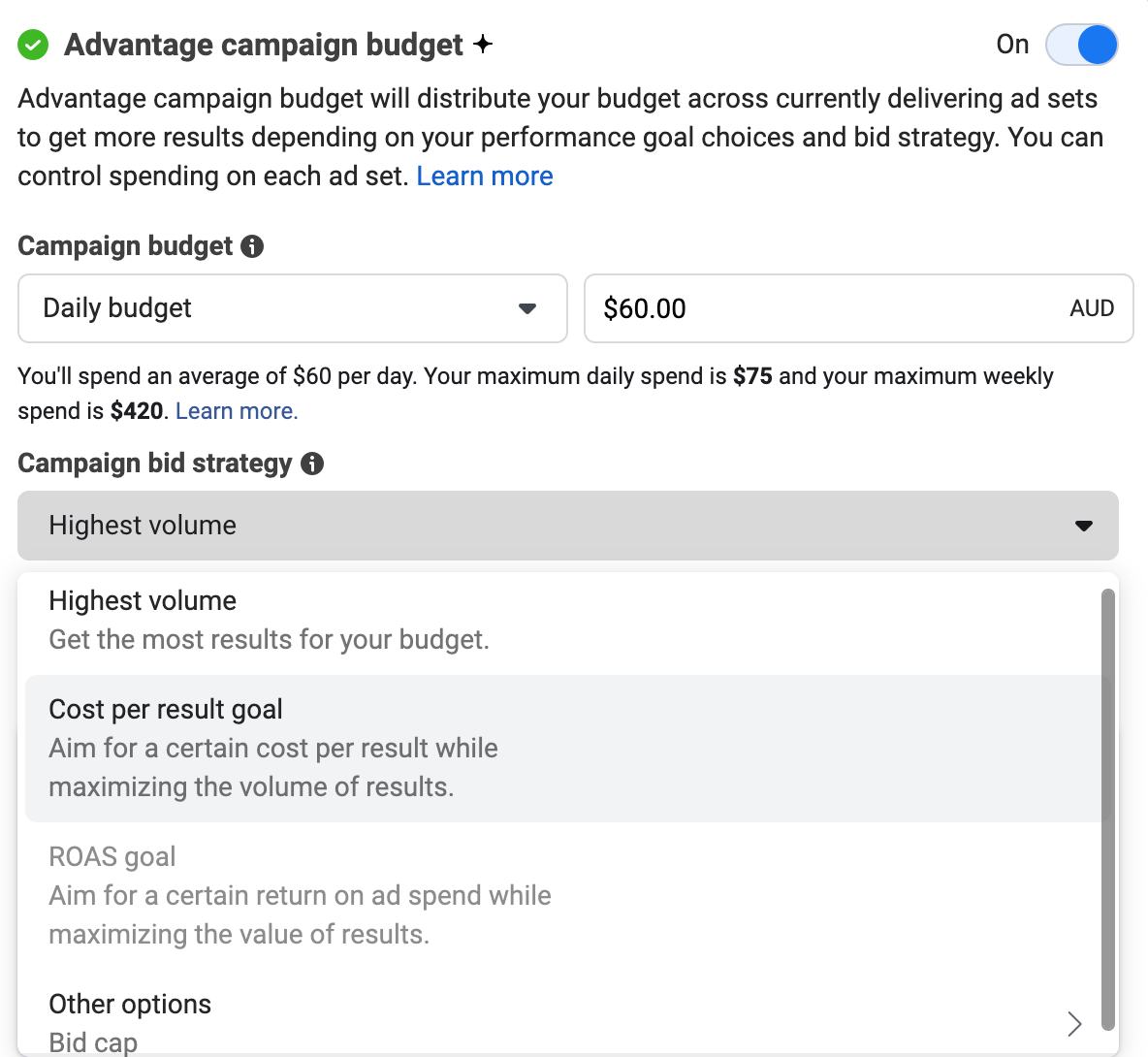
2. ABO vs. CBO: A Strategic Deep Dive
The choice between manual control (ABO) and automation (CBO) has significant strategic implications for your campaigns. To understand these differences in detail, let's turn to an excellent article that breaks them down.
ABO vs CBO Facebook Ads: Which Budget Strategy Wins in 2025
The article 'ABO vs CBO Facebook Ads' from AGrowth.io provides a clear, detailed comparison of the two budget strategies. It's one of the best resources for understanding the strategic nuances of each approach.
Please read the section titled 'ABO vs CBO: The Core Differences Explained' and pay close attention to the summary table. This will give you a solid framework for comparing the two strategies across key areas like control, scaling, and testing.
Based on that article and our other resources, let's summarize the key strategic differences in a hotel context:
| Feature | ABO (Ad Set Budget Optimization) | CBO (Advantage Campaign Budget) |
|---|---|---|
| Control | Manual & Granular. You have full control. You can decide to spend exactly $50/day on your "wedding leads" ad set. | Automated & Flexible. Meta's AI is in control, shifting budget to the ad sets most likely to get you a booking at the lowest cost. |
| Learning Phase | Isolated. Each ad set learns on its own. A low budget per ad set can lead to "Learning Limited" status. | Aggregated. The campaign learns as a whole. The AI can push budget to one ad set to help it exit learning faster, optimizing the campaign quicker. |
| Best For | Testing & Control. Perfect for running A/B tests on audiences or creatives, or when you have strict budget rules. | Scaling & Efficiency. The best choice for getting the most results (e.g., bookings) for your budget once you know what works. |
| Scaling Method | Vertical. You manually increase the budget of a winning ad set. This can be risky and may reset the learning phase. | Horizontal. You add more winning audiences or creatives to the campaign, letting the CBO re-allocate the budget. This is more stable. |
The most important takeaway here is the difference between a testing tool (ABO) and a performance tool (CBO).
3. When to Use Each Strategy for Your Hotel
Now for the most practical part: applying this knowledge. The choice isn't about which one is "better" overall, but which one is right for your specific goal at that moment.
Use ABO (The Precision Tool) when you need control:
- Testing Audiences or Creatives: This is the primary use case. If you want to know whether a Lookalike Audience of past guests performs better than an interest-targeted audience of "frequent international travelers," you must use ABO. It ensures each audience gets an equal budget for a fair, scientific test.
- Strict Budget Allocation: Imagine your hotel is running promotions for both room bookings and your on-site restaurant. These might have different budgets and goals. ABO allows you to assign a specific, guaranteed budget to the "Restaurant Bookings" ad set and a separate one to the "Room Bookings" ad set.
- Small Budgets: If you're starting with a very small daily budget (e.g., $25/day), it's often better to use ABO to focus that entire budget on your single best audience. Spreading $25 across five ad sets in a CBO campaign would give each one only $5, which is not enough for the algorithm to learn effectively.
Use CBO (The Scaling Engine) when you need efficiency and scale:
- Maximizing Results (Bookings): This is the core strength of CBO. Let's say you have a $300/day budget and three strong audiences for your "Summer Sale" campaign. CBO will automatically analyze which audience is delivering the cheapest bookings and shift more budget there. This drives down your overall Cost Per Booking and maximizes your ROAS. As the article from yournextguest.com states, this is how you "keep your cost per booking stable while you grow."
- Scaling Proven Winners: You've used ABO to test and have identified a winning audience and ad. The best way to scale is to move that winning ad set into a CBO campaign. This lets you increase the overall campaign budget without the risk of disrupting the performance of a single ad set.
- Simplifying Campaign Management: CBO automates the complex task of budget allocation, saving you time and preventing manual errors. It's especially powerful when you have warm audiences (like website visitors) of varying sizes. CBO will dynamically adjust spend to these audiences as they grow or shrink, something that is difficult to manage manually.
To see this in action, let's watch a demonstration.
CBO vs ABO? Facebook Campaign Budget Optimization or Ad Set Budget Optimization?
Let's return to Ben Heath's 'CBO vs ABO?' video. He provides a great walkthrough of setting up both types of campaigns and discusses the pros and cons in practice.
Please watch the following two clips: ABO Demo (01:06 - 02:56): See how the budget is set at the ad set level. CBO Demo (02:56 - 04:42): See how the budget is moved to the campaign level and what this enables. Notice how the structure changes in Ads Manager for each approach.
Test your understanding!
You are launching a campaign for your hotel's new "Work from Hotel" package, which offers a room, high-speed internet, and coffee service. Your goal is to get as many bookings as possible with a $150 daily budget. You have three ad sets:
- Retargeting people who visited your website in the last 30 days.
- A Lookalike Audience based on past corporate clients.
- An interest-targeted audience of "remote work" and "digital nomad."
Which budget optimization strategy should you choose, and why?
Show answer
You should use Campaign Budget Optimization (CBO), now called Advantage Campaign Budget.
The goal is to get the "maximum number of bookings possible." CBO is designed for this. It will automatically analyze the performance of all three ad sets and distribute the $150 budget to whichever ones are generating bookings at the lowest cost. For example, if the retargeting audience is converting exceptionally well, CBO will allocate more spend there to maximize your overall return on ad spend.
4. The Hybrid Strategy: The Professional Workflow
Top-tier advertisers don't just choose one strategy; they use both in a systematic way.
- Phase 1: Test with ABO. Create a dedicated testing campaign using ABO. Use this to find winning audiences, creatives, and offers. Think of this as your "Research & Development" department.
- Phase 2: Scale with CBO. Take the proven winners from your ABO tests and move them into a separate CBO campaign. This is your "Production" or "Scaling" campaign, designed for maximum efficiency.
Hotel Example:
- ABO Campaign: You test three different ad images for a "Book Direct" offer: one of the pool, one of the lobby, and one of a suite. You give each ad set a $20/day budget.
- Analysis: After 4 days, the suite image is generating bookings at a much lower cost.
- CBO Campaign: You add the ad with the winning suite image to your main "Direct Bookings - CBO" campaign, which runs with a larger budget and targets all your proven audiences.
Conclusion
You now have a clear framework for making one of the most important strategic decisions in your Meta ad campaigns.
Key Takeaways:
- ABO (Ad Set Budget) is for manual control. Use it for testing, when you need to enforce strict budgets, or with very small daily spends.
- CBO (Advantage Campaign Budget) is for automated efficiency. Use it to scale proven winners and maximize your overall campaign results, like bookings.
- The Hybrid Strategy (test with ABO, scale with CBO) is a professional workflow that balances rigorous testing with efficient scaling.
What's Next?
We've now covered the key strategic decisions for setting up a campaign: objective, audiences, and budget. In the next module, Technical Implementation: GA4 & Meta Tracking, we'll shift gears from strategy to the essential hands-on work of setting up your measurement foundation. Our first lesson will be to set up a new Google Analytics 4 property and configure its data stream, which is the first step toward tracking the success of all your digital marketing efforts.