Hello! Welcome to the third module of your course, "Advanced Meta Ads: Audience & Campaign Strategy."
In the previous module, we focused on the technical foundations, ensuring you have a robust tracking system with both the Meta Pixel and the Conversions API. You now understand how to capture high-quality data about how users interact with your hotel's website.
Today, we transition from technical setup to strategic execution. This lesson addresses the learning outcome: Structure Meta ad campaigns using the campaign-ad set-ad hierarchy for different hotel offerings (e.g., rooms, events, restaurant).
We will break down the three-level structure that forms the backbone of all Meta advertising. Understanding this hierarchy is the key to organizing your efforts, controlling your budget, and systematically testing what works. For a business like a hotel with multiple offerings—from rooms and wedding packages to spa services and restaurant promotions—a clear structure is not just good practice; it's essential for success.
1. The Blueprint: Campaign, Ad Set, Ad
Every ad you run on Meta (Facebook, Instagram, etc.) exists within a three-level hierarchy. Getting this right is the first step toward moving beyond simply "boosting posts" to running strategic, scalable advertising campaigns.
To start, let's watch a short video that clearly explains the role of each level.
Facebook Ad Campaign Structure Explained: Campaigns, Ad Sets & Ads
This video from 3 Minutes Fix provides a concise and clear overview of the Campaign, Ad Set, and Ad hierarchy. It's a perfect introduction to the core concepts we'll be building on.
Watch the segment from 00:39 to 02:10. As you watch, think about how this could apply to your hotel. For example, a 'Sales' campaign could be for booking rooms, and a 'Leads' campaign could be for inquiries about corporate events.
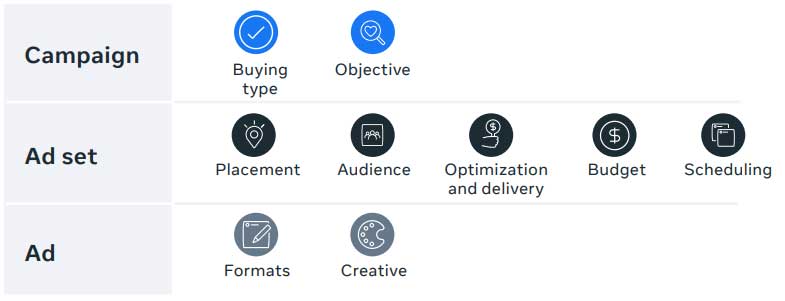
As the video explained, the structure works like this:
- Campaign: This is the highest level. Here, you choose a single objective for everything within it. This objective tells Meta's algorithm what you want to achieve (e.g.,
Sales,Leads,Awareness). Think of this as the main goal for a specific marketing initiative. - Ad Set: Nested inside a campaign, this is the strategic layer. For each ad set, you define your audience (who you want to see the ads), placements (where the ads appear, like Instagram Stories or Facebook Feed), budget, and schedule. You can have multiple ad sets within one campaign to target different groups of people.
- Ad: This is the creative layer, nested inside an ad set. The ad is the actual image, video, and text that your audience sees. You can have multiple ads within an ad set to test which creative performs best.
The power of this structure lies in its ability to provide organization and control, which is vital for testing and optimization.
2. Structuring Campaigns for Hotel Offerings
Now, let's apply this framework to the real-world context of a hotel. A hotel isn't a single product; it's a collection of services. A well-structured account will have separate campaigns for separate business goals.
We'll use a common strategic approach: mapping campaigns to different stages of the marketing funnel.
Meta Ads for Hotels: A Comprehensive Setup Guide
This article from Sona is written specifically for hoteliers and provides an excellent framework for structuring campaigns. It will help us connect Meta's objectives to tangible hotel outcomes.
Please read the sections 'Matching Meta Campaign Objectives to Hotel Outcomes' and 'Recommended Campaign Structure for Hotels'. Pay close attention to how they recommend segmenting at the ad set level by traveler type, geography, and season.
Let's walk through three common scenarios for your hotel, using the principles from the Sona article and adding more detail on structure.
Scenario 1: Driving Direct Room Bookings
This is your core business and is a "direct offer" campaign—you are asking the user to make a purchase directly.
-
Campaign Level:
- Name:
Sales - Room Bookings - [Date] - Objective:
Sales(previously called Conversions). This tells Meta to find people most likely to complete the booking process on your website.
- Name:
-
Ad Set Level: Here, you segment your audiences to test who responds best.
- Ad Set 1 (Retargeting): Target your "warmest" audience—people who have recently visited your booking site but didn't complete a purchase.
- Ad Set 2 (Cold - Business Travelers): Target a "cold" audience of people based on interests like "business travel" and behaviors like "frequent traveler," focusing on key corporate feeder markets.
- Ad Set 3 (Cold - Leisure Travelers): Target another cold audience interested in "family vacations" or located near tourist attractions relevant to your hotel.
-
Ad Level: Within each ad set, you test different creative approaches to see what resonates.
- Ad 1 (Video): A short video tour of the hotel's key amenities (pool, lobby, a beautiful room).
- Ad 2 (Carousel): A carousel ad where each card showcases a different room type (e.g., Standard Queen, Deluxe King, Junior Suite).
- Ad 3 (Image): A stunning image of the hotel exterior with a promotional headline like "Stay 3 Nights, Save 20%".
A crucial professional tip is to use the same ads across your different cold audience ad sets. This allows you to conduct a fair test. If Ad Set 2 (Business Travelers) outperforms Ad Set 3 (Leisure Travelers), you know it's because the audience is better, not because it was shown a better ad.
Scenario 2: Generating Leads for Weddings or Events
Here, the goal isn't an immediate online sale but to collect contact information for a high-value service that requires a sales conversation. This is often called a "lead magnet" strategy.
-
Campaign Level:
- Name:
Leads - Wedding Packages - [Date] - Objective:
Leads. This tells Meta to find people likely to fill out a form to download a brochure or request a quote.
- Name:
-
Ad Set Level: Your audience segmentation will be very different.
- Ad Set 1 (Retargeting): Target users who visited the
/weddingspage on your website but didn't submit an inquiry. - Ad Set 2 (Cold - Engaged Couples): Target users with a "Life Event" of "Newly Engaged" in your local area. You can layer this with interests like "wedding dresses" or "wedding planning."
- Ad Set 3 (Lookalike Audience): Target a Lookalike Audience created from a list of your past wedding clients. (We'll cover how to create these audiences in the next lesson).
- Ad Set 1 (Retargeting): Target users who visited the
-
Ad Level: The creatives should focus on inspiring and informing potential clients.
- Ad 1 (Video): A cinematic video featuring highlights from a real wedding hosted at your venue.
- Ad 2 (Image): A beautiful photo of a wedding setup with a call-to-action to "Download Our 2026 Wedding Brochure."
- Ad 3 (Testimonial): An ad featuring a quote and photo from a happy couple, building social proof.
Scenario 3: Building Awareness for Your Hotel Restaurant
Sometimes the goal is simply to get your name out there, especially to a local audience that might not be staying at the hotel.
-
Campaign Level:
- Name:
Awareness - Hotel Restaurant - [Date] - Objective:
AwarenessorReach. The goal is to maximize the number of people who see your ad within a specific area.
- Name:
-
Ad Set Level: Targeting is typically geographic and interest-based.
- Ad Set 1 (Local Radius): Target all users within a 5-mile radius of your hotel.
- Ad Set 2 (Local Foodies): Target users in your city who have shown interest in "fine dining," "cocktails," or follow popular local food bloggers.
-
Ad Level: The ads should be visually appealing and entice locals to visit.
- Ad 1 (Video): A short, "food-porn" style video of a chef plating a signature dish.
- Ad 2 (Carousel): A carousel showcasing the best dishes from your menu.
- Ad 3 (Offer): An image ad promoting a specific offer like "Weekly Happy Hour" or a "Prix-Fixe Dinner Menu."
The following video provides an excellent, in-depth walkthrough of the "Direct Offer" and "Lead Magnet" structures. While the presenter uses e-commerce examples, the logic is directly applicable to our room booking and event lead scenarios.
I Found THE BEST Campaign Structure For Facebook Ads
This video from Ben Heath is a masterclass in campaign structure. He explains the strategic reasoning behind how many ad sets to use and how to test ads effectively.
Please watch these two sections: 'Direct to Offer' (00:57 - 11:35): As you watch, mentally replace 'shoes' with 'hotel rooms'. Notice his logic for including a warm audience ad set within a campaign primarily targeting cold audiences when using Campaign Budget Optimization. 'Lead Magnet' (11:35 - 18:20): Here, replace 'free template' with 'wedding brochure'. This will solidify your understanding of how to structure a campaign for generating leads versus direct sales. Focus on the why behind his structural choices, as this strategic thinking is what separates novice advertisers from experts.
Test your understanding!
Your hotel wants to promote a new "Weekend Spa Package." Based on what you've learned, outline a simple campaign structure to drive direct bookings for this package. Specify the Campaign Objective, two potential Ad Sets, and two ideas for Ads.
Show answer
-
Campaign:
- Name:
Sales - Spa Package Promotion - [Date] - Objective:
Sales
- Name:
-
Ad Sets:
- Ad Set 1 (Warm/Retargeting): Target people who have visited the spa page on your website or past hotel guests from your email list who have shown interest in wellness.
- Ad Set 2 (Cold/Prospecting): Target users in nearby cities (e.g., within a 3-hour drive) with interests like "spas," "wellness," "yoga," and "luxury travel."
-
Ads:
- Ad 1 (Video): A calming video showing snippets of the spa experience: a massage, the relaxation lounge, the sauna, etc.
- Ad 2 (Image Carousel): A carousel where each card details a different part of the package (e.g., Card 1: The Massage, Card 2: Healthy Lunch Included, Card 3: Full Day Pool Access).
Conclusion
You have now learned the fundamental blueprint for organizing successful Meta Ad campaigns. By mastering this structure, you can move from reactive, one-off ads to a proactive, strategic portfolio of campaigns that align with your hotel's diverse business goals.
Key Takeaways:
- The Hierarchy is Universal: All Meta ads are organized into Campaigns, Ad Sets, and Ads.
- One Goal per Campaign: The Campaign level sets a single, clear objective (e.g., Sales, Leads). You should create separate campaigns for distinct business goals like booking rooms, generating wedding leads, or promoting the restaurant.
- Segment Audiences at the Ad Set Level: Use Ad Sets to test different targeting strategies, such as retargeting your website visitors versus prospecting for new customers (cold audiences).
- Test Creatives at the Ad Level: Use the Ad level to test different formats (video vs. image) and messages to discover what best captures your audience's attention.
What's Next?
In this lesson, we talked a lot about targeting different audiences like "website visitors," "past guests," or "lookalikes." But how do you actually create these powerful audience segments within Meta Ads Manager?
Our next lesson, "Build custom audiences from customer lists and website traffic for targeted promotions," will give you the hands-on skills to do just that. You will learn how to turn the raw data from your Meta Pixel and customer lists into actionable audiences that are essential for the high-performing retargeting and lookalike ad sets we've designed today.