Hello again! I hope you found the introduction to the 4 Ps insightful. It’s a framework you’ll see referenced again and again.
In our last lesson, we established the core levers of marketing strategy: Product, Price, Place, and Promotion. Now, we’re going to explore the two primary philosophies for pulling those levers: branding and performance marketing. This is one of the most important distinctions in the industry today, and understanding it is key to your goal of working in an agency, where teams are often structured around these very functions.
By the end of this 60-minute lesson, you will be able to distinguish between branding (which focuses on building long-term value) and performance marketing (which focuses on immediate results), and, most importantly, explain how they are deeply interrelated.
Let's get started.
The Two Sides of the Marketing Coin
Imagine a company has a marketing budget. Should they spend it on a beautiful, inspiring TV commercial that tells the company's story? Or should they spend it on highly-targeted social media ads that offer a 20% discount and a "Buy Now" button?
This is the classic dilemma between branding and performance marketing.
- Brand Marketing is the "marathon." It's about building a reputation, creating an emotional connection, and earning trust over the long term. It’s the reason you might choose Nike over an unknown brand, even if the price is higher.
- Performance Marketing is the "sprint." It's focused on getting a specific, measurable action right now—a click, a sign-up, a sale. It’s all about immediate, data-driven results.
To get a solid grasp of their distinct goals, methods, and challenges, please read the following sections from the article "Brand- vs. Performance Marketing" by YOC.
Performance vs. Branding: Which Strategy Is Right? - YOC
This article does an excellent job of defining both concepts clearly and lists their respective strengths and weaknesses, using the 'marathon vs. sprint' analogy.
Please read the sections titled 'What is Brand Marketing?' and 'What is Performance Marketing?'. As you read, pay close attention to the lists of strengths and challenges for each. This will help you see the trade-offs involved.
A Structured Comparison
Now that you have the foundational definitions, let's look at a more structured breakdown of the differences. The following video offers six clear points of comparison that are extremely helpful for telling these two disciplines apart.
Branding vs. Marketing: What's the Difference?
This video by marketing expert Philip VanDusen neatly breaks down the strategic differences between branding and marketing activities, which in this context maps directly to branding vs. performance marketing.
Please watch from 01:46 to 05:23. The video outlines six key differences. Try to summarize each one in your own words after watching (e.g., 'Branding is the 'why,' performance is the 'how').
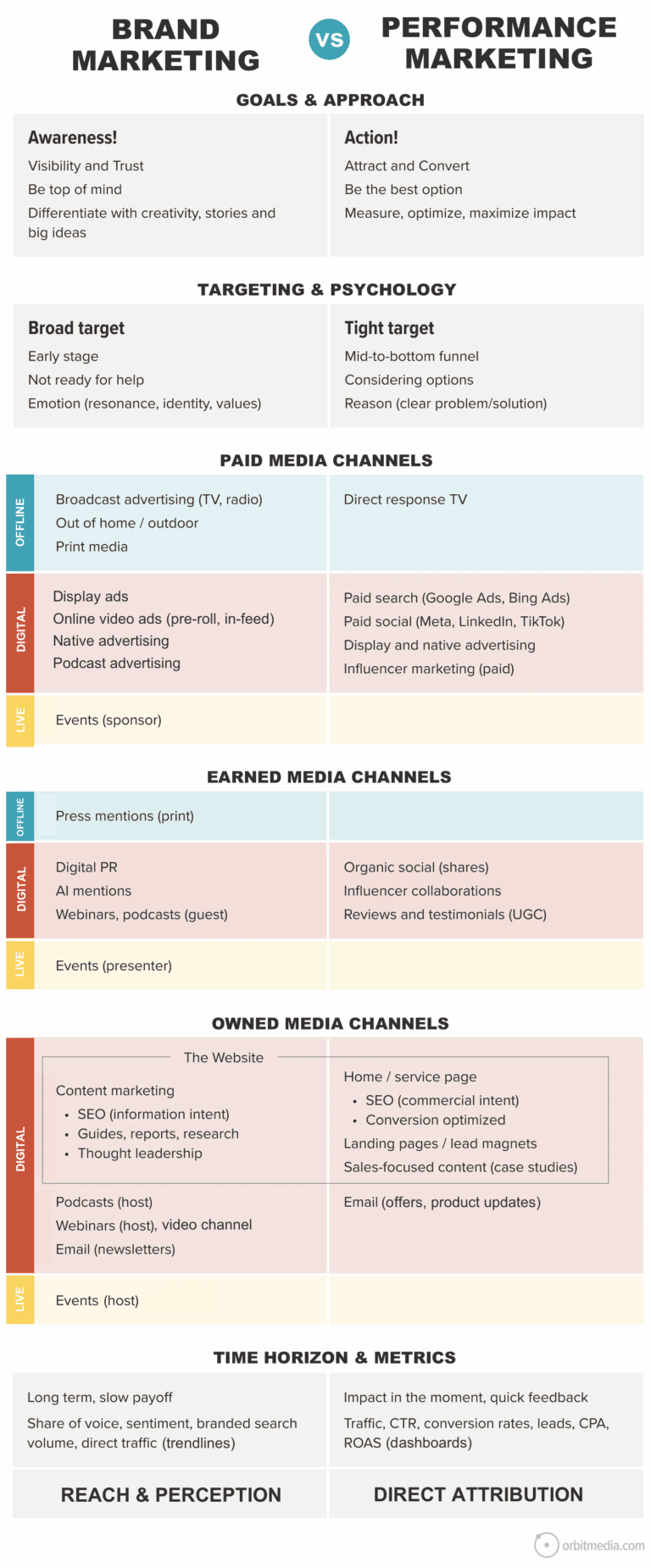
To bring all these points together, here is a detailed comparison chart. Think of it as a "cheat sheet" you can refer back to. It organizes the differences by goals, targeting, channels, and metrics.
The Performance Marketing "Treadmill"
Given your goal of working in an agency and eventually as a solopreneur, it's tempting to focus only on performance marketing. It's measurable, you see results quickly, and you can directly calculate the return on your spending. This is why many new businesses and marketers fall into the "performance marketing trap." They become so focused on short-term conversions that they neglect to build a brand.
What happens when you only do performance marketing? The next video explains this brilliantly.
Performance Marketing without Branding is a TRAP!
The creator of the 'Senator We Run Ads' channel is a performance marketer, which makes his argument for branding particularly powerful. He explains why relying solely on performance ads becomes unsustainable.
Watch the first two sections, from the beginning to 06:14. Pay close attention to the 'treadmill' analogy he uses. Notice his definition of branding: it's not just 'awareness,' it's 'trust.' This is a critical insight.
As the video highlights, a business without a brand is completely reliant on paid ads. The moment you stop paying, the sales stop. You haven't built any lasting value or loyalty.
Furthermore, strong branding makes your performance marketing more effective. When people already know and trust your brand, they are more likely to:
- Click on your ad (Higher Click-Through Rate, or CTR)
- Believe your claims (Higher trust)
- Complete a purchase on your website (Higher Conversion Rate, or CVR)
This means a strong brand directly leads to a better Return On Ad Spend (ROAS)—a key metric we'll cover later.
Finding the Synergy: "Brandformance"
So, if doing only performance marketing is a trap, and doing only brand marketing doesn't pay the bills in the short term, what's the solution? The answer is to do both, strategically. Modern marketing aims to integrate them.
This integrated approach is sometimes called "Brandformance"—creating marketing activities that both build the brand and drive a measurable action.
The article from DMEXCO below discusses this trend, citing examples like Adidas and Nike who learned the hard way that a sole focus on performance can erode brand value.
Performance branding – the recipe for success in 2025 - DMEXCO
This article discusses the current industry shift towards combining branding and performance. It reinforces the idea that one cannot be successful without the other in the long run.
Please read the sections 'Why performance marketing doesn’t work without branding' and 'How to achieve the perfect blend of performance and brand marketing'. This will solidify the concept of synergy.
This Venn diagram provides a great visual summary of how the two areas can overlap. While some activities are distinct, many modern tactics like Content Marketing and SEO serve both branding and performance goals simultaneously.

A popular rule of thumb, proposed by marketing researchers Les Binet and Peter Field, is the 60/40 split: successful brands often allocate about 60% of their budget to long-term brand building and 40% to short-term performance marketing. This is just a guideline, but it highlights the importance of investing in both.
Conclusion
In this lesson, we've unpacked the crucial difference between branding and performance marketing. They are not opposing forces, but two complementary parts of a holistic marketing strategy. Neglecting one for the other leads to an unsustainable business—either one that has no immediate sales, or one that has no long-term future.
Key Takeaways:
- Branding is a long-term strategy focused on building trust, recognition, and emotional connection. It creates lasting value.
- Performance Marketing is a short-term strategy focused on driving immediate, measurable actions like clicks and sales. It captures existing demand.
- Relying only on performance marketing is a "trap" because it creates dependence on ad spend and doesn't build a sustainable asset.
- A strong brand makes performance marketing cheaper and more effective by increasing trust, click-through rates, and conversion rates.
- The most effective marketing strategies integrate both branding and performance goals, an approach often called "Brandformance".
In our next lesson, we will explore the customer journey. This is the path people take from first hearing about a brand to becoming a loyal customer. Understanding this journey is the key to deciding when to use branding tactics and when to use performance tactics for maximum impact.