Hello! Welcome to your next lesson.
In our last session, we drew a clear line between branding (the long-term marathon of building trust) and performance marketing (the short-term sprint for immediate results). We concluded that the most powerful strategies do both.
The natural question is: when do you focus on branding, and when do you push for performance? The answer lies in understanding the customer journey. This journey is the path a person follows from being a complete stranger to your brand to becoming a loyal, repeat customer. It’s one of the most fundamental concepts in marketing because it provides a map for your actions.
Today's lesson is dedicated to this map. Your learning outcome is to describe the stages of a modern customer journey, from awareness and consideration to purchase and loyalty. By understanding this process, you can deliver the right message to the right person at the right time, making your marketing far more effective and empathetic—a skill that's invaluable whether you're in an agency or working for yourself.
What is a Customer Journey?
At its core, the customer journey is the story of a customer's relationship with a business. A customer journey map is a tool marketers use to visualize this story. It's not just about tracking clicks; it's about understanding the customer's questions, feelings, and goals at every step.
To get a quick introduction to this concept, let's watch the first part of this tutorial.
Customer Journey Mapping Tutorial
This video from SiteGround.com provides a great analogy, comparing the customer journey to a well-marked route up a mountain. It explains why visualizing this path is so important.
Please watch from 00:41 to 01:24. Focus on the definition of a customer journey map and the 'touchpoints' concept.
A journey map can be simple or incredibly detailed. Here is an example of a more comprehensive map. Don't worry about absorbing all the details; just notice how it tries to capture the customer's experience—their thoughts, feelings, and the channels they use.

This focus on the customer's internal world (their thoughts and feelings) is what makes this tool so powerful. It forces us to think from their perspective.
The Core Stages of the Customer Journey
While every customer's path is unique, we can group their experiences into a few key stages. The following video breaks down a standard four-stage model. This is the foundational framework you'll use constantly as a marketer.
Customer Journey Mapping Tutorial
The same video from SiteGround.com now explains the four primary stages of the customer journey. It clearly outlines the customer's mindset and the company's goal at each stage.
Please watch from 07:32 to 11:37. As you watch, take note of the four stages: Awareness, Consideration, Decision, and Retention.
Let's recap and expand on those stages. A fifth stage, Advocacy, is often added to represent the ultimate goal: turning a happy customer into a promoter.
| Stage | Customer's Mindset | Your Marketing Goal |
|---|---|---|
| 1. Awareness | "I have a problem/need, or I'm just exploring." | Attract. Make them aware of the problem and your brand as a potential solution. |
| 2. Consideration | "I'm researching and comparing different options to solve my problem." | Engage. Differentiate your solution and provide detailed information to build trust. |
| 3. Decision | "I'm ready to choose one solution and make a purchase." | Convert. Make the buying process as easy as possible and remove any final doubts. |
| 4. Retention | "I've made the purchase. How do I use it? Was it the right choice?" | Support. Ensure a great post-purchase experience to encourage repeat business. |
| 5. Advocacy | "I love this product/brand and I want to tell others about it!" | Delight. Exceed expectations to turn satisfied customers into vocal brand fans. |
A Practical Example: The Soccer Class
Let's use the soccer class example from a HubSpot Marketing video to make this concrete:
- Awareness: A parent is overwhelmed about an upcoming school break. They search on Google for "what to do with kids during school break." They find a blog post from you titled "10 Fun School Break Activities," which lists soccer classes as an option.
- Consideration: The parent is now thinking about soccer. They visit your website to learn more. They're worried their kid won't like sports or that classes won't fit their schedule. They read your FAQ page and see testimonials from other parents.
- Decision: The parent is convinced. They go to your pricing page. A "2 slots left!" notification creates urgency, and they sign up.
- Retention: A week before class, they receive an automated email reminding them of the start date and answering a common question: "Do kids need to bring their own soccer ball?"
- Advocacy: After a great experience, the parent posts a positive review on a local Facebook group, recommending your soccer classes to other parents.
The Modern Journey is Not a Straight Line
It's crucial to understand that real customer journeys are rarely this linear. The video you watched mentioned the "messy middle," where customers bounce back and forth between stages, do more research, and reconsider options.
For example, a customer might be at the Decision stage, with a product in their online cart, but then see a competitor's ad. This sends them right back to the Consideration stage to compare again.
As a marketer, your job isn't to force people down a rigid path. It's to be present with helpful information wherever they are in their journey.
Using AI at Every Stage
Your interest in AI is highly relevant here. AI tools are transforming how companies engage with customers at every single one of these stages.
This image provides a great high-level overview.
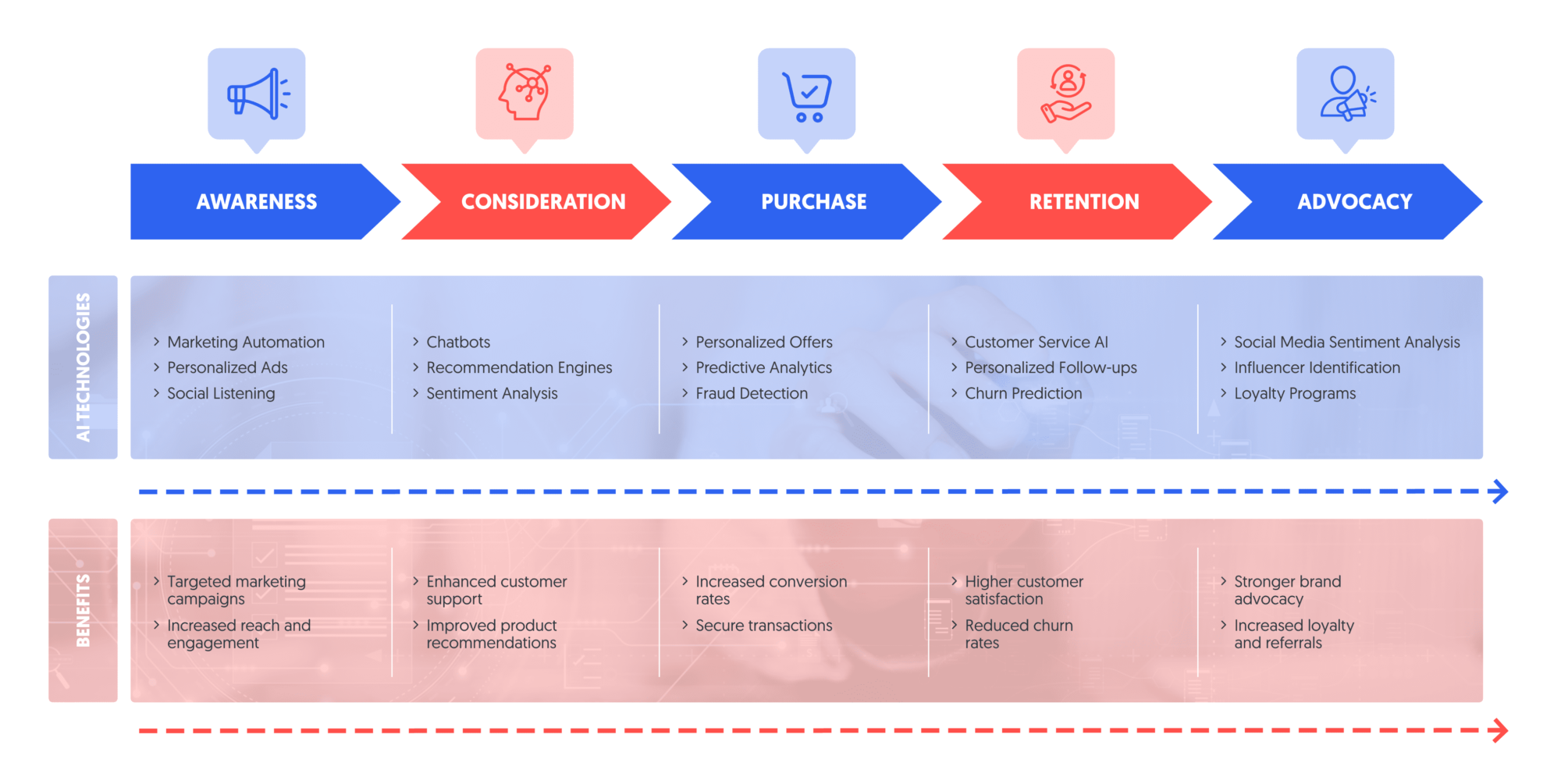
To dig deeper, let's look at some practical applications of AI tools. The following article from Medium provides a fantastic breakdown.
How AI is Transforming Every Stage of the Customer Journey
This article, 'How AI is Transforming Every Stage of the Customer Journey,' provides concrete examples of AI tools and strategies for each phase of the journey. It's a great way to connect this framework to the practical, tech-focused approach you're interested in.
Please read the following sections: '1. Awareness Stage', '2. Consideration Stage', '3. Purchase Stage', and '8. Loyalty and Advocacy Stage'. As you read, notice the specific tools mentioned (like Google Ads AI, Zendesk, or Yotpo) and how they help achieve the goal of that particular stage.
To summarize the connection between the journey stages and AI tools:
- In the Awareness stage, AI can help you find the right audience by using predictive analytics in tools like Google Ads to show your ads to people who are most likely to be interested.
- In the Consideration stage, AI-powered chatbots on your website (like Zendesk) can answer complex questions 24/7, helping customers who are comparing options.
- In the Purchase stage, AI can personalize the checkout experience, for example, by recommending relevant add-on products through tools like Shopify's AI features.
- In the Retention & Advocacy stages, AI can analyze customer feedback to identify at-risk customers (tools like ChurnZero) or personalize rewards in loyalty programs (tools like Smile.io) to keep customers happy and engaged.
This is exactly the kind of practical application you'll be involved with at a marketing agency.
Conclusion
Today, we've mapped out the modern customer journey. It’s the foundational framework that connects your marketing activities to what your customer is actually thinking and doing.
Key Takeaways:
- The customer journey describes the path from Awareness (learning about you), to Consideration (evaluating you), Decision (buying from you), Retention (staying with you), and finally Advocacy (recommending you).
- Your marketing goal changes at each stage—from attracting attention at the beginning to delighting customers at the end.
- Modern journeys are not linear. Customers often move back and forth between stages in a "messy middle."
- AI tools offer powerful ways to enhance every stage, from targeting ads more effectively to personalizing customer support.
In our next lesson, we'll zoom in on the person taking this journey. Now that we understand the path, we need to understand the traveler. You'll learn how to develop a target audience persona, creating a detailed profile of your ideal customer to make all your marketing efforts—and your journey maps—even more powerful.