Hello and welcome to your first lesson! I'm excited to get started on this journey with you.
This course is designed to take you from the fundamentals of marketing to the practical skills needed to run campaigns and build a career, whether in an agency or as a solopreneur. We'll focus on the "how" and "why" and integrate modern tools like AI to make your work more efficient.
Today, we'll start with the absolute bedrock of marketing strategy: the marketing mix, more famously known as the 4 Ps. By the end of this lesson, you will be able to define its core components—Product, Price, Place, and Promotion—using real-world examples. Understanding this framework is the first and most crucial step before building any brand or launching any campaign.
Let's begin.
What is the Marketing Mix?
At its core, marketing is about putting the right product, in the right place, at the right price, with the right promotion. These four elements are the strategic levers you can control to meet your customers' needs and your business's goals. This framework was developed decades ago, but it remains just as relevant today for analyzing everything from a local coffee shop to a global tech giant.
To get a clear overview of each of the 4 Ps, let's start with a foundational video.
Marketing Mix: 4Ps (With Real World Examples) | From A Business Professor
This video from Business School 101 provides a clear, structured introduction to the 4 Ps, defining each one and offering some initial examples to bring the concepts to life.
Please watch from the beginning until 04:44. Focus on how each 'P' is defined and the role it plays in a company's overall strategy. You can skip the Starbucks case study for now; we'll come back to it later.
As the video explained, the 4 Ps are:
- Product: The actual good or service you are offering. It's the solution you provide to your customer's problem or need. This can be a physical item (like a smartphone), a service (like subtitling), or a digital product (like a software subscription).
- Price: The amount of money customers pay for the product. This isn't just about covering costs; it's a powerful signal of your product's value, quality, and position in the market.
- Place: Where and how customers can access your product. This includes physical stores, websites, mobile apps, or any distribution channel that connects you with your audience.
- Promotion: All the activities you undertake to communicate your product's value and persuade customers to buy it. This covers advertising, social media, public relations, and more.
A Deeper Look at Each 'P'
Now that we have the basic definitions, let's explore each component in more detail, focusing on the kinds of strategic questions a marketer would ask.
Product: The Core Offering
Everything starts with the product. Without a good product that people actually want or need, even the most brilliant marketing will eventually fail. A strong product is the foundation upon which you build everything else.
To see how product decisions influence the entire marketing strategy, let's look at an article from SurveyMonkey.
How To Use The 4 Ps Of Marketing For Successful Campaigns
This article clearly explains how the Product is the foundation of the marketing mix and gives the example of Apple's iPhone to illustrate the point.
Please read the section titled 'Product' and its sub-section 'Product's role in the marketing mix'. Notice how it connects a strong product to customer loyalty and its influence on the other Ps.
Price: The Value Exchange
Pricing is more than just a number; it's a strategic tool. The price you set affects how customers perceive your brand and determines your profitability. The HubSpot video below does an excellent job of breaking down different pricing strategies.
4 Ps of The Marketing Mix : Watch THIS To Level Up Your Campaigns (Explainer)
This HubSpot video offers a very practical look at pricing, breaking it down into four common strategies that businesses use.
Watch the segment on 'Price' from 01:23 to 04:28. Pay attention to the four strategies discussed: Cost-Plus, Competitive, Value-Based, and Penetration Pricing. Think about why a company might choose one over another.
To summarize the key pricing strategies from the video:
- Cost-Plus: Calculating your costs and adding a markup. Simple and ensures costs are covered.
- Competitive: Setting your price in relation to competitors. You can price below, at, or above them depending on your strategy.
- Value-Based: Pricing based on the customer's perceived value of the product, not just its cost.
- Penetration: Setting a low initial price to quickly gain market share, often with the plan to raise it later.
Choosing the right strategy depends entirely on your product, your market, and your goals.
Place: Distribution and Access
How do your customers find and receive your product? In today's world, "Place" is both physical and digital. A flawed distribution strategy can make even the best product inaccessible.
4 Ps of The Marketing Mix : Watch THIS To Level Up Your Campaigns (Explainer)
Let's return to the HubSpot video to explore a modern interpretation of 'Place' that includes digital channels and customer habits.
Watch the segment on 'Place' from 04:28 to 05:33. Notice the distinction between reaching a Millennial audience versus a Gen Z audience. This is a core concept in performance marketing—meeting your audience where they are.
Promotion: Communicating Value
Promotion is how you tell your target audience about your product. This is often the most visible part of marketing. It’s not just about running ads; it’s about crafting a message that resonates with your audience and communicates the unique value of your product.
This is also an area where AI can be a powerful assistant. As you wanted to integrate AI into your workflow, let's look at an article that connects promotion directly with AI tools.
The 4 P's in the Marketing Mix: Your Keys to Success
This article from Copy.ai specifically discusses how AI can help with promotional activities. It gives a glimpse into how you can use these tools for practical tasks like writing content.
Read just the section titled '4. Promotion'. It provides a quick overview of what promotion entails and hints at how AI can streamline content creation for campaigns.
The 4 Ps in Action: Real-World Case Studies
The real power of the 4 Ps framework comes from seeing how the elements work together. A decision in one area directly impacts the others. A premium product often requires a high price, selective place (e.g., exclusive boutiques), and sophisticated promotion.
Let's look at a few examples.
First, let's go back to the Business School 101 video and watch its excellent, detailed case study on Starbucks.
Marketing Mix: 4Ps (With Real World Examples) | From A Business Professor
This final segment of the video breaks down how Starbucks masterfully combines all 4 Ps to create a globally dominant brand.
Watch the section 'Starbucks Corporations Four P's' from 04:44 to 08:14. Notice how Starbucks' product (the 'third place' experience), premium price, convenient place, and community-focused promotion all work in harmony.
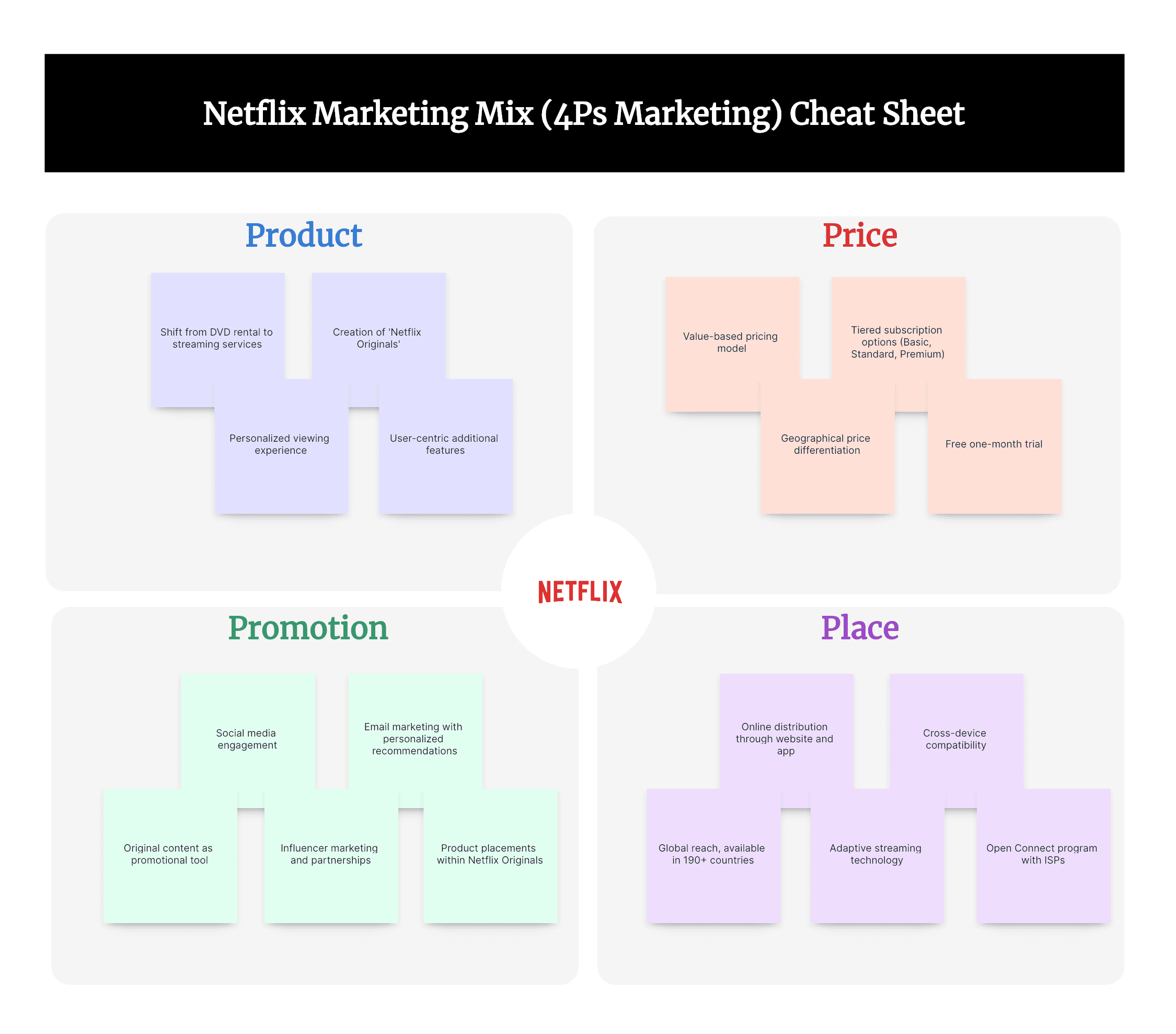
For a quicker, at-a-glance view, "cheat sheets" are incredibly useful. Below are two images that break down the marketing mix for two giant, but very different, brands: Nike and Netflix.

Your Turn: A Quick Reflection
To help solidify these concepts, take five minutes to think about a brand you use every day. It could be your phone's brand, your favorite snack, or a software tool you use. Quickly jot down your thoughts on its 4 Ps:
- Product: What is it and what problem does it solve for you?
- Price: Is it a one-time purchase or a subscription? Do you consider it cheap, expensive, or fair value?
- Place: Where do you buy or access it? (e.g., a supermarket, an app store, their website)
- Promotion: How did you find out about it? Do you see ads for it? On TV, social media, or somewhere else?
This isn't a formal assignment, but simply an exercise to get you into the habit of seeing the 4 Ps all around you.
Conclusion
In this lesson, we've defined the four core components of the marketing mix: Product, Price, Place, and Promotion. We've seen that these are not just separate items on a checklist, but interconnected levers that must work together to create a successful strategy. By analyzing brands like Starbucks, Nike, and Netflix, you can see how this foundational framework applies to any business.
Key Takeaways:
- The 4 Ps are the fundamental building blocks of a marketing strategy.
- Product is the core offering that solves a customer's need.
- Price signals value and determines profitability.
- Place ensures your product is accessible to your target audience.
- Promotion communicates your product's value and drives purchases.
- The most successful brands are those that create a seamless and consistent experience across all 4 Ps.
In our next lesson, we'll build directly on this foundation. We will explore the difference between branding (building long-term value and perception) and performance marketing (driving immediate, measurable results), and you'll see how the 4 Ps are applied differently to achieve these distinct goals.