Introduction
In our previous lesson, you mastered the crucial skill of core bracing and maintaining a neutral spine—the very foundation of safe and powerful movement. Today, we'll learn how to properly prepare your entire body for the work ahead. Think of it as the pre-flight check before takeoff; a non-negotiable step that ensures all systems are warm, lubricated, and ready for the demands of your workout.
This lesson will guide you through constructing and performing a basic warm-up routine. You will learn the scientific principles behind warming up, the difference between effective and counterproductive stretching, and a practical, follow-along routine that focuses on joint mobility and muscle activation. By the end of this session, you'll have a 10-minute sequence to perform before every training session, designed to maximize performance and minimize injury risk.
The Science of an Effective Warm-Up
Before we jump into the exercises, it's important to understand why we warm up. A well-designed warm-up isn't just about feeling loose; it creates specific physiological changes that directly improve your workout. It serves two primary purposes: reducing injury risk and increasing strength performance.
Let's watch a brief segment from a video by Jeff Nippard, who excels at breaking down exercise science.
The Most Effective Science-Based Warm Up & Mobility Routine (Full Body)
This clip from "The Most Effective Science-Based Warm Up & Mobility Routine" explains the evidence-backed benefits of warming up.
Watch from the beginning of the explanation. Pay attention to the distinction he makes between simply raising body temperature and a routine focused heavily on stretching, and note the performance benefits of a higher body temperature, like improved muscle metabolism and power output.
As the video highlights, the key is to literally warm the body. This increases blood flow, raises muscle temperature, and prepares the nervous system for movement. A common point of confusion, however, lies in how we achieve this. Many people default to old-school static stretching, which can actually be counterproductive before a workout.
Dynamic Warm-up vs. Static Cool-down
The single most important principle of a pre-workout warm-up is to use dynamic movements, not static holds.
- Dynamic Stretching: Involves moving your joints and muscles through their full range of motion in a controlled manner. Think of arm circles or leg swings. This increases blood flow, activates the nervous system, and improves mobility without compromising strength.
- Static Stretching: Involves holding a stretch at its end range for an extended period (e.g., 30-60 seconds). This is excellent for increasing long-term flexibility and cooling down after a workout, but studies show it can temporarily decrease muscle strength and power output if done immediately beforehand.
This infographic provides a clear visual summary of the two approaches and their respective places in your training session.

For a more detailed explanation of this crucial distinction, the following article is very insightful.
The Ultimate Calisthenics Warm-up Guide: Prevent injuries ...
This article from The Movement Athlete explains why avoiding static stretches during your warm-up is critical.
Read the section titled The truth behind static stretching. It clearly outlines the risks of pre-workout static stretching and reinforces the benefits of a dynamic approach.
Your 10-Minute Calisthenics Warm-Up Routine
Now, let's put theory into practice. A great warm-up follows a simple three-part structure:
- Pulse Raiser: 1-2 minutes of light cardio to increase your heart rate and core temperature.
- Joint Mobility: 5-7 minutes of dynamic stretches, systematically working through all the major joints from top to bottom.
- Specific Activation: 1-2 minutes of exercises that mimic the main movements of your workout to prime the target muscles (e.g., preparing the wrists and shoulders for push-ups).
The following video from NhuActive Calisthenics provides a complete, easy-to-follow routine that perfectly embodies this structure. It requires no equipment and is ideal for preparing for any calisthenics workout.
Full Body Calisthenics Warm Up for Beginners (No Equipment | Injury Free)
This video, "Full Body Calisthenics Warm Up for Beginners," will be your guide. Follow along with the instructor as she demonstrates each movement.
Perform the entire warm-up routine from start to finish. Below is a breakdown of what you'll be doing and why: Phase 1: Pulse Raiser (Jumping Jacks): This raises your heart rate and core body temperature, signaling to your body that it's time to move. Phase 2: Joint Mobility (Top-to-Bottom Mobilization): You will systematically mobilize your joints. This is the core of the warm-up. By moving your neck, wrists, elbows, shoulders, torso, hips, knees, and ankles through their available range, you are lubricating them with synovial fluid, which is analogous to oiling a mechanical joint to ensure smooth, friction-free operation. Phase 3: Specific Activation (Calisthenics Prep): This final phase is critical. In calisthenics, your wrists and shoulders are not just moving; they are bearing your entire body weight. The wall scapula push-ups teach your shoulder blades to move correctly, which is essential for stable push-ups and rows. The wrist mobilization sequence prepares the delicate wrist joints for the intense load they will experience, significantly reducing the risk of sprains and other common injuries.
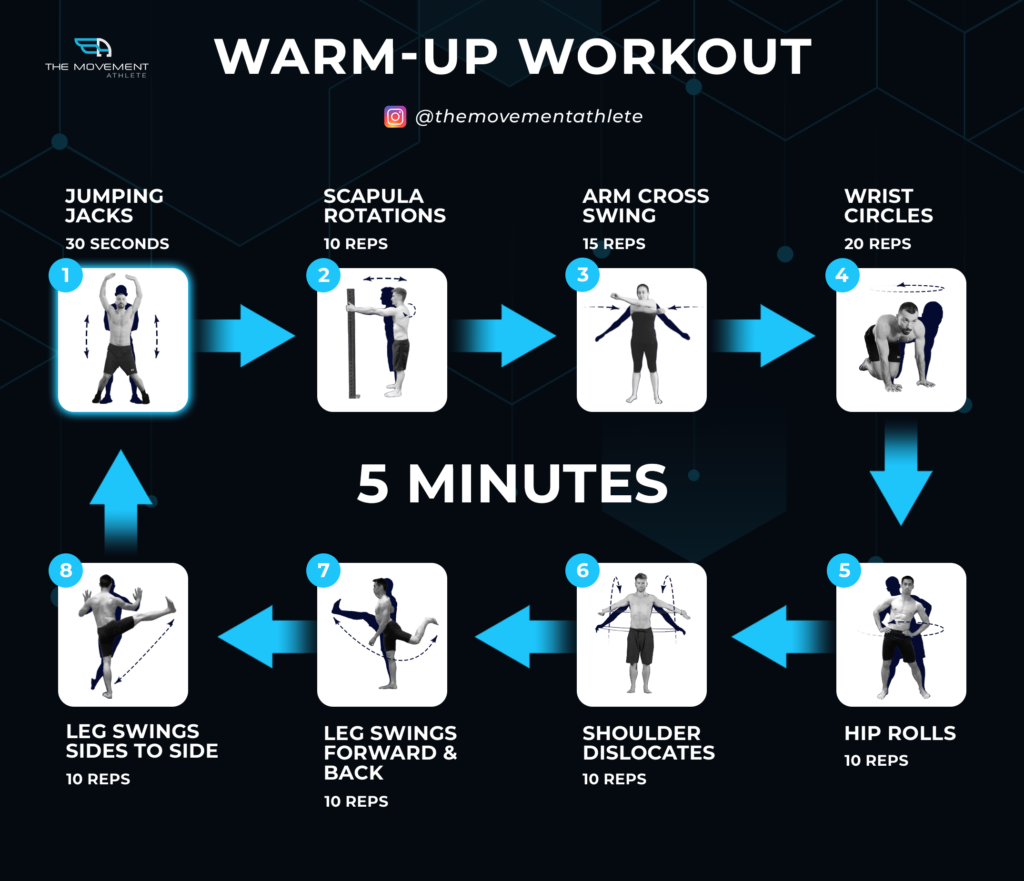
As you progress, you may want to add or substitute exercises, but this routine provides a fantastic and complete foundation. Here is another visual example of a well-structured warm-up that incorporates similar dynamic movements.
Conclusion
You have now learned not only how to perform a complete warm-up but also the scientific reasoning that makes it so effective. This routine is your first line of defense against injury and a simple way to boost your performance in every session.
Key Takeaways:
- A proper warm-up increases body temperature, enhances performance, and reduces injury risk.
- Your warm-up should consist of dynamic movements (like swings and circles), not static holds. Save static stretching for your cool-down.
- A complete warm-up has three phases: a pulse raiser, a joint mobility sequence, and specific activation for the movements you're about to perform.
- For calisthenics, special attention must be paid to mobilizing the wrists and shoulders, as they are major load-bearing joints.
From now on, you will begin every single workout with the routine you just learned. In our next lesson, we will kick off Module 2 by putting this into action. You will perform your first set of fundamental strength exercises: negative push-ups, bodyweight rows, and squats, all built upon the stable core and prepared body you now know how to achieve.