Hello! Welcome to the first lesson of our new module, "Herbal Pharmacology and Interactions."
In the previous module, we established a strong foundation in modern pharmacology. Our last lesson was particularly important, as we explored the four major receptor families—the cellular "locks" that drugs interact with. We saw how binding to a receptor initiates a signal transduction pathway, leading to a physiological response.
Today, we will begin our exploration of the "keys" that are found in medicinal plants. The learning outcome for this lesson is to describe the major classes of bioactive phytochemicals found in medicinal plants (e.g., alkaloids, flavonoids, terpenoids). These chemical compounds are the very ligands that interact with the receptor systems we've just learned about. Understanding their structure and classification is the first step in translating the wisdom of Ayurveda's Dravya Guna (the science of substances) into the language of modern pharmacology.
What are Phytochemicals?
Plants produce a vast array of chemical compounds. These are often categorized into two groups:
- Primary Metabolites: These are essential for the plant's life, involved in fundamental processes like growth and photosynthesis. They include familiar molecules like carbohydrates, proteins, and lipids.
- Secondary Metabolites: These are not directly involved in the basic survival of the plant but serve other important functions, such as defense against herbivores and microbes, attracting pollinators, or protection from environmental stress.
When we talk about the medicinal properties of plants, we are almost always referring to these secondary metabolites. The general term for these plant-derived compounds is phytochemicals (phyto means "plant"). It is this incredible chemical diversity that makes plants such a rich source of medicines.
To get a visual overview of how these compounds are classified, take a look at the following chart. It provides a helpful roadmap for the major families we will be discussing.
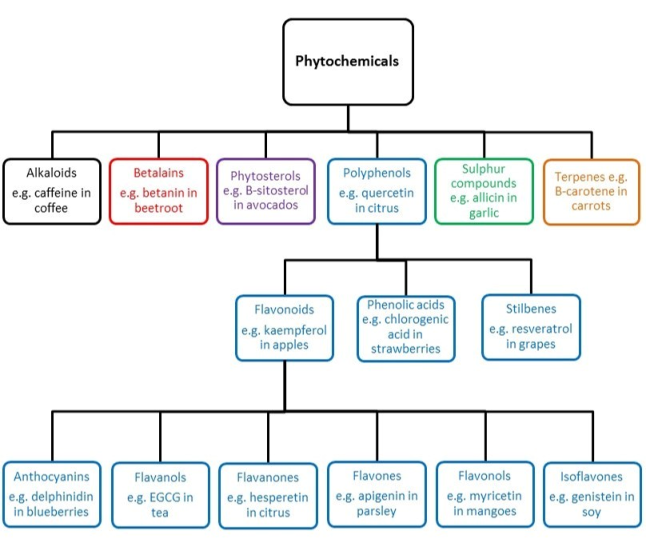
1. The Phenolic Compounds: Antioxidants and Pigments
Phenolic compounds are one of the largest and most widespread groups of phytochemicals in the plant kingdom. Their defining feature is the presence of at least one phenol group—an aromatic ring with a hydroxyl (-OH) group attached. This structure makes them particularly effective antioxidants.
This large family includes several important sub-classes. Let's explore them with the help of a video.
Plant Secondary Metabolites: Phenolics
The video 'Plant Secondary Metabolites: Phenolics' from the TeachEthnobotany channel provides a clear and systematic introduction to this diverse group.
Please watch the following segments, which cover the key sub-classes of phenolics: Introduction to Phenolics & Coumarins (02:19 - 07:49): Pay attention to the basic phenolic structure and the example of coumarins, which include the anticoagulant drug warfarin. Flavonoids (07:49 - 09:14): Note their role as plant pigments and their significance as dietary antioxidants. Tannins (10:09 - 11:48): Focus on their characteristic astringency and their ability to bind to proteins. While watching, think about how these chemical properties might relate to the qualities of herbs you know from Ayurveda.
Let's summarize the key groups of phenolic compounds:
- Flavonoids: This is a vast and very important subgroup. They are responsible for much of the color in flowers and fruits (e.g., the deep purple of blueberries from anthocyanins). In your Ayurvedic studies, you'll find that many plants valued for their health-promoting properties are rich in flavonoids. For instance, Quercetin, a common flavonoid, is found in Tulsi (Ocimum sanctum).
- Tannins: These compounds are responsible for the astringent taste, known as Kashaya Rasa in Ayurveda. This property comes from their ability to bind and precipitate proteins, which you can feel as a drying, puckering sensation in your mouth (like when drinking strong black tea). This action is utilized medicinally, for example, in anti-diarrheal preparations. Amla (Emblica officinalis) and Haritaki (Terminalia chebula) are rich in tannins like gallic acid.
- Coumarins: These contribute to the aroma of plants like freshly cut grass. Some coumarins have potent biological activity; for example, dicoumarol (found in spoiled sweet clover) led to the development of the anticoagulant drug Warfarin.
2. Alkaloids: The Potent Modulators
Alkaloids are perhaps the most famous class of phytochemicals due to their often potent and dramatic physiological effects. Their defining chemical feature is the presence of at least one nitrogen atom, typically as part of a heterocyclic ring. Many alkaloids have names ending in "-ine".
Plant Secondary Metabolism: Alkaloids
Now, let's explore alkaloids with the video 'Plant Secondary Metabolism: Alkaloids', also from TeachEthnobotany. It highlights several medically important examples.
Please watch the following segments: Introduction to Alkaloids (00:00 - 01:26): This introduces the defining features of alkaloids. Isoquinoline Alkaloids (04:04 - 05:18): This section is particularly relevant as it covers morphine, but also berberine, a key compound in the important Ayurvedic herb Daruharidra (Berberis aristata). Purine Alkaloids (06:59 - 08:33): This covers compounds you are likely very familiar with—caffeine and theophylline from coffee and tea.
Alkaloids are classified based on their chemical structure. Here are a few key examples relevant to both modern medicine and Ayurveda:
- Isoquinoline Alkaloids: This group includes the powerful pain-reliever morphine from the opium poppy. It also includes berberine, the bright yellow compound responsible for many of the antimicrobial and anti-inflammatory effects of Daruharidra (Indian Barberry).
- Indole Alkaloids: This class includes potent anticancer drugs like vincristine and vinblastine, isolated from the Madagascar periwinkle (Catharanthus roseus).
- Piperidine Alkaloids: Piperine, the compound that gives black pepper (Pippali) its pungent taste (Katu Rasa), belongs to this group. In Ayurveda, piperine is also known for its yogavahi property—its ability to enhance the bioavailability of other substances. This is now understood scientifically as an inhibition of metabolic enzymes.
3. Terpenoids: Aromas and Steroids
Terpenoids (or terpenes) are a very large and diverse class of phytochemicals built from a repeating five-carbon building block called an isoprene unit. They are often responsible for the characteristic aromas of plants and form the basis of essential oils.
Phytochemicals: Types, Examples, and Health Benefits
To learn about terpenoids, please read a section from the article 'Phytochemicals: Types, Examples, and Health Benefits' on the Microbe Notes website. It provides a good summary of their structure and classification.
Please read the section titled 'Terpenoids'. Focus on how they are classified based on the number of isoprene units (mono-, sesqui-, di-, tri-, and tetra-terpenes).
The classification of terpenoids is based on the number of isoprene units they contain:
- Monoterpenes (2 isoprene units): These are volatile and aromatic. Examples include menthol from mint and limonene from citrus fruits.
- Sesquiterpenes (3 isoprene units): Artemisinin, from Artemisia annua, is a famous example used as a powerful anti-malarial drug.
- Diterpenes (4 isoprene units): This class includes paclitaxel (Taxol), a major chemotherapy agent isolated from the Pacific yew tree.
- Triterpenes (6 isoprene units): This is a particularly interesting group for you. It includes saponins (which have soap-like properties) and the precursors to steroids. The active compounds in Ashwagandha (Withania somnifera), the withanolides, are steroidal lactones derived from triterpenes.
- Tetraterpenes (8 isoprene units): This group is also known as the carotenoids. They are pigments like β-carotene from carrots (a precursor to Vitamin A) and lycopene from tomatoes.
Connecting Phytochemicals to Ayurvedic Herbs
The true power in bridging Ayurveda and modern science comes from connecting these chemical classifications to the plants you are familiar with.
Phytochemicals from Indian Ethnomedicines
The research paper 'Phytochemicals from Indian Ethnomedicines' contains an excellent table that does exactly this. It lists common Ayurvedic plants and their main active phytochemicals.
Please take a moment to look at Table 1 in this article. You don't need to read the whole article. Just scan the table and find some familiar herbs. For example, locate: Ashwagandha and see its main phytochemicals listed as Withanolides. Haridra (Curcuma longa) and see Curcumin. Guduchi (Tinospora cordifolia) and see Berberine and phenolic compounds. Pippali (Piper longum) and see Piperine.
This table powerfully illustrates that the therapeutic actions (Karma) of these revered medicinal plants are mediated by specific chemical compounds belonging to the classes we've just discussed.
Test your understanding!
Based on the lesson, categorize the following well-known phytochemicals into one of the three major classes we've discussed (Phenolics, Alkaloids, or Terpenoids).
- Curcumin (from Turmeric / Haridra)
- Morphine (from Opium Poppy)
- Withanolides (from Ashwagandha)
Show answer
- Curcumin is a Phenolic compound (specifically, a curcuminoid).
- Morphine is an Alkaloid (specifically, an isoquinoline alkaloid).
- Withanolides are derived from Terpenoids (specifically, they are triterpenoid derivatives).
Conclusion
Today, we've organized the vast chemical world of medicinal plants into manageable categories. This classification is the foundation upon which the entire field of pharmacognosy (the study of medicinal drugs from plants) is built.
Key Takeaways:
- The medicinal properties of plants are due to bioactive secondary metabolites called phytochemicals.
- The three most prominent classes are Phenolic Compounds, Alkaloids, and Terpenoids.
- Phenolics (e.g., flavonoids, tannins) are characterized by phenol rings and are often antioxidants. Curcumin in Turmeric is a key example.
- Alkaloids (e.g., morphine, berberine, piperine) are nitrogen-containing compounds with often potent physiological effects.
- Terpenoids (e.g., menthol, withanolides, carotenoids) are built from isoprene units and are responsible for many plant aromas and steroid-like compounds.
- The therapeutic actions (Karma) of Ayurvedic herbs can be explained, at least in part, by the specific phytochemicals they contain.
Preview of the Next Lesson:
Now that we know what these compounds are, the next logical question is, how do scientists get them out of the plant and study them? In our next lesson, we will address this by learning about methods for extraction, standardization, and identification of active compounds in herbal preparations. This is a crucial step for ensuring the quality, safety, and efficacy of herbal medicines in a modern research and clinical context.