Hello! Welcome back to our module on Herbal Pharmacology.
In our last lesson, we explored the "what" of herbal medicine by classifying the major families of phytochemicals—the phenolics, alkaloids, and terpenoids. We saw that specific compounds, like the withanolides in Ashwagandha or berberine in Daruharidra, are responsible for the therapeutic actions described in Ayurveda.
Today, we transition from the "what" to the "how." We will address the learning outcome: Explain methods for extraction, standardization, and identification of active compounds in herbal preparations. This lesson is fundamental to your goal of bridging Ayurveda and modern science, as it details the critical steps required to transform a raw plant into a consistent, safe, and effective medicinal product suitable for research and clinical use.
We will cover:
- Extraction: How to separate the desired bioactive compounds from the plant material.
- Standardization: How to ensure that every batch of an herbal preparation has consistent quality, purity, and strength.
- Identification: How to confirm the identity of the plant and its active compounds.
1. Extraction: Getting the Good Stuff Out
Extraction is the first crucial step in phytochemistry. It is the process of selectively dissolving the target phytochemicals from the plant's cellular matrix using a suitable solvent.
The image below provides a great overview of a typical laboratory extraction process.
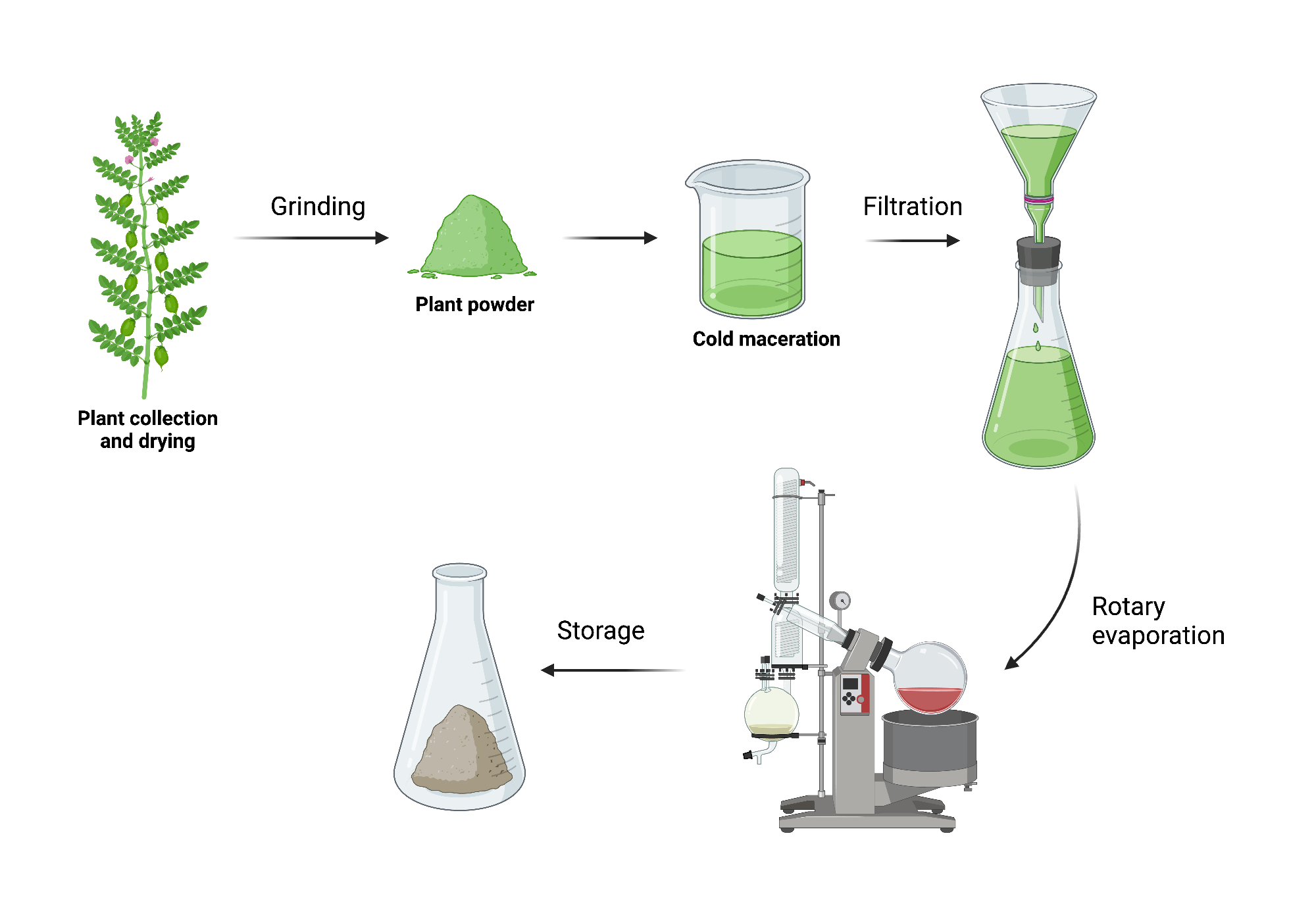
The choice of solvent is critical and depends on the polarity of the target compounds we discussed in the last lesson. For example:
- Polar solvents like water or ethanol are good for extracting polar compounds like many flavonoids and tannins.
- Non-polar solvents like hexane are used for extracting non-polar compounds like lipids and some terpenoids.
There are many different extraction techniques, ranging from traditional methods that have been used for centuries to modern, highly efficient methods.
Different methods of extraction of bioactive compounds and ...
To understand the principles behind these methods, please read a selection from the review article 'Different methods of extraction of bioactive compounds and ...'. It provides an excellent overview of both traditional and modern techniques.
Please read the following sections: Classical and Conventional Methods: Focus on understanding the basic principles of Maceration (4.1.1), Decoction (4.1.5), and Soxhlet extraction (4.1.9). Think about how Maceration and Decoction are similar to traditional Ayurvedic preparations like Hima (cold infusion) and Kwatha (decoction). Innovative (non-conventional) Techniques: Read about Microwave-assisted extraction (MAE) (4.2.1) and Ultrasound-assisted extraction (UAE) (4.2.2). Note their advantages in terms of speed and efficiency. Finally, review Table 1 at the end of the paper. This table provides a concise summary of the pros and cons of these methods and is a great study aid.
To see one of these methods in action, let's watch a short video clip demonstrating a simple decoction.
Extraction, Isolation, Purification & Identification of Phytochemical | Phytochemical Test | ENGLISH
The video 'Extraction, Isolation, Purification & Identification of Phytochemical' from Solution- Pharmacy shows the process of extracting caffeine from tea leaves.
Watch the first part of the video on Extraction (01:10 - 03:09). Observe how the powdered tea leaves are boiled in water (the solvent), and how the soluble compounds move from the plant material into the water to create an aqueous extract.
Optimizing the Extraction
Modern phytochemistry focuses on optimizing extraction to maximize the yield of active compounds while minimizing degradation and the use of toxic solvents. As detailed in the article "Advancing herbal medicine...", scientists carefully control variables like:
- Solvent-to-herb ratio
- Temperature and time
- Particle size of the plant material
- pH of the solvent
By fine-tuning these parameters, researchers can develop a reproducible process that consistently yields a high-quality extract.
2. Standardization: Ensuring Consistency and Quality
One of the biggest challenges for herbal medicine in a modern context is variability. The chemical composition of a plant can change based on its genetics, growing conditions, harvest time, and processing. Standardization is the process of implementing quality controls to ensure that each batch of an herbal product is consistent in its identity, purity, and concentration of active compounds.
This is essential for both research (to ensure results are reproducible) and clinical practice (to ensure a predictable therapeutic dose).
Standardization of Herbal Drugs | Pharmacognosy & Phytochemistry | IIMT College of Pharmacy
The video 'Standardization of Herbal Drugs' provides a practical overview of the different parameters used to standardize herbal materials. The narration is a helpful mix of English and Hindi.
Please watch the following segments to understand the key evaluation methods: Definition of Standardization (00:00 - 02:32): This introduces the concept of confirming identity, quality, and purity. Macroscopic/Morphological Evaluation (02:32 - 05:46): This is the first level of quality control, using the naked eye to check features like color, shape, and texture. Microscopic Evaluation (05:46 - 18:36): Watch the explanations for parameters like stomatal index and palisade ratio. You don't need to memorize the details, but appreciate how these microscopic features are like fingerprints for a plant species. Physical Parameters (18:36 - 28:54): Focus on the concepts of moisture content, solubility, and ash value. Understand why controlling for high moisture is important (to prevent microbial growth) and how ash value can indicate the presence of inorganic impurities.
Chemical Standardization
Beyond the physical and microscopic checks, the "gold standard" of standardization is chemical standardization. This involves identifying one or more specific marker compounds in the herb and quantifying their concentration.
- An active marker is a compound known to be responsible for the herb's therapeutic effect (e.g., curcumin in turmeric).
- An analytical marker is a compound that is characteristic of the plant, used for identification and quality control, even if its bioactivity isn't fully known.
By ensuring that every batch of a turmeric extract contains, for example, at least 95% curcuminoids, a manufacturer can guarantee a consistent potency. This is detailed in the paper "Advancing herbal medicine: enhancing product quality..." as a key aspect of quality control.
3. Identification: Confirming the Identity
After extracting and purifying a compound, how do we confirm what it is? And how do we verify the authenticity of the starting plant material? This is the process of identification.
A powerful and widely used technique for this is chromatography. The basic principle of chromatography is to separate a mixture of compounds by passing it through two phases: a stationary phase (a solid or a liquid on a solid support) and a mobile phase (a liquid or gas). Compounds in the mixture will travel at different speeds depending on their chemical affinity for each phase, causing them to separate.
Thin-Layer Chromatography (TLC)
TLC is a simple, fast, and inexpensive chromatographic technique used for identification.
Extraction, Isolation, Purification & Identification of Phytochemical | Phytochemical Test | ENGLISH
Let's return to the video on caffeine extraction to see a practical demonstration of TLC.
Watch the segment on Identification by TLC (06:59 - 10:07). Pay close attention to these steps: A test sample (the extracted caffeine) and a standard sample (pure, known caffeine) are spotted on the TLC plate (the stationary phase). The plate is placed in a chamber with a solvent (the mobile phase), which then travels up the plate. The spots for the test and standard samples travel up the plate to the same height. By comparing the Rf value (Retardation factor: the ratio of the distance traveled by the spot to the distance traveled by the solvent), the identity of the extracted compound is confirmed.
Advanced Identification Methods
While TLC is excellent for quick identification, modern research employs more sophisticated techniques:
- High-Performance Liquid Chromatography (HPLC): This is a highly sensitive and quantitative version of chromatography. It is the workhorse of the modern phytochemistry lab, used for both identifying compounds and quantifying them for standardization.
- Mass Spectrometry (MS): Often coupled with chromatography (e.g., GC-MS or LC-MS), this technique measures the precise mass of a molecule, providing definitive structural information for identification.
- DNA Barcoding: This is a molecular technique used to identify the plant species itself. By sequencing a short, standardized region of the plant's DNA, scientists can confirm its botanical identity, which is especially useful when the herb is in a powdered or processed form where macroscopic identification is impossible.
Test your understanding!
You are developing a standardized extract of Guduchi (Tinospora cordifolia) for a clinical study on its immunomodulatory effects. Berberine, an alkaloid, is one of its known active compounds.
- Extraction: Based on what you know about alkaloids from the previous lesson and solvents from this one, what kind of solvent (polar or non-polar) might be a good starting point to extract berberine?
- Standardization: What is one key parameter you would need to define and measure in every batch to call your extract "standardized"?
- Identification: You have a pure, known sample of berberine from a chemical supplier. What simple technique could you use to confirm that your extract also contains berberine?
Show answer
- Extraction: Alkaloids are often extracted in their salt form, which is soluble in polar solvents. Therefore, a polar solvent like ethanol or a water-ethanol mixture would be a good starting point.
- Standardization: To standardize the extract, you would need to measure the concentration of berberine in every batch (e.g., "Guduchi extract standardized to contain 5% berberine"). Other parameters like moisture content and ash value would also be important for overall quality control.
- Identification: You could use Thin-Layer Chromatography (TLC). By spotting your extract alongside the pure berberine standard on a TLC plate and running them in the same mobile phase, you could confirm the presence of berberine in your extract if it produces a spot at the same Rf value as the standard.
Conclusion
Today, we have walked through the essential scientific processes that bridge the gap between a traditional herb and a modern phytopharmaceutical. These methods don't replace traditional knowledge; rather, they provide the tools to verify, refine, and ensure the safety and efficacy of that knowledge.
Key Takeaways:
- Extraction is the process of separating bioactive compounds from plants, with the choice of method (e.g., decoction, Soxhlet, UAE) and solvent depending on the target compound and desired efficiency.
- Standardization is the critical process of ensuring batch-to-batch consistency. It involves macroscopic, microscopic, physical (moisture, ash), and chemical (quantifying marker compounds) evaluations.
- Identification confirms the identity of the plant material and its chemical constituents using techniques like chromatography (TLC, HPLC) and DNA barcoding.
Preview of the Next Lesson:
Now that we understand how to produce a standardized herbal extract, we must consider its fate in the human body. Herbal medicines are complex mixtures, not single molecules. In our next lesson, we will explore the pharmacokinetic challenges specific to herbal medicines, such as constituent multiplicity and variable composition. This will set the stage for understanding herb-drug interactions and the unique complexities of clinical research in this field.