Introduction
Hello! In our last few lessons, we've focused on what happens when a company's share issue is extremely popular, leading to oversubscription. We learned how to manage this through pro-rata allotment and even how to handle surplus money by creating a Calls-in-Advance account.
Today, we will explore the opposite scenario. What happens when the public's response is lukewarm and not all shares offered are applied for? This lesson will teach you how to account for the undersubscription of shares and its crucial implications. We will define what undersubscription is, understand the most important rule associated with it—the minimum subscription—and learn how to pass the correct journal entries.
This concept is much simpler than oversubscription, but understanding its rules is vital for both your exams and for a complete picture of share capital accounting.
1. Understanding the Types of Subscription
When a company offers shares to the public, there are three possible outcomes based on the number of applications received:
- Full Subscription: The number of shares applied for is exactly equal to the number of shares offered.
- Oversubscription: The number of shares applied for is more than the number of shares offered. (You've already mastered this!)
- Undersubscription: The number of shares applied for is less than the number of shares offered.
To get a clear definition of undersubscription, please watch the introductory part of the following video.
Undersubscription of Shares- Company A/C -Accounting for share capital. P6 .ch 8 accounts class 12
This short clip from Commerce Classes by Tabita Massey clearly defines undersubscription and contrasts it with the other two scenarios.
Watch the video from the beginning up to 01:34. Focus on the definition of undersubscription and the example given.
As you saw, if a company offers 100,000 shares but only receives applications for 95,000 shares, this is a case of undersubscription. But can a company proceed with the issue if it only gets applications for, say, 10,000 shares? This brings us to a critical legal requirement.
2. The Key Implication: The Minimum Subscription Rule
Undersubscription has one major implication that you must know: the minimum subscription rule. A company cannot allot shares unless it receives a minimum level of subscription from the public. This rule is in place to protect investors' money, ensuring the company has raised enough capital to be viable and achieve the project's objectives for which the funds were raised.
According to the Companies Act, 2013, and SEBI (Securities and Exchange Board of India) guidelines, the minimum subscription has been set at 90% of the issued amount.
- If subscription is 90% or more: The company can go ahead with the allotment of shares.
- If subscription is less than 90%: The company cannot allot any shares. It must refund the entire application money received to the applicants within a specified time. The entire share issue is cancelled.
Let's dive deeper into this rule and its logic.
Pro rata Allotment | Over Subscription & Undersubscription | Issue of shares class 12. Part 5
The following video by Sunil Panda explains the 90% rule in detail and uses a great analogy to help you understand why this rule exists.
Watch the segment from 02:27 to 06:52. Pay close attention to the 90% calculation and the 'cake' analogy, which explains the logic behind protecting investors.
To summarize the key points from the video and other resources:
- The Threshold: Minimum subscription is 90% of the shares issued.
- The Consequence of Failure: If applications for less than 90% of shares are received, the issue fails. All application money must be returned.
- The Rationale: It prevents companies from starting projects with insufficient funds, which would likely lead to failure and loss of investors' money.
For a quick textual reference on this topic, you can review the article from GeeksForGeeks.
Difference between Oversubscription and Undersubscription
This article provides a concise explanation of undersubscription and the 90% minimum subscription rule.
Read the section titled 'What is Undersubscription of Shares?'. Focus on the definition, the causes, and the explanation of the 90% rule.
3. Accounting for Undersubscription
If the minimum subscription of 90% is met, the company can proceed with the allotment. The accounting treatment for undersubscription is straightforward and simpler than for oversubscription.
The Golden Rule of Undersubscription: All journal entries for application, allotment, and calls must be calculated based on the number of shares subscribed, not the number of shares issued or offered.
Think about it logically: if the public only applied for and was allotted 95,000 shares, the company can only collect money for those 95,000 shares. The 5,000 shares that were never applied for are irrelevant for accounting purposes.
Let's see this in action.
Undersubscription of Shares- Company A/C -Accounting for share capital. P6 .ch 8 accounts class 12
This video demonstrates how to pass journal entries in an undersubscription scenario. Notice how all calculations use the number of subscribed shares.
Watch from 02:20 to 06:18. The example involves issuing 12,000 shares, but only 11,000 are subscribed. Observe how every calculation (Application, Allotment, Call) is based on 11,000 shares.
Now, let's solidify this by looking at some worked-out examples for shares issued at par and at a premium.
Types Of Equity Shares Subscriptions with Examples.
The following article from Commerce Ninjas provides two excellent, straightforward examples of undersubscription.
First, read the section 'Undersubscription of Shares'. Then, carefully review the solutions for both 'EXAMPLE 1' (Parth Ltd. - issue at par) and 'EXAMPLE 2' (Suhani Ltd. - issue at premium). In each case, confirm that all calculations are based on the number of shares the public applied for.
As you can see from these examples, there are no complex adjustments for excess money, no pro-rata tables, and no refunds (unless the 90% rule is not met). You simply use the smaller number—the number of subscribed shares—for all your calculations.
Test your understanding!
ABC Ltd. issued 50,000 shares of ₹10 each, payable as follows:
- On Application: ₹3 per share
- On Allotment: ₹4 per share
- On First & Final Call: ₹3 per share
The public applied for 48,000 shares, and all applications were accepted. All money was duly received.
What is the journal entry for the amount received on allotment?
Show answer
First, we pass the 'due' entry for allotment:
- Share Allotment A/c Dr. 1,92,000
- To Share Capital A/c 1,92,000
(Being allotment money due on 48,000 shares @ ₹4 each)
- To Share Capital A/c 1,92,000
The calculation is based on 48,000 shares, not 50,000.
Amount = 48,000 shares × ₹4 = ₹1,92,000.
Next, we pass the 'receipt' entry:
- Bank A/c Dr. 1,92,000
- To Share Allotment A/c 1,92,000
(Being allotment money received)
- To Share Allotment A/c 1,92,000
The key is to use 48,000 shares for the calculation.
4. Oversubscription vs. Undersubscription: A Summary
To bring everything together, let's look at a clear comparison between the two concepts.
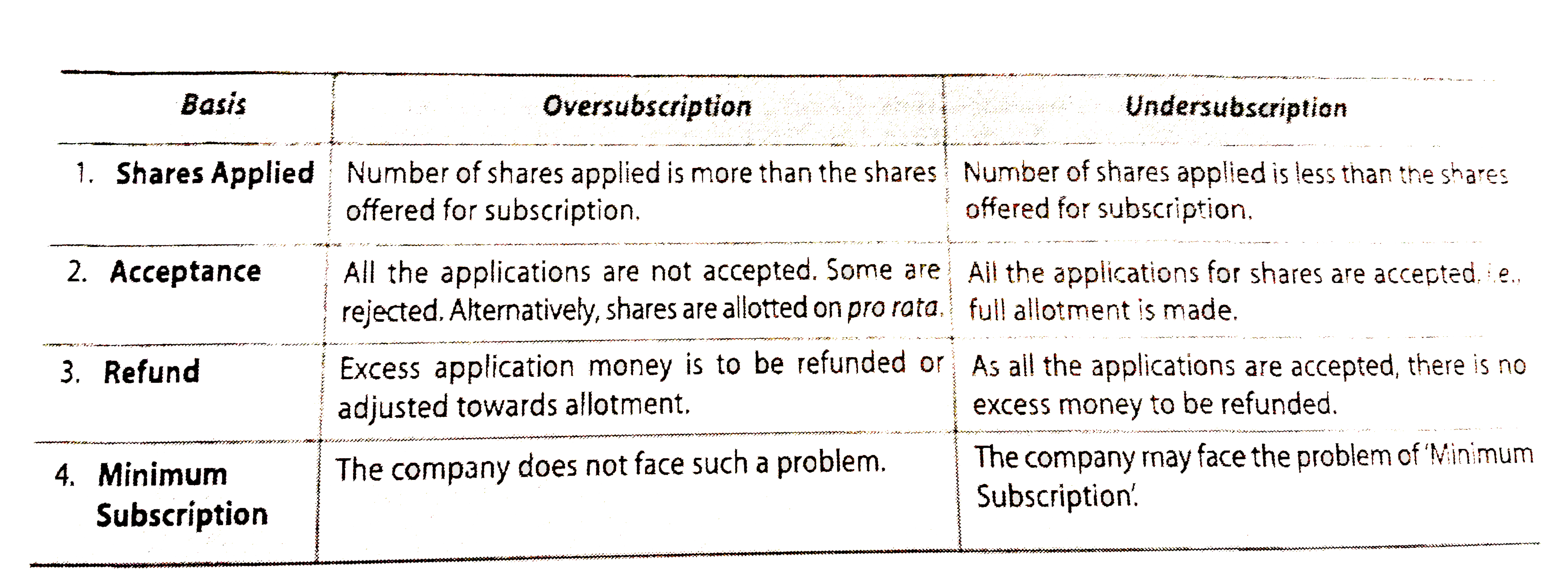
The table reinforces that in undersubscription:
- Shares Applied < Shares Offered.
- All applications are fully accepted.
- No refund is necessary (assuming the 90% rule is met).
- Minimum subscription is a major concern.
Conclusion
Well done! You have now covered the full spectrum of share subscription scenarios, from the high demand of oversubscription to the low demand of undersubscription.
Key Takeaways:
- Undersubscription occurs when the number of shares applied for is less than the number offered by the company.
- The most critical implication is the Minimum Subscription Rule: a company must receive applications for at least 90% of the issued shares to proceed with the allotment.
- If the 90% threshold is not met, the share issue is cancelled, and all application money must be refunded.
- In a valid undersubscription scenario (≥90%), all accounting entries for application, allotment, and calls are based on the number of shares subscribed, not the number of shares issued.
In our next lesson, we will address a common issue that can arise in any subscription scenario: what happens when a shareholder fails to pay their allotment or call money? We will learn how to record journal entries for Calls-in-Arrears.