Introduction
Hello! In our last lesson, we looked at undersubscription, where a company receives fewer applications than the shares it offered. We assumed that in such cases, all shareholders who were allotted shares paid their dues on time.
Today, we address a practical problem that companies often face: what happens when a shareholder fails to pay the money due on allotment or calls? This unpaid amount is known as Calls-in-Arrears.
This lesson is dedicated to learning how to record the journal entries for Calls-in-Arrears. We will explore the two common accounting methods for this, understand the concept of charging interest on these arrears, and work through examples to solidify your understanding. This is a fundamental concept that builds directly on the journal entries you've already mastered.
1. What are Calls-in-Arrears?
When a company requests payment for allotment or any of the calls, some shareholders might not be able to pay the amount by the due date. The total amount that has been called up by the company but not yet paid by the shareholders is called Calls-in-Arrears.
To see this in a simple scenario, let's watch the beginning of the following video.
Issue of Shares | Calls in arrears and advance | Class 12 | Accounts | Part 6
Rajat Arora uses a very clear and simple example to introduce what Calls-in-Arrears means in a practical sense.
Watch the video from the beginning until 02:27. Focus on how the final call money not paid by 'Chintu' is identified as Calls-in-Arrears.
From an accounting perspective, Calls-in-Arrears represents money receivable by the company from its shareholders. Therefore, the Calls-in-Arrears account is an asset and has a debit balance.
2. Accounting for Calls-in-Arrears
There are two methods to record Calls-in-Arrears in the company's books. Both are acceptable, but one is generally preferred for its clarity.
Method 1: Without Opening a Calls-in-Arrears Account
In this method, we do not open a new, separate account for the arrears. When recording the receipt of money for a call, we simply debit the Bank Account with the actual amount received.
The journal entry would be:
| Date | Particulars | L.F. | Debit (₹) | Credit (₹) |
|---|---|---|---|---|
| Bank A/c | Dr. | |||
| To Share Allotment/Call A/c | ||||
| (Being amount received on allotment/call) |
Because the amount credited to the Share Allotment/Call Account is less than the amount debited when the call was made due, that account will automatically show a debit balance equal to the unpaid amount (the arrears).
Issue of Shares | Calls in arrears and advance | Class 12 | Accounts | Part 6
Let's see this first method in action. The same video by Rajat Arora now demonstrates the journal entries without opening a specific arrears account.
Watch the segment from 02:27 to 06:26. Notice how on the final call, the Bank A/c is debited with only ₹99,000, and the Share Second & Final Call A/c is credited with the same, leaving an unclosed balance in the call account.
Method 2: By Opening a Calls-in-Arrears Account
This is the more common and recommended method as it provides a clearer picture of the amount due from shareholders. Here, a specific account called "Calls-in-Arrears A/c" is opened and debited with the unpaid amount.
The journal entry upon receipt of money for a call would be:
| Date | Particulars | L.F. | Debit (₹) | Credit (₹) |
|---|---|---|---|---|
| Bank A/c | Dr. | (Amount Received) | ||
| Calls-in-Arrears A/c | Dr. | (Amount Not Received) | ||
| To Share Allotment/Call A/c | (Total Amount Due) | |||
| (Being amount received and calls in arrears recorded) |
This method closes the relevant Share Allotment/Call account completely and transfers the unpaid balance to a dedicated Calls-in-Arrears account.
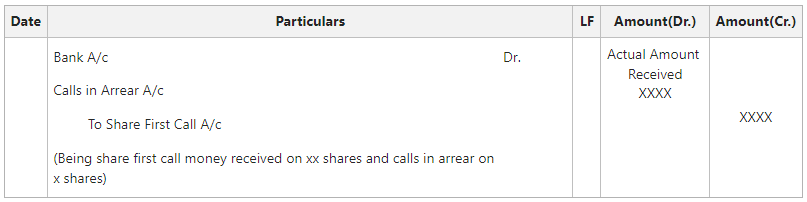
Let's watch a detailed explanation of this preferred method.
#6 Issue of Shares - Calls in Arrears & Calls in Advance - Class 12 / CA - By Saheb Academy
The instructor in this video from Saheb Academy explains why opening a Calls-in-Arrears account is better and walks through the journal entries for a multi-stage default.
Watch the video from 03:05 to 09:05. Pay close attention to how the 'Calls in Arrears' account is debited at each stage (allotment, first call, final call) for the amount not paid.
Test your understanding!
Alpha Ltd. made a first call of ₹2 per share on its 1,00,000 shares. A shareholder, Rohan, holding 500 shares, did not pay the call money. All other shareholders paid the amount due.
What is the journal entry for the receipt of the first call money, assuming the company opens a Calls-in-Arrears account?
Show answer
First, let's calculate the amounts:
- Total amount due on first call = 1,00,000 shares × ₹2 = ₹2,00,000.
- Amount not paid by Rohan (Calls-in-Arrears) = 500 shares × ₹2 = ₹1,000.
- Amount received in bank = ₹2,00,000 - ₹1,000 = ₹1,99,000.
The journal entry is:
| Date | Particulars | L.F. | Debit (₹) | Credit (₹) |
|---|---|---|---|---|
| Bank A/c | Dr. | 1,99,000 | ||
| Calls-in-Arrears A/c | Dr. | 1,000 | ||
| To Share First Call A/c | 2,00,000 | |||
| (Being first call money received on 99,500 shares and calls in arrears on 500 shares recorded) |
3. Interest on Calls-in-Arrears
To discourage late payments, a company's Articles of Association may permit it to charge interest on the amount of calls-in-arrears.
- If the Articles are silent, the rules of Table F of the Companies Act, 2013, apply.
- Table F specifies that interest can be charged at a rate not exceeding 10% per annum.
This interest is calculated from the due date of the call until the date the arrears are actually paid.
For a comprehensive look at the journal entries for both creating and receiving arrears, as well as the related interest, please study the following article from GeeksForGeeks.
Calls in Arrear: Accounting Entries with Examples on Issue of Shares
This article provides a textual summary of both accounting methods and includes a detailed section on calculating and recording interest on Calls-in-Arrears.
Read the sections titled 'Interest on Calls in Arrear' and 'Journal Entries on Interest on Calls in Arrear'. Then, study the 'Example of Interest on Calls in Arrear' to see how the calculation and entries are done.
The key entries for interest are:
- For making interest due: Sundry Members A/c Dr. To Interest on Calls-in-Arrears A/c
- For receiving interest payment: Bank A/c Dr. To Sundry Members A/c
When the shareholder finally pays the overdue call amount, the entry simply reverses the initial arrear entry for that amount:
| Date | Particulars | L.F. | Debit (₹) | Credit (₹) |
|---|---|---|---|---|
| Bank A/c | Dr. | (Amount Received) | ||
| To Calls-in-Arrears A/c | (Amount Received) | |||
| (Being calls-in-arrears amount received) |
Conclusion
Great work today! We've tackled the important issue of what happens when shareholders don't pay their dues on time. Understanding Calls-in-Arrears is crucial, as it's a common element in more complex problems involving share capital.
Key Takeaways:
- Calls-in-Arrears is the portion of the called-up share capital that has not been paid by shareholders.
- There are two methods for accounting: without opening a Calls-in-Arrears account (leaving a debit balance in the call account) or by opening a Calls-in-Arrears account (transferring the unpaid amount to a separate asset account). The second method is preferred for clarity.
- When a Calls-in-Arrears account is used, it is debited when the amount becomes overdue.
- A company can charge interest on arrears at a rate up to 10% p.a. as per Table F of the Companies Act, 2013.
In our next lesson, we will shift our focus slightly. So far, we've assumed shares are always issued for cash. We will now learn how to record journal entries for the issue of shares for consideration other than cash, such as when a company buys an asset and pays for it with its own shares.