Introduction
Hello! In our last lesson, we tackled oversubscription and learned how to adjust excess application money against the amount due on allotment using pro-rata allotment. You practiced this with scenarios involving refunds, adjustments, and a combination of both.
Today, we're taking that concept one step further. What happens when the excess application money received from shareholders is so large that it not only covers their allotment dues but leaves a surplus? This lesson will teach you how to record journal entries to adjust this surplus towards future calls, using an account called Calls-in-Advance.
This is a common scenario in comprehensive problems for your CBSE exams. Mastering this will ensure you can handle even the most complex oversubscription questions.
When does Excess Money go to Future Calls?
In a pro-rata allotment, you already know we first use the excess application money to settle the amount due on allotment. If there's still a surplus after that, the company has two options, which will be specified in the question:
- Refund the surplus: The amount remaining after the allotment adjustment is returned to the shareholder.
- Adjust against future calls: The surplus is held by the company and used to pay for the first call, second call, etc., on behalf of the shareholder. This amount is credited to a temporary liability account called Calls-in-Advance.
The Golden Rule: Always read the question carefully! The problem will state whether the excess money beyond allotment should be refunded or adjusted against calls. If nothing is mentioned, the standard practice is to refund it.
The Accounting Treatment for Calls-in-Advance
When you determine that excess money will be adjusted against future calls, it impacts two key stages of your journal entries.
1. At the Time of Allotment:
The second journal entry (for transferring application money) is expanded. You debit Share Application with the total money received and credit the respective accounts. The new addition is To Calls-in-Advance A/c.
The entry will look like this:Share Application A/c Dr.
To Share Capital A/c
To Share Allotment A/c (Excess money adjusted against allotment)
To Calls-in-Advance A/c (Surplus after allotment, held for future calls)
To Bank A/c (Any money being refunded)
2. At the Time a Call is Made:
When you make a call (e.g., First Call), you first pass the usual 'due' entry. However, in the 'receipt' entry, you won't receive the full amount in cash because some shareholders have already paid. You will debit the Calls-in-Advance account to cancel the liability for those shareholders.
The entry will look like this:Bank A/c Dr. (Cash received from other shareholders)Calls-in-Advance A/c Dr. (Amount being used from the advance)
To Share [First/Final] Call A/c
Let's see this in action with a detailed example.
Walkthrough: Adjusting Excess Towards Calls
The following resource provides a perfect example of how this works. The problem statement explicitly says, "The excess of application money is to be adjusted towards allotment and calls to be made."
Types Of Equity Shares Subscriptions with Examples.
Please read 'Example 3: Janta Papers Ltd' from this CommerceNinjas article. Pay close attention to the problem description and the working note, which calculates the amounts for allotment and calls-in-advance.
Focus on 'EXAMPLE 3'. First, read the question about Janta Papers Ltd. Then, carefully study the 'WORKING NOTE' that breaks down the application of the excess money. Finally, review the full set of journal entries provided in the solution.
Let's break down the journal entries from that example together.
Analysis of the Journal Entries:
-
Bank to Share Application (Jan 1): Simple enough. Total applications (400,000) × Application money (₹5) = ₹20,00,000.
-
Share Application Transfer (Feb 1): This is the most important entry for today's lesson.
Share Application A/cis debited with the full₹20,00,000.To Share Capital A/c: For the shares actually issued (100,000 shares × ₹5) =₹5,00,000.To Bank A/c: For the 200,000 rejected applications (200,000 × ₹5), plus an additional refund calculated in the working note. The total refund is₹11,00,000. (Wait, let's re-examine the resource. It looks like the working note has a slight typo and the numbers in the journal entry are what we should follow).
*Let's re-calculate based on the problem description:- Total Received: 400,000 apps * ₹5 = ₹20,00,000
- Rejected: 200,000 apps * ₹5 = ₹10,00,000 refunded.
- Full Allotment: 80,000 apps allotted 80,000 shares. Money is fine.
- Pro-rata: Remaining apps (400k - 200k - 80k) = 120,000 apps were allotted the remaining shares (100k - 80k) = 20,000 shares.
- Money from Pro-rata group: 120,000 apps * ₹5 = ₹6,00,000.
- Money needed for Application: 20,000 shares * ₹5 = ₹1,00,000.
- Excess money from Pro-rata group: ₹6,00,000 - ₹1,00,000 = ₹5,00,000.
To Share Allotment A/c: Amount due on allotment for this group is 20,000 shares × ₹7.50 =₹1,50,000. We can use the excess money for this.To Calls in Advance A/c: After allotment, we still have a surplus (₹5,00,000 - ₹1,50,000 = ₹3,50,000). The amount due on calls for this group is 20,000 shares × (₹6 + ₹6.50) = ₹2,50,000. We can adjust this amount. The entry shows₹2,50,000.To Bank A/c: This is for the rejected applications (200,000 * ₹5 =₹10,00,000). And what about the remaining surplus from the pro-rata group? (₹3,50,000 - ₹2,50,000 = ₹1,00,000). This is also refunded. So total refund = ₹10,00,000 + ₹1,00,000 =₹11,00,000. Now the journal entry makes sense!
-
Share Allotment Due (Feb 1): Normal entry for all 100,000 shares. (100,000 × ₹7.50 = ₹7,50,000).
-
Bank to Share Allotment (Feb 1): Total due was ₹7,50,000. The pro-rata group had ₹1,50,000 adjusted from their excess application money. So, the cash received is ₹7,50,000 - ₹1,50,000 =
₹6,00,000. -
Share First Call Due (Apr 1): Normal entry (100,000 × ₹6 = ₹6,00,000).
-
Bank & Calls-in-Advance to First Call (Apr 1): This is the second key entry. The total due is ₹6,00,000. The working note shows that the pro-rata group (20,000 shares) has advance payment for this. Their portion is 20,000 × ₹6 =
₹1,20,000. This amount is debited fromCalls in Advance A/c. The remaining cash received is ₹6,00,000 - ₹1,20,000 =₹4,80,000. Note: The resource seems to have a typo in this entry, showing Bank Dr with 600,000 and Calls in Advance Dr with 120,000. Based on the logic, the Bank Dr should be 480,000.
This step-by-step logic is crucial for solving these problems correctly.
Reinforcing the Concept
Let's look at another resource that clearly illustrates the journal entries for this process.
Oversubscription of Shares: Pro-rata Allotment
This article from GeeksForGeeks also explains the concept well. Focus on the third scenario discussed.
Scroll down to section '3. Excess amount Adjusted with Allotment and Calls with Interest on Calls in Advance'. Study the journal entries and the 'Sayeba Ltd.' illustration. Note how the 'To Calls in Advance A/c' is used in the second entry.
The image below, from the GeeksForGeeks article, provides a concise visual summary of the journal entries for Sayeba Ltd. Notice the To Calls in Advance A/c in the second entry.
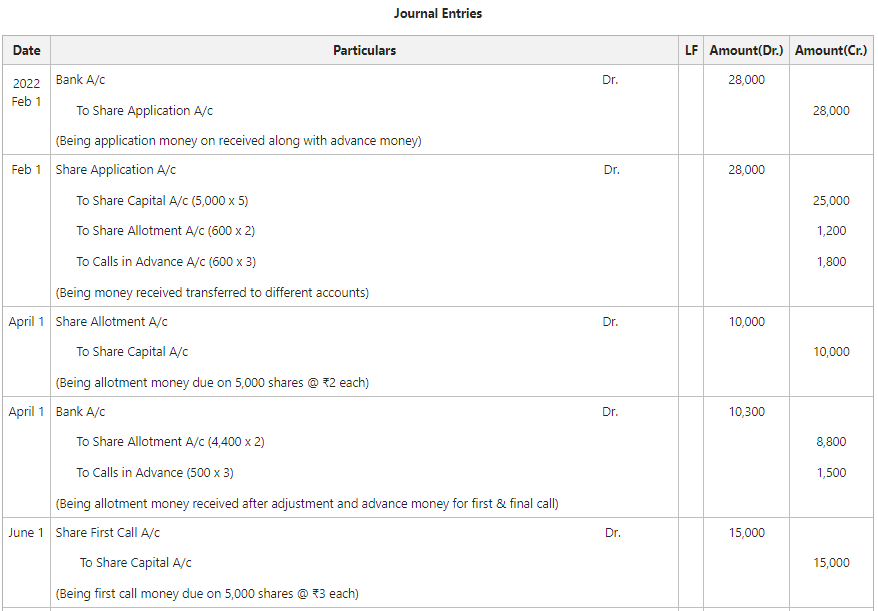
This example also mentions interest on Calls-in-Advance. As per the Companies Act, 2013, if the Articles of Association of a company provide for it, interest (up to 12% p.a.) can be paid on the amount of calls paid in advance. For your exam problems, you only need to calculate this if the question specifically asks you to.
Test your understanding!
X Ltd. issued 20,000 shares of ₹10 each. It received applications for 35,000 shares.
A group of applicants for 15,000 shares was allotted 10,000 shares on pro-rata basis. The excess money was to be adjusted against allotment and calls.
The share was payable as: Application ₹3, Allotment ₹4, First & Final Call ₹3.
Calculate the amount that will be transferred to:
- Share Allotment A/c
- Calls-in-Advance A/c
Show answer
-
Calculate Excess Application Money:
- Applications from the group: 15,000
- Shares allotted to the group: 10,000
- Excess applications: 15,000 - 10,000 = 5,000 shares
- Total Excess Money: 5,000 shares × ₹3 (application money) = ₹15,000
-
Amount to be Adjusted against Allotment:
- Allotment money due for this group: 10,000 shares × ₹4 (allotment money) = ₹40,000
- Since the excess money (₹15,000) is less than the allotment due (₹40,000), the entire excess amount will be adjusted against allotment.
- Amount transferred to Share Allotment A/c = ₹15,000
-
Amount to be Adjusted against Calls:
- After adjusting for allotment, there is no surplus left (₹15,000 excess - ₹15,000 used for allotment = ₹0).
- Amount transferred to Calls-in-Advance A/c = ₹0
In this case, the excess money was not large enough to cover the allotment and spill over into calls.
Conclusion
You have now added a powerful tool to your accounting skill set for company accounts. You can confidently handle situations where a company is so popular that shareholders pay for their shares far in advance!
Key Takeaways:
- When excess application money from a pro-rata allotment exceeds the amount due on allotment, it may be adjusted against future calls if the question specifies.
- The amount held for future calls is credited to a liability account: Calls-in-Advance A/c.
- The key journal entry is the transfer of application money, which will now include a credit to
Calls-in-Advance A/c. - When the actual call is made,
Calls-in-Advance A/cis debited in the receipt entry to show that the cash was already received.
In our next lesson, we will shift gears and look at the opposite scenario: undersubscription. We will learn what it means and how it affects the accounting process for issuing shares.