Introduction
Hello! Welcome back. In our last lesson, we mastered the journal entries for issuing shares at par and at a premium. We followed the money through each stage: application, allotment, and calls. You're now comfortable with the standard eight-entry process.
Today, we tackle a very common and important real-world scenario: oversubscription. What happens when the public's demand for a company's shares is so high that they apply for more shares than the company is offering? This is a sign of a strong company, but it creates an accounting puzzle.
Our goal for this lesson is to learn how to account for oversubscription of shares, including pro-rata allotment and partial refunds. You will learn the three main strategies a company can use and how to record the corresponding journal entries. This is a critical concept for your Grade 12 syllabus and frequently appears in exams.
What is Oversubscription and How Do Companies Handle It?
Oversubscription occurs when the number of shares applied for by the public is greater than the number of shares issued by the company. For example, if a company offers 10,000 shares but receives applications for 15,000 shares, the issue is oversubscribed by 5,000 shares.
A company cannot allot more shares than it has offered. So, what does it do with the excess applications and the extra money received? The board of directors has three main options:
- Rejection of Excess Applications: Accept some applications in full and completely reject the rest, refunding their application money.
- Pro-Rata Allotment: Allot shares proportionally to all applicants. No one gets the full amount they applied for, but everyone gets some shares. The excess application money is then used to pay for the allotment stage.
- Combination: A mix of the first two options, where some applications are rejected outright, and the remaining applicants are allotted shares on a pro-rata basis.
Let's dive into the accounting for each of these scenarios. The following video provides an excellent, step-by-step guide through each one. We will watch it in parts as we cover each case.
How to Solve Oversubscription ? Use of PRO - RATA | Issue of Shares - Part 5 | Class 12 | Accounts
To start, let's get an overview of oversubscription and these three options. Watch the introductory part of this video by CA Parag Gupta.
Watch from the beginning until 04:07. The instructor will clearly define oversubscription and lay out the three scenarios we are about to explore: Rejection, Pro-rata, and a Combination.
Scenario 1: Rejection of Excess Applications
This is the simplest approach. The company decides which applications to accept in full (up to the limit of shares offered) and rejects the rest. The application money received from the rejected applicants is returned in full.
The key change to our journal entries happens when we transfer the application money to share capital.
- Bank A/c Dr. To Share Application A/c: This entry is for the total application money received, even from the applicants who will be rejected. So, if applications for 15,000 shares were received, you calculate the amount based on 15,000.
- Share Application A/c Dr. ...: This is the crucial entry. You will debit the total application money, but the credit side will be split:
To Share Capital A/c: For the application money of the shares you actually allotted.To Bank A/c: To account for the money being refunded to the rejected applicants.
Let's see this in action.
How to Solve Oversubscription ? Use of PRO - RATA | Issue of Shares - Part 5 | Class 12 | Accounts
Now, let's continue with the same video to see how to account for the first scenario.
Watch the segment from 04:07 to 15:44. Focus on 'Example 1'. Pay close attention to the second journal entry, where the excess application money is refunded by crediting the Bank Account.
As you saw, all subsequent entries for allotment and calls are completely normal, calculated on the number of shares actually issued (10,000 in the example). The oversubscription only affects the application stage entries.
Scenario 2: Pro-Rata Allotment
"Pro-rata" means "in proportion." Instead of rejecting applicants, the company allots shares to them in a fixed ratio. For example, if 15,000 applications are received for 10,000 shares, the ratio is 10,000:15,000, or 2:3. This means for every 3 shares an investor applied for, they are allotted 2.
What about the excess application money? Since these applicants are now shareholders, the company doesn't refund the money. Instead, it holds onto it and adjusts it against the amount due on allotment.
The journal entries change as follows:
- Bank A/c Dr. To Share Application A/c: Same as before, for the total money received.
- Share Application A/c Dr. ...: The credit side now looks different:
To Share Capital A/c: For the application money of the shares allotted.To Share Allotment A/c: For the excess application money that will be adjusted against the allotment amount.
- Bank A/c Dr. To Share Allotment A/c: When you receive the allotment money, you will receive less than the total amount due, because some of it has already been paid via the excess application money.
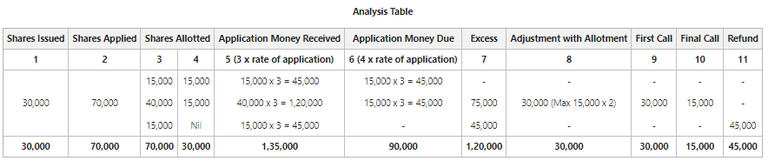
To handle the calculations, accountants often use a working table or an "Analysis Table." This helps systematically track the money received, due, excess, and adjusted.
How to Solve Oversubscription ? Use of PRO - RATA | Issue of Shares - Part 5 | Class 12 | Accounts
Let's see how pro-rata allotment and the adjustment of excess money works. The video explains this with 'Example 2' and introduces a very helpful analysis table.
Watch from 15:44 to 42:25. This is a longer segment, so focus on: The meaning of a pro-rata ratio (e.g., 3:2). The 'special working' table used to calculate the 'Excess Money' and how much is 'Adjusted' towards allotment. The journal entries, especially how To Share Allotment A/c is used in the second entry and how the amount received for allotment in the fourth entry is reduced.
Scenario 3: Combination of Rejection and Pro-Rata
This is the most comprehensive and realistic scenario. The company might reject some applicants entirely (e.g., very small applications) and then allot shares on a pro-rata basis to the remaining pool of applicants.
The accounting for this simply combines the logic of the first two scenarios. The main journal entry for transferring application money will have credits to all three accounts:
Share Application A/c Dr.(Total money received)To Share Capital A/c(Application money for shares allotted)To Bank A/c(Money refunded to rejected applicants)To Share Allotment A/c(Excess money from pro-rata applicants adjusted towards allotment)
Let's watch the final example, which brings everything together.
How to Solve Oversubscription ? Use of PRO - RATA | Issue of Shares - Part 5 | Class 12 | Accounts
This final segment on 'Example 3' will demonstrate the combination approach.
Watch from 42:25 to 1:00:10. Observe how the analysis table is used for the pro-rata category, and how the second journal entry now includes both a refund (To Bank A/c) and an adjustment (To Share Allotment A/c).
The Analysis Table: A Key Tool
As you saw in the videos, for complex oversubscription problems, especially those involving a combination approach, an Analysis Table is invaluable. It helps you organize your calculations and avoid errors. Here is what a typical table looks like:
Test your understanding!
A Ltd. issued 50,000 shares of ₹10 each. Applications were received for 80,000 shares. The directors decided to handle the applications as follows:
- Applicants for 20,000 shares were rejected.
- Applicants for 60,000 shares were allotted 50,000 shares on a pro-rata basis.
The money was payable as: ₹3 on Application, ₹4 on Allotment.
Calculate the amount of money that will be received on allotment.
Show answer
-
Total Allotment Money Due:
- 50,000 shares × ₹4 per share = ₹2,00,000
-
Excess Application Money from Pro-Rata Group:
- Shares applied for: 60,000
- Shares allotted: 50,000
- Excess applications: 10,000 shares
- Excess application money received: 10,000 shares × ₹3 per share = ₹30,000
-
Amount Received on Allotment:
- Total Due - Excess Adjusted = Amount Received
- ₹2,00,000 - ₹30,000 = ₹1,70,000
The company will receive ₹1,70,000 in cash when the allotment money is collected.
Conclusion
Today, we've untangled the complexities of oversubscription. You now have a systematic framework to handle any scenario a company might choose.
Key Takeaways:
- Oversubscription means demand for shares exceeds supply.
- Companies can handle this by rejecting applications, making a pro-rata allotment, or a combination of both.
- The key accounting treatment happens in the second journal entry, where excess application money is either:
- Refunded (
To Bank A/c). - Adjusted against the next installment (
To Share Allotment A/c).
- Refunded (
- For complex problems, always use an Analysis Table to organize your calculations for each category of applicant.
In our next lesson, we will continue exploring the nuances of share issues. We'll learn how to account for Calls-in-Advance, which is what happens when the excess application money from a pro-rata allotment is so large that it covers not only the allotment but also future calls.