Welcome back! In our last lesson, we gave a face and a story to our target audience by creating the buyer persona "Creative Carla." We now have a clear picture of who we are trying to reach. The logical next question for any marketer is: What do we want them to do?
This lesson tackles that question head-on. We'll move from understanding our audience to defining our purpose. You will learn how to write clear, actionable marketing objectives using the powerful SMART framework. This is a crucial skill that transforms marketing from a series of random activities into a focused, strategic plan where every action is tied directly to a business goal. Without this, you risk spending time and money on efforts that don't move the needle.
By the end of this lesson, you will be able to write SMART marketing objectives for a sample brand, ensuring your marketing efforts are purposeful and measurable.
From Vague Wishes to Concrete Goals
In marketing, it's easy to start with fuzzy ideas: "I want more website visitors," "We need to grow our Instagram," or "Let's increase brand awareness." While the intention is good, these statements are not effective goals. Why? Because they lack clarity. How many more visitors? By when? How will you know if your "brand awareness" has actually improved?
This is where the SMART goal framework comes in. It's a simple but powerful mnemonic that forces you to add the necessary detail to turn a vague wish into an actionable plan.
The HubSpot Marketing channel has a great video that breaks down this concept. It walks through the process of taking a general objective and refining it, step-by-step, into a full-fledged SMART goal.
How to Set SMART Goals for Your Business (Guide)
This video, "How to Set SMART Goals for Your Business," provides a clear and practical introduction to the framework, explaining each component with a running example.
Please watch from the explanation of the acronym to the end of the walkthrough. As you watch, pay close attention to how the initial goal—"get more engagement to generate leads"—is progressively sharpened at each step of the SMART process.
To summarize the video's points, a SMART goal must be:
- S - Specific: Clearly state what you want to achieve. Who is involved? What are the actions? Why is it important?
- M - Measurable: Include numbers to quantify success. How will you know when you've reached your goal?
- A - Attainable: Be realistic. Is the goal challenging but possible given your time, budget, and resources?
- R - Relevant: Ensure the goal matters. Does it align with the larger objectives of the business?
- T - Time-bound: Set a deadline. When do you want to achieve this goal?
This simple chart offers a great at-a-glance summary of what to do—and what to avoid—for each letter of the framework.

The Crucial Link: Business Goals vs. Marketing Objectives
One of the most important aspects of the SMART framework is Relevance. A marketing objective is only useful if it supports a larger business goal. It's easy to get distracted by "vanity metrics" like likes or followers, but if those metrics don't contribute to the health of the business, they are a waste of effort.
- Business Goals are the high-level targets for the entire company. They are usually tied to revenue, profitability, or market share.
- Example: Increase overall company revenue by 20% this year.
- Marketing Objectives are the specific, measurable outcomes that the marketing team must achieve to help the business reach its goals.
- Example: Generate 500 qualified sales leads in the first half of the year.
Every marketing objective should have a clear line of sight to a business goal. The following reading explains this critical distinction and shows how to connect the two.
9 Exclusive Examples of SMART Goals in Digital Marketing
This article from Women Conquer Biz does an excellent job of clarifying the hierarchy between business goals and the marketing goals that support them.
Please read the section titled "Business Goals vs. Digital Marketing Goals". The example provided perfectly illustrates how specific marketing goals (like publishing blog posts) directly support a broader business goal (increasing coaching revenue).
To see this connection in action, here's a very short clip from another HubSpot video. The speaker quickly connects a high-level business goal (increasing subscriptions) to specific marketing actions and metrics.
How To Create a Marketing Campaign (FREE Template)
This clip from "How To Create a Marketing Campaign" provides a concise, real-world example of linking a business goal to marketing tactics.
Watch from "Let's go back to my goal". Notice how the business goal—increasing cookie box subscriptions by 30%—is directly supported by a marketing objective to generate 50 new leads via an Instagram campaign and email opt-in.
Your Turn: Crafting a SMART Objective
Now, let's put this all into practice. We'll return to our hypothetical business, "The Daily Grind" coffee shop, and our persona, "Creative Carla."
Imagine the owner has set a clear business goal: Increase total revenue by 15% in the fourth quarter (Q4).
The marketing team has an idea to help achieve this. They want to encourage repeat business from existing customers. Their initial, vague marketing goal is:
"Get people to sign up for our new loyalty program."
Your task is to transform this vague goal into a robust SMART objective. The template below provides guiding questions for each step of the process.
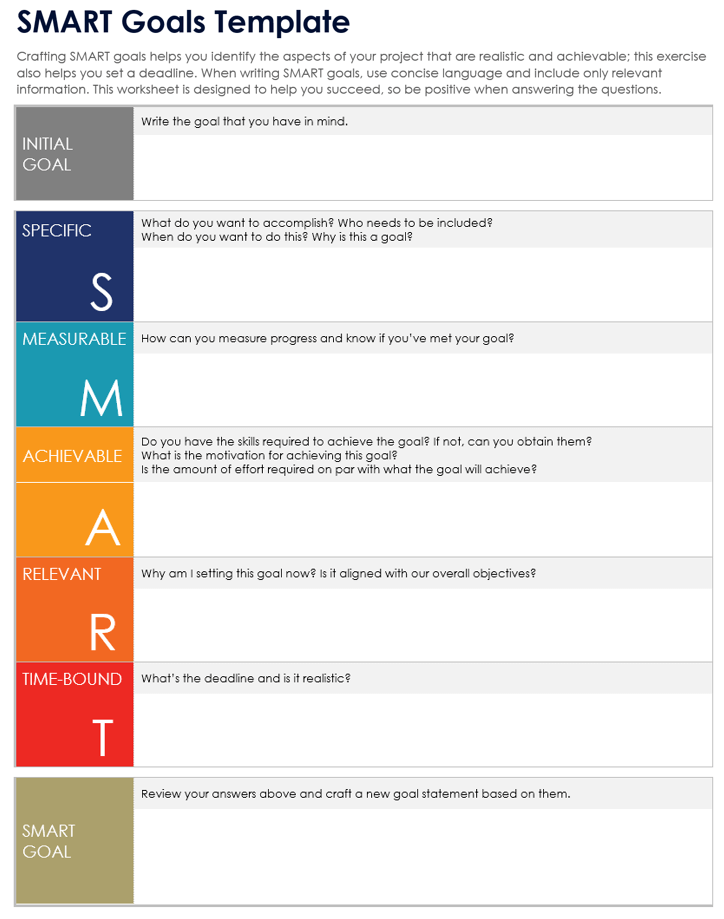
Let's use this template to refine the goal for "The Daily Grind."
-
Initial Goal: Get people to sign up for our new loyalty program.
-
Specific:
- What do you want to accomplish? Acquire new members for the loyalty program.
- Who needs to be included? We'll target existing customers like "Creative Carla" in-store.
- When do you want to do this? In Q4.
- Why is this a goal? To increase customer retention and repeat purchases.
-
Measurable:
- How can you measure progress? By tracking the number of new sign-ups.
- Let's set a target: Let's aim to acquire 250 new members.
-
Achievable:
- Do you have the skills/resources? Yes, the baristas can promote it, and we can print a simple QR code for sign-ups.
- Is the goal realistic? 250 members in 3 months for a single coffee shop is ambitious but possible if we offer a compelling incentive, like a free coffee upon signing up.
-
Relevant:
- Why are you setting this goal now? It directly supports the Q4 business goal of a 15% revenue increase.
- Is it aligned with overall objectives? Yes, a loyalty program is a classic strategy to boost customer lifetime value and revenue.
-
Time-bound:
- What's the deadline? The end of Q4 (e.g., December 31st).
- Is it realistic? A 3-month window gives us enough time to promote the program and see results.
Now, combine these answers into a single, powerful statement. Take a moment to write your own version before looking at the example below.
Example SMART Objective:
Acquire 250 new members for "The Daily Grind" loyalty program by the end of Q4, by promoting it in-store with a QR code and a "free coffee on sign-up" offer, to increase customer retention and help achieve the business goal of a 15% revenue increase.
See the difference? This objective is no longer a vague wish. It's a clear, actionable, and measurable plan that anyone on the team can understand and execute.
Conclusion
Today, you've learned one of the most fundamental skills in strategic marketing: how to set proper goals. By moving beyond vague aspirations and embracing the SMART framework, you ensure that your marketing efforts are focused, accountable, and aligned with what truly matters to the business.
Key Takeaways:
- Vague goals like "increase traffic" are ineffective. Effective objectives require clarity and detail.
- The SMART framework—Specific, Measurable, Attainable, Relevant, and Time-bound—is the standard for creating actionable goals.
- Every marketing objective must be Relevant to a broader business goal. Always ask how your marketing efforts contribute to revenue, profit, or other key business outcomes.
- The process involves defining the business goal, identifying a supporting marketing objective, and then using the SMART criteria to add the necessary detail.
In our next lesson, we will zoom in on the "M" in SMART—Measurable. Now that we've set a goal like "acquire 250 new members," we need to know how to track our progress. We will define the essential Key Performance Indicators (KPIs) that digital marketers use every day, such as Click-Through Rate (CTR), Cost Per Acquisition (CPA), and Return on Ad Spend (ROAS).