Hello again! In our last lesson, we took a broad look at a brand's potential customers and learned how to segment them into specific groups using demographics, psychographics, and behaviors. That process gave us a clear, data-driven picture of our ideal customer profile.
Today, we'll take that profile and bring it to life. This lesson is all about turning abstract data into a concrete, practical tool: the buyer persona. You will learn how to build a basic buyer persona document for a sample business. This is a fundamental skill in marketing that transforms how you think about your audience, moving from "who are they?" to "who is she?" or "who is he?". It's the key to creating marketing that feels personal, empathetic, and truly effective.
From Audience Profile to Buyer Persona
In our previous session, we built an audience profile. A buyer persona is the next evolutionary step. It's a semi-fictional character you create to represent a key segment of your target audience. Instead of just a list of attributes, you give this character a name, a face, and a story. This simple act of humanization is incredibly powerful.
How to create detailed buyer personas for your business ...
This HubSpot article provides an excellent definition and clearly illustrates the difference between a simple demographic profile and a rich buyer persona.
Please read the introductory section of the article, from the beginning down to the comparison image. Pay close attention to how "Marketing Manager Maria" is described—it's a perfect example of moving from data to a person.
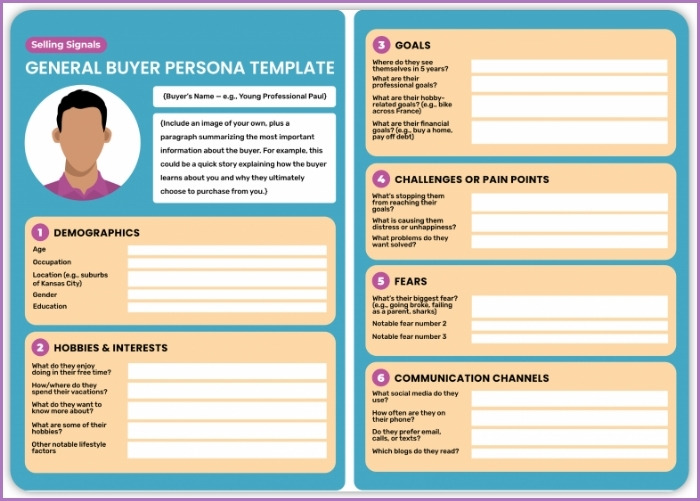
To visualize what we're aiming to create, here is a common template for a buyer persona. It organizes all the crucial information into a single, easy-to-understand document.
The Core Components of a Persona
While templates vary, all strong personas are built on a few core pillars. These should feel very familiar, as they are direct extensions of the segmentation principles we learned last lesson. We'll explore five key elements.
A fantastic video from the marketing agency Exposure Ninja breaks these down with clear, real-world examples. Watching how brands like Google, The Ordinary, and Avaron target different personas will make these concepts stick.
How To Design the PERFECT Buyer Persona
The video "How To Design the PERFECT Buyer Persona" provides a memorable framework for what to include in your persona document.
Please watch the following segments. As you watch, notice how each component adds another layer of depth to the customer's character. Demographics: This is the "who" we discussed in the last lesson. "Towards" Motivations: This covers their goals and aspirations. What are they trying to achieve? "Away From" Motivations: This explores their fears, challenges, and pain points. What are they trying to avoid? Online Habits: This is a behavioral component, focusing on where they spend their time online. Quote Library: This adds a human voice and summarizes the persona's mindset.
By combining these five elements, you create a multi-dimensional character that your whole team can understand and rally behind. You're not just marketing to "women aged 25-34"; you're creating content for "Sustainable Sarah," who values ethical consumption and gets her information from Instagram.
How to Gather the Information
This is where theory meets practice. A persona is only as good as the research behind it. You can't just invent these details. Fortunately, there are many practical ways to gather this information, even as a beginner.
The methods fall into two main categories:
- Internal Research: Using data you already have access to.
- External Research: Actively seeking new information from customers and prospects.
The HubSpot article and the Exposure Ninja video you just watched both provide excellent, actionable steps for this research process.
How to create detailed buyer personas for your business ...
This section of the HubSpot article provides a practical, step-by-step guide to gathering the necessary data. It's a great roadmap for your research.
Read through the five steps, from "Step 1" to "Step 5". Focus on understanding the difference between quantitative data (like website analytics) and qualitative research (like customer interviews).
To complement the reading, let's return to the Exposure Ninja video, which offers some clever and accessible research tactics.
How To Design the PERFECT Buyer Persona
The second half of the Exposure Ninja video is dedicated to practical ways to collect persona information.
Please watch the segment from "how do you actually get this stuff?" This part is packed with hands-on tips, from using Reddit and Quora for insights to conducting simple customer interviews.
Your Turn: Build a Basic Persona
Now it's time to put it all together. Let's create a buyer persona for a hypothetical business: "The Daily Grind," a new, independent coffee shop focused on sustainable, ethically sourced beans and providing a quiet space for remote workers and students.
Below is a finished persona for a different company to show you what a complete, professional-looking document can look like.

Now, using the information we've gathered from our hypothetical coffee shop, let's build a persona. Your task is to take the raw data points below and organize them into a persona document. You can structure it like the "General Buyer Persona Template" shown earlier.
Raw Data for "The Daily Grind" Coffee Shop:
- Name: Let's call her "Creative Carla."
- Demographics: 29 years old, female, lives in a downtown apartment, works as a freelance graphic designer, has an income of around $65,000/year.
- Hobbies & Interests: Enjoys visiting art galleries, practices yoga, reads fiction, and follows local artists and sustainability bloggers on Instagram.
- Goals:
- To find a "third place" outside of her home and office to work and relax.
- To support local businesses that align with her values (sustainability, ethics).
- To discover high-quality, single-origin coffee.
- Challenges / Pain Points:
- Feels that large coffee chains are impersonal and lack quality.
- Struggles to find quiet spots with reliable Wi-Fi to work for a few hours.
- Is wary of "greenwashing" and wants to support genuinely sustainable brands.
- Communication Channels:
- Discovers new places through Instagram and local food blogs.
- Trusts recommendations from friends and peers.
- Checks Google Maps for reviews and photos before visiting a new spot.
- Quote: "I'm tired of noisy, crowded coffee chains. I want a place where the coffee is as good as the atmosphere, and I can feel good about where my money is going."
Take a few minutes to structure this information into a persona document. Don't worry about fancy design; just focus on organizing the categories logically. This exercise is the core of what marketers do when creating personas.
Conclusion
You've now moved from understanding an audience in the abstract to building a tangible, humanized representation of an ideal customer. This is a massive step forward in your journey as a marketer.
Here are your key takeaways from this lesson:
- A buyer persona is a semi-fictional character that represents a segment of your target audience, giving a name, face, and story to your data.
- Strong personas include demographics, goals (towards motivations), challenges (away from motivations), online habits, and a unifying quote or narrative.
- Persona creation is a research-based process, combining existing data (analytics, sales feedback) with new insights (surveys, interviews, social listening).
- The ultimate goal is to create an empathetic tool that helps you make better decisions about your content, products, and overall marketing strategy.
In our next lesson, we will use our understanding of the customer to set clear goals for our marketing efforts. Now that we know who we are talking to with our persona, we'll answer the question: What do we want them to do? This will lead us to the crucial skill of writing SMART marketing objectives.