Hello! In our last lesson, we focused on setting clear, actionable goals using the SMART framework. We established that the "M" for Measurable is crucial—if you can't measure it, you can't manage it. Today, we're diving deep into exactly what you should be measuring.
This lesson introduces the language of digital marketing analytics: Key Performance Indicators, or KPIs. These are the vital signs that tell you whether your marketing efforts are healthy and effective. We will define the six most essential KPIs that every digital marketer, from beginner to expert, uses daily: Click-Through Rate (CTR), Cost Per Click (CPC), Cost Per Acquisition (CPA), Return on Ad Spend (ROAS), Customer Acquisition Cost (CAC), and Customer Lifetime Value (LTV).
By the end of this hour, you'll be able to confidently define these core metrics, understand what they measure, and see how they fit together to paint a picture of marketing performance. This foundational knowledge is the first step toward making data-driven decisions that lead to successful campaigns.
What's a KPI, Anyway?
Before we start throwing around acronyms, let's clarify a fundamental point. You'll hear the words "metric" and "KPI" used often, sometimes interchangeably. However, they aren't quite the same thing, and understanding the difference helps you focus on what truly matters.
Digital Marketing Metrics & KPIs Explained (With Clear Examples) - Responsive MTS
This article from Responsive MTS provides a simple, clear explanation of what KPIs are and why they are so important. It uses a great lemonade stand analogy to distinguish a simple metric from a meaningful KPI.
Start by reading the introduction from the top to understand why tracking matters. Then, focus on the section "The Difference Between Metrics and KPIs". This will solidify the idea that a KPI is a metric that is directly tied to a business goal.
In short: a metric is any number you can measure (e.g., 100 people walked by your store). A KPI is a metric you've chosen to measure progress toward a specific goal (e.g., your goal is 20 sales, and you made 10, so your KPI shows you're 50% of the way there). For a digital marketer, KPIs are the metrics that matter most to the business's success.
KPIs Across the Marketing Funnel
Not all KPIs are equally important at all times. Their relevance often depends on which stage of the customer journey, or "marketing funnel," you're focused on. As we learned in a previous lesson, a customer moves from Awareness, to Engagement (or Consideration), and finally to Conversion. Different KPIs help us measure our success at each stage.
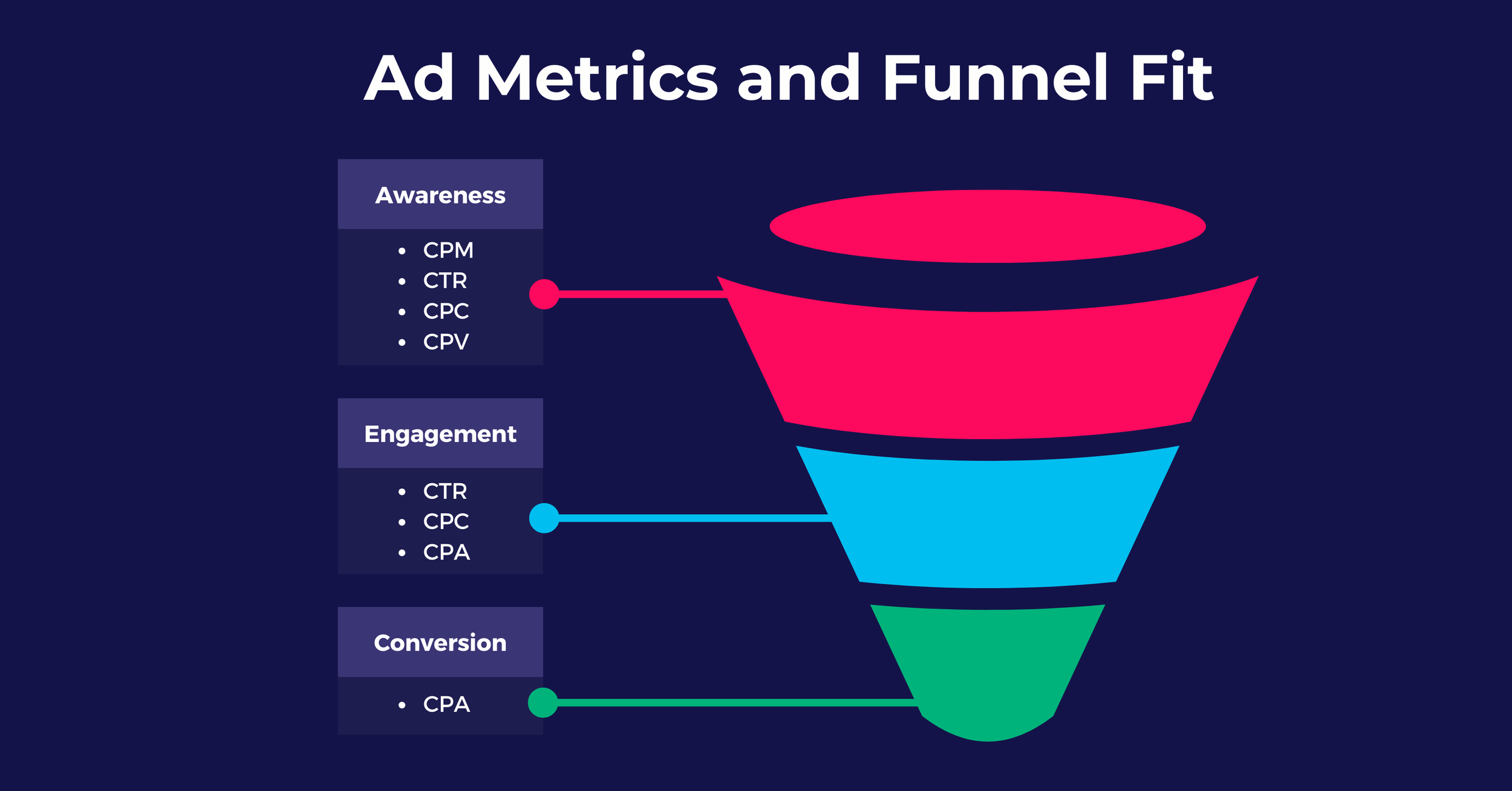
Let's break down the KPIs you need to know, starting from the top of the funnel. For these definitions, we'll refer to a comprehensive guide from Spilno Agency.
ROAS, ROMI, ROI and other key digital marketing metrics: 2026 guide — Spilno Agency
This guide provides concise, professional definitions and formulas for the metrics we're discussing. It's a great resource to bookmark for future reference.
First, read the section on impression and click metrics. Pay close attention to the definitions and formulas for CPC and CTR. Next, read the subsection defining CPA under "Action & conversion metrics".
Top/Middle of Funnel: Measuring Interest
When you first present an ad to someone, you want to know two things: Are they seeing it, and are they interested enough to click?
-
CTR (Click-Through Rate): This is the percentage of people who saw your ad (an impression) and then clicked on it. It’s your first and fastest indicator of whether your ad creative and message are compelling to your target audience.
A high CTR suggests your ad is relevant and engaging. A low CTR might mean your ad isn't grabbing attention, or you're showing it to the wrong people.
-
CPC (Cost Per Click): This is the price you pay each time someone clicks on your ad. This is the fundamental currency of many ad platforms like Google Search. Your goal is usually to get the most valuable clicks for the lowest possible cost.
Bottom of Funnel: Measuring Action
Clicks are good, but they don't pay the bills. You need visitors to take a valuable action, like making a purchase, signing up for a newsletter, or filling out a contact form. This is where CPA comes in.
- CPA (Cost Per Acquisition or Cost Per Action): This is the total cost you paid to get one person to complete a specific, desired action (a "conversion"). This is one of the most important metrics for judging the success of a campaign with a specific goal. If your CPA for generating a sale is higher than the profit you make from that sale, your campaign is losing money.
KPIs for Business Health: Measuring Profitability
While the first three metrics are great for judging campaign performance, the next three help you understand the overall financial health and sustainability of your marketing.
ROAS, ROMI, ROI and other key digital marketing metrics: 2026 guide — Spilno Agency
Let's return to the Spilno Agency guide to define the "big picture" metrics.
First, read the subsection defining ROAS. Note the crucial distinction it makes between revenue and profit. Then, jump to the next major section and read the definitions for LTV and CAC. Pay special attention to how CAC differs from the CPA you just learned about.
-
ROAS (Return on Ad Spend): This is the ultimate measure of ad campaign profitability. It tells you how much revenue you generated for every dollar you spent on advertising.
A ROAS of 4x or 400% means you made $4 in revenue for every $1 you spent on ads. Whether this is "good" depends entirely on your profit margins, a concept the article touches on with "break-even ROAS."
-
CAC (Customer Acquisition Cost): This looks like CPA, but it's broader. While CPA measures the cost of a single action from a specific ad campaign, CAC measures the total average cost to gain one new customer, including all marketing and sales expenses (salaries, tools, agency fees, etc.) over a period.
\text{CAC} = \frac{\text{Total Marketing & Sales Spend}}{\text{New Customers Acquired}} -
LTV (Customer Lifetime Value): This metric forecasts the total net profit your business will make from a single customer over the entire duration of their relationship with you. It answers the question: "How much is a customer worth to us in the long run?" While there are complex ways to calculate it, the simple concept is: (Average Value of a Sale) x (Number of Repeat Transactions) x (Average Retention Time).
The relationship between CAC and LTV is perhaps the most important concept for a sustainable business. For a business to be profitable and grow, your LTV must be significantly greater than your CAC. A common rule of thumb is that the LTV:CAC ratio should be at least 3:1.
A Practical Walkthrough
Let's see how these metrics come together in a real-world scenario. The following video by marketing expert Adam Erhart provides an excellent, step-by-step example of a marketing campaign, calculating the key metrics along the way.
Marketing Analytics 101 (A Beginner’s Guide To Marketing Metrics)
This video, "Marketing Analytics 101," is perfect for seeing how KPIs are calculated and used in practice, moving from initial budget to final ROI.
Watch from the beginning of the example. Follow along as he starts with a budget and goal, and then calculates CPM, CPC, CTR, CPA, conversion rate, revenue, profit, and finally, ROI (which is conceptually similar to ROAS in this context). This practical application will help connect all the definitions you've just learned.
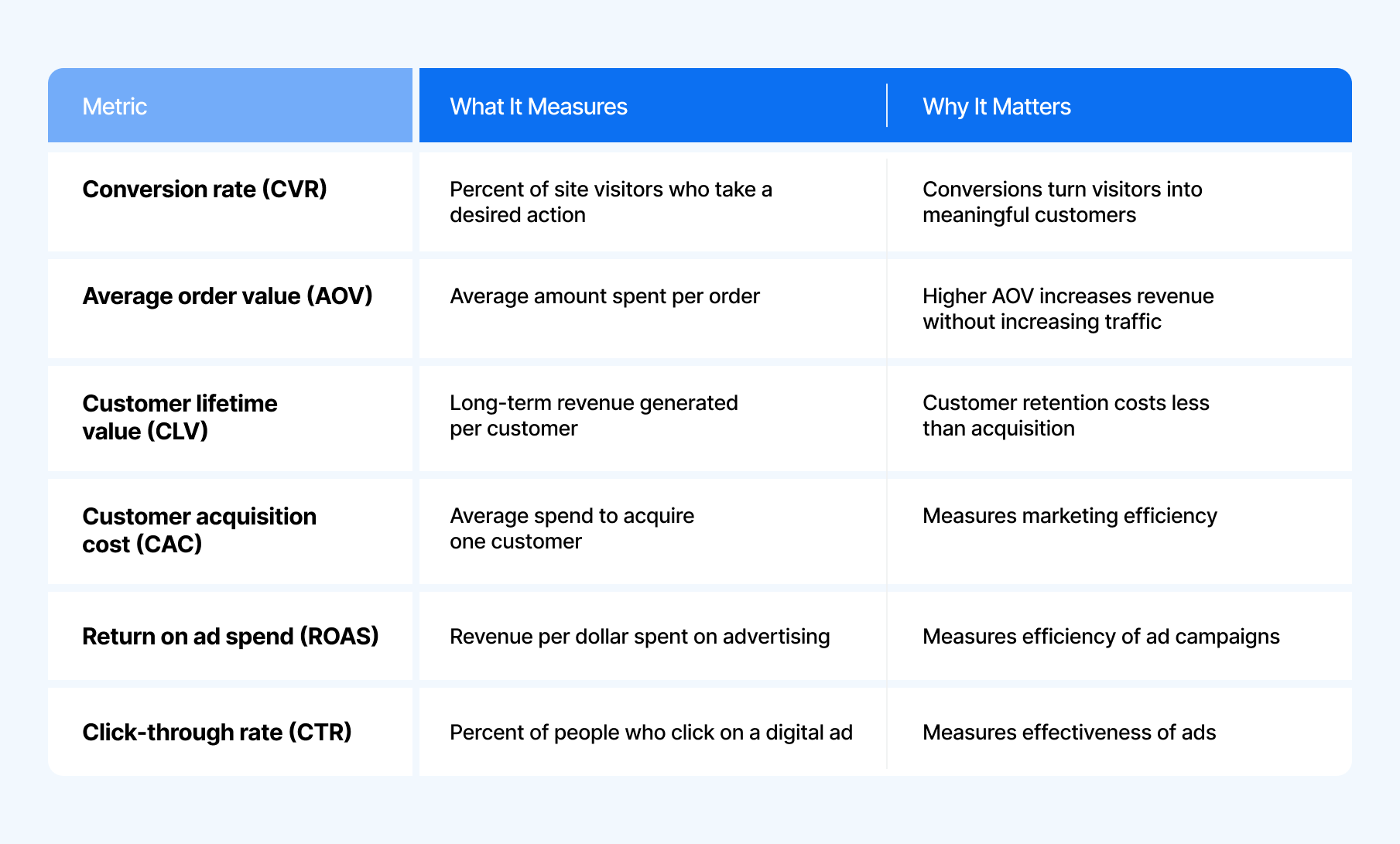
Summary: Your KPI Cheat Sheet
You've just learned the core language of marketing performance. These six acronyms will appear in every report, every analytics dashboard, and every strategic marketing discussion.
Conclusion
Today, we've translated the abstract idea of "measurability" into concrete, defined Key Performance Indicators. You now have the vocabulary to understand and discuss marketing performance like a professional.
Key Takeaways:
- KPIs are metrics tied directly to business goals. They help you focus on what matters.
- CTR & CPC measure the effectiveness of your ads at generating initial interest.
- CPA measures the cost of getting a user to take a valuable action, like a purchase or sign-up.
- ROAS measures the direct revenue return from your ad spend, telling you if a campaign is profitable.
- CAC & LTV are "big picture" metrics that determine the long-term, sustainable health of your business. The golden rule is LTV > CAC.
In our next lesson, we'll move from defining these KPIs to actually calculating them. You'll be given sample data in a spreadsheet and will get hands-on practice calculating ROAS, CAC, and LTV yourself, putting today's theory into direct, practical use.