Hello! Welcome back to our module on cultivating a high-performance mindset.
In our last lesson, we defined the crucial difference between a fixed mindset (the belief that abilities are static) and a growth mindset (the belief that abilities can be developed). You learned to distinguish between these two fundamental beliefs and saw how they lead to different goals—either to look smart or to learn.
Today, we'll explore the direct consequences of these mindsets. We will focus on our learning outcome: to explain how mindset affects effort, response to feedback, and resilience after setbacks. This lesson gets to the heart of why mindset is a cornerstone of performance psychology, connecting the underlying belief to the specific behaviors that drive success or stagnation.
1. Mindset and the Meaning of Effort
How do you view effort? Is it a necessary tool for growth, or is it a sign that you lack natural talent? Your answer likely depends on your mindset.
- Fixed Mindset: Views effort as a negative. The core belief is, "If I was truly smart or talented, I wouldn't need to try so hard." Effort exposes a perceived lack of innate ability, making it feel threatening.
- Growth Mindset: Views effort as the primary mechanism for activating and growing ability. The belief is, "Effort is what makes me smarter and more skilled." Effort is the path to mastery, not a sign of deficiency.
This difference in perspective has profound implications. To see how, let's look at how these mindsets create entirely different goals.
Why Mindset Matters | STANFORD magazine
The following excerpt from an article in STANFORD magazine, 'Why Mindset Matters', vividly illustrates how a focus on performance (fixed mindset) versus learning (growth mindset) changes a person's entire approach to a task.
Please read the section that begins 'She continued to do so as an assistant professor...' and ends with '...each mistake becomes a chance to learn.' Pay close attention to the distinction between 'learning goals' and 'performance goals.'
As the article describes, people with a fixed mindset adopt performance goals. Their main objective is to prove their ability and avoid looking incompetent. As a result, they may shy away from difficult tasks that require significant effort, as the struggle itself could damage their self-image.
In contrast, those with a growth mindset adopt learning goals. Their priority is to increase their competence. They see effortful tasks not as threats, but as the very experiences needed to grow and flourish. As Dweck's research showed, one student might even exclaim, "I love a challenge!" because a challenge signals an opportunity to learn.
2. Mindset and Response to Feedback
Feedback is essential for improvement, but how we receive it depends entirely on our mindset. Since a fixed mindset is invested in protecting a static self-image, it interprets critical feedback as a personal attack. A growth mindset, however, sees feedback as valuable information for development.
One of the most powerful ways to see this in action is to examine how praise—a form of feedback—shapes behavior. The type of praise we receive (and give ourselves) can either reinforce a fixed mindset or cultivate a growth one.
How Feedback Affects Performance - Andrew Huberman - Growth Mindset
Neuroscientist Andrew Huberman provides an excellent breakdown of a landmark study by Carol Dweck and Claudia Mueller. This research reveals the surprising and powerful effect that different types of praise have on performance and motivation.
Please watch the following clips from the video 'How Feedback Affects Performance': 02:23 - 03:40: Listen for the distinction between feedback tied to identity (e.g., 'you're smart') and feedback tied to effort (e.g., 'you tried hard'). 04:47 - 06:06: Understand the difference between intelligence feedback (labels like 'smart') and effort feedback (verbs like 'persisted'). 06:06 - 08:24: Pay close attention to the study's results. Notice how the two groups responded differently when offered a choice between easy and hard problems. 08:24 - 11:11: Observe the striking finding about how the two types of praise directly impacted subsequent performance on problem sets.
The findings from this research are critical for understanding how to build a high-performance mindset:
- Intelligence Praise ("You're so smart"): This feedback, tied to a fixed identity, made children fragile. They became more interested in preserving the "smart" label than in learning.
- They chose easier problems to guarantee success and avoid risking failure.
- Their actual performance declined after hitting a difficult patch.
- They enjoyed the tasks less and were even more likely to misrepresent their scores.
- Effort Praise ("You worked so hard"): This feedback, tied to a controllable process, made children resilient.
- They chose harder problems that would allow them to learn more.
- Their performance significantly improved as they applied more effort.
- They showed more persistence and enjoyment.
This shows that when you operate from a fixed mindset, negative feedback is a verdict on your character. When you operate from a growth mindset, all feedback—positive or negative—is simply data you can use to adjust your strategy and effort.
3. Mindset and Resilience After Setbacks
Setbacks are inevitable on any path to achieving something meaningful. Resilience is the ability to bounce back from these setbacks, and mindset is the engine of resilience.
A fixed mindset views failure as a devastating verdict. It says, "I failed, therefore I am a failure." This leads to what Dweck calls the "tyranny of now"—a feeling of being permanently defined by a single moment of struggle.
A growth mindset, however, reframes failure through the "power of not yet." It interprets a setback not as a final judgment, but as an indicator of your current position on a learning curve. Failure simply means you have not yet mastered the skill.
Let's hear Carol Dweck explain this concept and the different reactions to failure it produces.
Developing a Growth Mindset with Carol Dweck
In this clip from her talk, 'Developing a Growth Mindset,' Carol Dweck introduces the 'power of not yet' and contrasts the behaviors of students with fixed versus growth mindsets when they encounter difficulty.
Watch from the beginning of the video to 02:11. Notice the specific, non-resilient behaviors that a fixed mindset triggers after failure (cheating, social comparison, avoiding difficulty).
As Dweck highlights, the response to failure is starkly different:
- Fixed Mindset Response (Not Resilient):
- Give up or avoid the task in the future.
- Become defensive and blame others or the circumstances.
- Engage in ego-saving behaviors like cheating or finding someone who did worse to feel better about oneself.
- Growth Mindset Response (Resilient):
- Increase effort and persist.
- Analyze mistakes and search for new strategies.
- Seek help and feedback.
- Embrace the challenge as informative and motivating.
This link between mindset and resilience is so strong that psychologists David Yeager and Carol Dweck argue that these beliefs create entirely different psychological worlds for students.
Mindsets That Promote Resilience
To solidify the connection between mindset and resilience, let's read a short section from a key research paper, 'Mindsets That Promote Resilience.' This explains exactly how the two mindsets create different frameworks for interpreting academic life.
Please read the section titled 'Why Do Implicit Theories of Intelligence Affect Academic Resilience?' which starts with 'Students’ implicit theories of intelligence predict...' and ends with '...and/or become defensive)'. This passage synthesizes how a mindset impacts goals, beliefs about effort, and learning strategies.
Summary: Two Mindsets, Two Paths
We've seen how a simple belief about the nature of ability can create a cascade of different behaviors. This image provides a clear, concise summary of how a fixed vs. growth mindset plays out in response to the very factors we've discussed today.
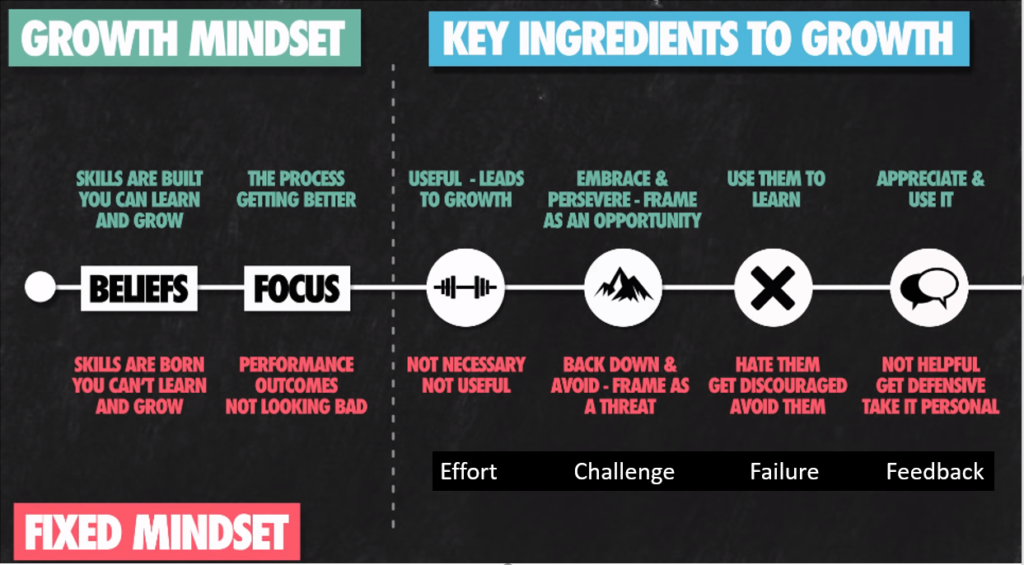
Take a moment to review the chart. See how the core belief (left column) directly leads to the different approaches to effort, challenges (setbacks), and feedback (right column). This is the engine of performance in action.
Conclusion
Today, we moved from defining mindsets to analyzing their powerful effects. You now have a science-backed explanation for how your internal beliefs about ability directly influence your actions and, ultimately, your results.
Key Takeaways:
- Mindset and Effort: A fixed mindset sees effort as a sign of weakness, leading to avoidance of difficult tasks. A growth mindset sees effort as the path to mastery, leading to an embrace of challenges.
- Mindset and Feedback: A fixed mindset treats feedback as a judgment, causing defensiveness. A growth mindset treats feedback as valuable data for improvement, fostering a desire to learn from criticism.
- Mindset and Resilience: A fixed mindset interprets setbacks as a final verdict, leading to helplessness. A growth mindset views setbacks through the "power of not yet," promoting persistence and strategic adjustments.
Preview of the Next Lesson:
Having established the power of your belief about ability in general, we will next explore a related and equally important belief: your confidence in your ability to execute specific tasks. In the next lesson, we will define self-efficacy and explain its four sources. This will give you another powerful tool for understanding and building the confidence needed to tackle your goals.