Hello! Welcome back to our module on cultivating a high-performance mindset.
In our last lesson, we explored how your fundamental belief about whether ability is fixed or can be developed—your mindset—shapes your approach to effort, feedback, and setbacks. We saw that a growth mindset is the foundation for resilience and learning.
Today, we'll build on that by examining a more specific type of belief: self-efficacy. While mindset is your general theory about ability, self-efficacy is your confidence in your capability to execute a specific task to achieve a desired outcome. This concept, developed by psychologist Albert Bandura, is a cornerstone of performance psychology because it directly predicts whether you'll even attempt a challenge, how much effort you'll invest, and how long you'll persist.
Our learning outcome for this lesson is to define self-efficacy and explain its four sources: mastery experiences, vicarious experiences, verbal persuasion, and physiological states. Understanding these sources will give you a practical framework for systematically building the confidence required to achieve your goals.
1. What is Self-Efficacy?
Self-efficacy isn't a vague feeling of self-worth or general self-confidence. It's a highly specific judgment about your ability to perform a particular action in a given situation. For example, you might have very high self-efficacy for preparing a presentation but very low self-efficacy for coding a website.
To get a clear understanding of this concept, let's watch a short video that defines self-efficacy and illustrates its task-specific nature.
This video from the channel Brett D. Jones provides a clear, academic definition of self-efficacy using a concrete example involving basketball.
Please watch the clip from 01:50 to 03:14. Pay close attention to how self-efficacy is defined as a perceived capability for performing an action at designated levels.
As the video explains, self-efficacy is your personal answer to the question, "Can I do this?" Your belief about your capabilities profoundly influences your motivation. If your self-efficacy for a task is low, you are less likely to invest your full effort because, consciously or not, you might think, "Why bother if I don't believe I can succeed anyway?" Conversely, a strong sense of self-efficacy fuels motivation and persistence, especially when difficulties arise.
2. The Four Sources of Self-Efficacy
So, where does this critical belief come from? Albert Bandura identified four main sources that shape our self-efficacy. Understanding these allows you to be an architect of your own confidence, rather than a passive observer of it.

Let's get a concise video overview of these four sources before we dive deeper into each one.
The same video now explains the four factors that influence our self-efficacy beliefs.
Now, watch the segment from 03:14 to 05:56. The video walks through each of the four sources: actual performances, vicarious experiences, social persuasion, and physiological indexes.
Now that you have an overview, let's explore each source in more detail. We will use the article "Self-Efficacy: Bandura's Theory Of Motivation In Psychology" from Simply Psychology, which provides excellent, in-depth explanations.
Source 1: Mastery Experiences
Bandura stated that mastery experiences are the single most powerful source of self-efficacy. Nothing convinces you of your capabilities more effectively than your own past successes.
Self-Efficacy: Bandura's Theory Of Motivation In Psychology
This section of the article explains why direct, personal success is the most influential factor in building self-efficacy and how overcoming challenges makes this belief even stronger.
Please read the section titled '1. Mastery Experiences (Performance Outcomes).' Notice the critical point that successfully navigating setbacks can build more resilient self-efficacy than if you never faced difficulty at all.
This connects directly to our previous lesson on growth mindset. To gain mastery experiences, you must be willing to take on challenges and apply effort. Each time you persist and succeed—especially after a struggle—you provide yourself with irrefutable proof of your capability, creating a powerful positive feedback loop.
Source 2: Vicarious Experiences
The second source is observing others. When you see someone similar to you succeed at a task, it raises your own belief that you can do it, too.
Self-Efficacy: Bandura's Theory Of Motivation In Psychology
Next, let's explore how watching role models can build our confidence.
Read the section '2. Vicarious Experiences (Social Role Models).' Pay close attention to the factors that make this experience most effective, particularly the similarity to the model.
The key takeaway is that the more you can relate to the person you're observing, the greater the impact on your self-efficacy. Finding relatable role models or peers who have navigated the path you're on can be a powerful way to build belief before you've accumulated your own mastery experiences.
Source 3: Verbal Persuasion
Verbal persuasion involves receiving encouragement and positive feedback from others. Think of a coach, mentor, or friend telling you, "You've got this."
Self-Efficacy: Bandura's Theory Of Motivation In Psychology
While less powerful than direct experience, verbal persuasion can be a crucial factor in motivating you to put in the effort needed to succeed.
Read the section titled '3. Verbal Persuasion.' Note the conditions that make encouragement effective: it must be realistic, genuine, and come from a credible source.
Empty praise can be counterproductive, but realistic encouragement that highlights your actual progress or capabilities can provide the motivational push needed to persist through a tough spot, increasing the chances of achieving a mastery experience.
Source 4: Emotional and Physiological States
The final source is your own physical and emotional state. How you interpret your body's signals when facing a task can significantly raise or lower your self-efficacy.
Self-Efficacy: Bandura's Theory Of Motivation In Psychology
This last section explains how your interpretation of feelings like anxiety or excitement impacts your belief in your ability to perform.
Read section '4. Emotional and Physiological States.' The central idea here is that it's not the feeling itself, but your interpretation of it, that matters.
For someone interested in performance, this is a critical lever. The physical sensations of high-stakes performance—a racing heart, sweaty palms—can be interpreted as debilitating anxiety ("I'm going to fail") or as energizing excitement ("I'm ready"). Learning to reframe these signals is a key skill in performance psychology.
3. A Model for Performance
These four sources don't operate in isolation. They combine to create your overall sense of self-efficacy for a task, which then influences your behavior and, ultimately, your performance.
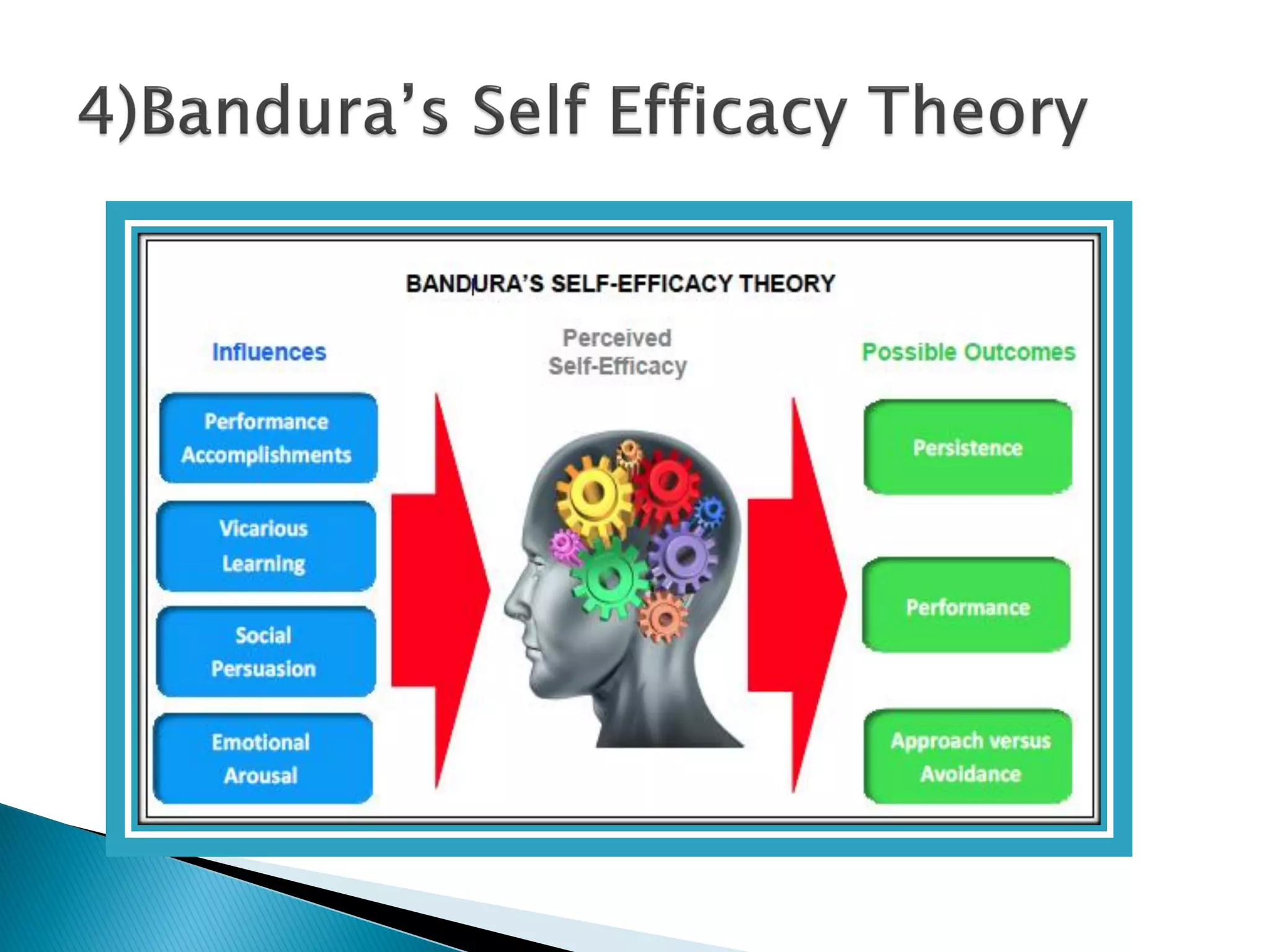
This model shows the practical pathway:
- Influences: You receive information from your own performance, watching others, hearing feedback, and your internal physical state.
- Perceived Self-Efficacy: You process this information to form a belief about your capability for the specific task at hand.
- Outcomes: This belief then directly impacts your actions. If self-efficacy is high, you're more likely to approach the task, persist in the face of obstacles, and perform at a higher level. If it's low, you're more likely to avoid the task, give up easily, and perform poorly.
Reflection
Think of a skill where you feel highly confident today (e.g., a sport, a video game, an academic subject). Can you trace your confidence back to the four sources?
- What were your key mastery experiences?
- Did you have any vicarious experiences (watching friends, family, or experts)?
- Did you receive any memorable verbal persuasion?
- How did you learn to interpret the physiological states associated with performing that skill?
Conclusion
Today, we've added another crucial concept to your mindset toolkit. You now understand that self-efficacy is a task-specific belief in your ability to succeed, and you know the four sources from which this belief is built. This knowledge transforms confidence from a mysterious trait into a skill that can be systematically developed.
Key Takeaways:
- Self-Efficacy is specific: It is the belief in your capacity to execute a particular task, not a general sense of self-worth.
- It has four primary sources: These are mastery experiences, vicarious experiences, verbal persuasion, and physiological/emotional states.
- Mastery is most powerful: The most effective way to build self-efficacy is by accumulating successes through effort and persistence.
- You can be an architect of your confidence: By strategically seeking out mastery experiences, finding relatable models, soliciting useful feedback, and reframing your body's signals, you can actively increase your self-efficacy for any goal you choose.
Preview of the Next Lesson:
We've now covered your beliefs about ability in general (mindset) and your beliefs about your specific capabilities (self-efficacy). Next, we will examine another core belief system: locus of control. We will differentiate between an internal and external locus of control and explore its profound impact on your sense of personal agency and responsibility for your own outcomes. This will add another layer to your understanding of the psychology of high performance.