Hello! Welcome to the first lesson in our new module, "Cultivating a High-Performance Mindset."
In our previous module, we focused entirely on the mechanics of behavior and habit formation—the actions you take. We learned how to make good habits obvious, attractive, and easy. But to achieve immense and lasting results, your actions must be supported by the right underlying beliefs. This is where mindset comes in.
Today's lesson addresses the foundational concept of this module. Our learning outcome is to distinguish between a fixed mindset and a growth mindset. This distinction, pioneered by Stanford psychologist Carol Dweck, is one of the most powerful ideas in performance psychology. Understanding it will change how you view your abilities, your challenges, and your entire potential for growth.
1. The Two Mindsets: An Introduction
At the core of Dweck's research is a simple but profound idea: the beliefs we hold about our own abilities and intelligence dramatically shape our lives. These beliefs fall into two categories: a "fixed mindset" and a "growth mindset."
To get a clear and articulate definition of these two opposing views, let's start with a short reading.
Fixed vs. Growth: The Two Basic Mindsets That Shape Our Lives
This article, 'Fixed vs. Growth: The Two Basic Mindsets That Shape Our Lives,' provides one of the clearest introductions to Carol Dweck's work. It lays out the core definitions that we will build upon throughout this module.
Please read the first several paragraphs of the article, from the beginning down to the line '...that it’s impossible to foresee what can be accomplished with years of passion, toil, and training.' Focus on understanding the fundamental belief that underpins each mindset.
As the article explains:
- A Fixed Mindset is the belief that your qualities, like intelligence or talent, are static, unchangeable traits. You have a certain amount, and that's it. This leads to an urgent need to prove yourself and avoid failure at all costs, as failure is seen as a direct measure of your innate (and limited) ability.
- A Growth Mindset is the belief that your basic abilities can be developed through dedication and hard work. This view sees challenges as opportunities for growth and failure not as a verdict on your intelligence, but as a springboard for learning.
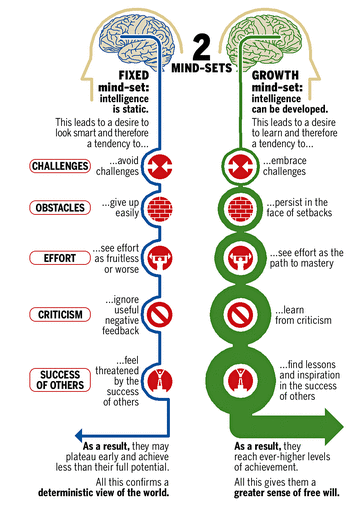
Here is a helpful visual summary of the key differences, which we will return to later in the lesson.
2. Exploring the Mindsets in Action
Definitions are useful, but seeing how these mindsets play out in real situations makes the concept truly click. The following video provides excellent animated explanations and examples.
Growth Mindset vs Fixed Mindset | Mindset by Carol Dweck
This video, 'Growth Mindset vs Fixed Mindset', summarizes Carol Dweck's book and does an excellent job of explaining not only what the mindsets are, but also how they might develop and how they affect our reactions to challenges.
Please watch from the beginning to 03:59. Pay close attention to: The clear definitions of each mindset (0:00 - 1:09). The discussion of how a fixed mindset leads to ego protection, avoidance of challenges, and a fear of failure (1:33 - 3:59).
The video highlights a critical point: individuals with a fixed mindset are primarily concerned with one question in any situation: "Will I look smart or dumb?" Their goal is to validate their existing ability. In contrast, those with a growth mindset are more interested in "How can I learn and get better?" Their goal is to develop their ability.
3. The Science and the "Power of Yet"
To deepen your understanding of the "why," let's hear from the source herself, Dr. Carol Dweck. In this talk, she explains the origin of her research and introduces two powerful concepts: the "power of not yet" and the neurological difference between the two mindsets.
Developing a Growth Mindset with Carol Dweck
In this famous talk, Carol Dweck shares the key findings from her research, including fascinating studies with children that reveal the stark differences in how the two mindsets approach difficulty.
Please watch the following three clips: 00:05 - 00:45: Understand the concept of 'Not Yet' as a frame for being on a learning curve. 00:45 - 01:47: Observe the different reactions to difficult problems between children with growth vs. fixed mindsets. 02:11 - 02:44: See the brain activity evidence. Notice how the growth mindset brain 'fires up' when processing errors, indicating active learning.
Dweck's research provides the scientific backing you're interested in. The brain scan evidence is particularly compelling. It shows that a growth mindset isn't just a feel-good platitude; it corresponds to a tangible difference in how the brain engages with mistakes. People with a growth mindset actively process errors, learn from them, and correct them. People with a fixed mindset tend to ignore errors, effectively shutting down the learning process to protect their ego.
4. Distinguishing the Mindsets: A Summary
Let's consolidate everything we've learned by revisiting the infographic from earlier and breaking it down. This table summarizes the core distinctions between the two mindsets when faced with common situations.
| Aspect | Fixed Mindset | Growth Mindset |
|---|---|---|
| Core Belief | My abilities are static and unchangeable. | My abilities can be developed through effort and learning. |
| Goal | Look smart at all costs. Validate my inherent talent. | Learn and grow. Stretch my existing abilities. |
| Challenges | Avoid them. They risk revealing a lack of ability. | Embrace them. They are opportunities to improve. |
| Obstacles | Give up easily. Obstacles are a sign I'm not good enough. | Persist in the face of setbacks. Obstacles are part of the process. |
| Effort | See it as fruitless or a sign of weakness. "If I have to try, I must not be smart." | See it as the path to mastery. "Effort is what makes me smart." |
| Criticism | Ignore or get defensive in response to useful feedback. | Learn from it. See feedback as valuable information for growth. |
| Success of Others | Feel threatened by it. It highlights my own perceived limits. | Find lessons and inspiration in it. |
A Moment for Self-Reflection
Think back on your own experiences, perhaps in school, sports, or a hobby.
- Can you recall a specific instance where you approached a situation with a fixed mindset? What was the situation, and how did you react to the challenge or feedback?
- Now, can you recall a time you approached a situation with a growth mindset? What was different about your attitude and your actions?
You don't need to write anything down, but take a minute to identify these moments in your own life. Recognizing these mindsets in yourself is the first step toward consciously choosing the more productive one.
Conclusion
Today, we established the crucial distinction between a fixed and a growth mindset. This is not just a personality quirk; it's a fundamental belief system that dictates how you approach every aspect of your performance journey.
Key Takeaways:
- Fixed Mindset: Believes abilities are "carved in stone." This leads to a focus on proving one's talent, avoiding challenges, and seeing effort as a sign of deficiency.
- Growth Mindset: Believes abilities can be cultivated. This fosters a passion for learning, an embrace of challenges, and views effort as the key to mastery.
- This difference is observable even at a neurological level, with growth-minded individuals showing greater brain engagement when learning from errors.
Preview of the Next Lesson:
Now that you can clearly distinguish between the two mindsets, our next lesson will explore their direct consequences. We will answer the question: How does mindset affect effort, response to feedback, and resilience after setbacks? We'll move from defining the beliefs to analyzing their powerful impact on the behaviors that drive high performance.