Hello! Welcome back to our second module on understanding and harnessing motivation.
In our last lesson, we explored Self-Determination Theory and its three universal psychological needs: autonomy, competence, and relatedness. We established that when these needs are met, we experience high-quality, intrinsic motivation. This provides a powerful framework for understanding the internal conditions that fuel our drive.
Today, we'll investigate a fascinating and counterintuitive phenomenon that occurs when the outside world gets involved. What happens when you start rewarding someone for an activity they already love to do? Logic might suggest it would supercharge their motivation, but the reality is often the opposite.
This lesson addresses the learning outcome: Explain the 'overjustification effect' where external rewards can undermine intrinsic motivation. Understanding this effect is critical for anyone looking to optimize long-term performance, as it reveals a hidden trap in how we often try to motivate ourselves and others.
Part 1: Defining the Overjustification Effect
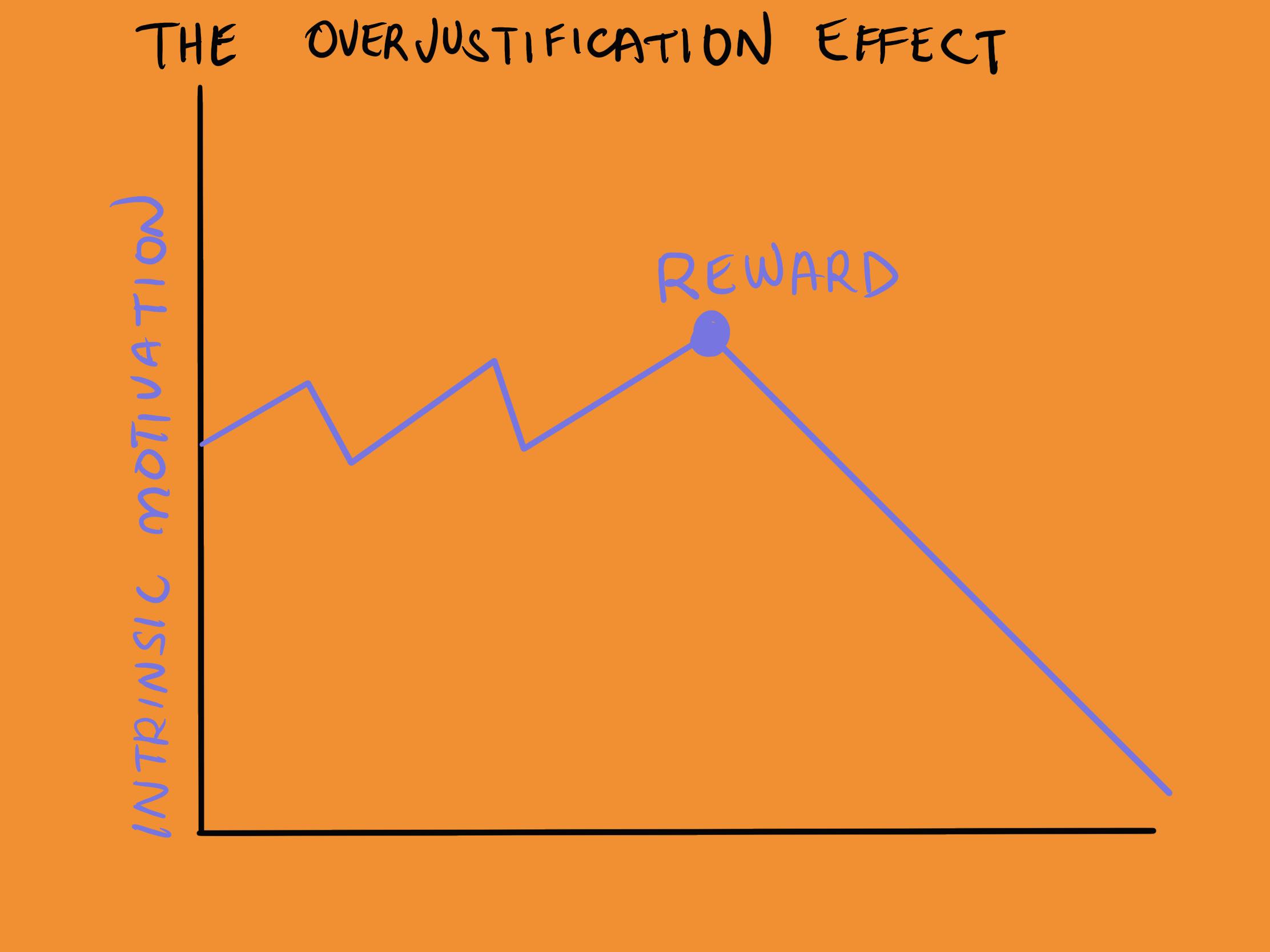
Let's start with a clear definition. The overjustification effect is a psychological phenomenon where offering an expected external incentive (like money, prizes, or grades) for an activity that is already intrinsically rewarding can lead to a decrease in that person's intrinsic motivation to perform the task.
In simple terms, when you start getting paid for your hobby, the "play" can start to feel like "work." The joy you once got from the activity itself gets replaced by a focus on the reward. When the reward is removed, the original passion often doesn't return.
This graph provides a simple visual for this concept.
To get a more detailed introduction, please read the first few paragraphs of the following article.
Overjustification Effect: Psychology, Examples, and Impact
This article from Neurolaunch provides a very accessible and engaging explanation of the overjustification effect.
Please read the section titled 'Understanding the Overjustification Effect: More Than Just a Mouthful'. Focus on the definition and the 'fish swimming for a prize' analogy.
Part 2: The Classic Experiment: Drawing for Rewards
This effect isn't just a theory; it's backed by decades of research. One of the most famous early studies was conducted in 1973 by Mark Lepper, David Greene, and Richard Nisbett with a group of preschool children who enjoyed drawing.
The following video explains this classic experiment and its striking results.
Intrinsic & Extrinsic Motivations (Intro Psych Tutorial #167)
This video from PsychExamReview clearly breaks down the 1973 study that first demonstrated the overjustification effect.
Please watch from 00:57 to 03:56. Pay close attention to the three phases of the experiment (baseline, reward, post-reward) and what happened to the amount and quality of the children's drawing in each phase.
As you saw, the results were clear:
- Baseline: The children enjoyed drawing during their free time.
- Reward Phase: When offered a "Good Player Award," drawing activity increased, as expected. However, the quality and creativity of the drawings declined; the children were just focused on getting the reward.
- Post-Reward: When the awards were discontinued, the children who had been rewarded now spent less time drawing than they did at the very beginning. Their intrinsic motivation had been "crowded out" by the external reward.
Part 3: The "Why" - Psychological Mechanisms
This brings us to the core question you are interested in: why does this happen? The explanation connects directly back to our last lesson on Self-Determination Theory. The overjustification effect is primarily a story about a loss of autonomy.
Let's look at two key theories that explain this process.
Overjustification Effect: Psychology, Examples, and Impact
The Neurolaunch article we looked at earlier also does an excellent job of explaining the psychological gears behind the effect. We'll revisit it to understand the 'why'.
Please read the section titled 'The Psychological Gears Behind the Overjustification Machine'. Focus on the explanations from Cognitive Evaluation Theory and Self-Perception Theory.
Let's break down those two explanations:
-
Cognitive Evaluation Theory (A sub-theory of SDT): This theory suggests that we interpret rewards in two ways: as feedback on our competence or as an attempt to control our behavior. When a reward is seen as controlling ("You are doing this because I am paying you"), it thwarts our fundamental need for autonomy. The perceived reason for the activity shifts from an internal one ("I do this because I want to") to an external one ("I do this to get the reward"). This shift undermines intrinsic motivation.
-
Self-Perception Theory: This theory proposes that we infer our own attitudes by observing our own behavior. When you see yourself engaging in an activity only when a reward is present, you might conclude, "I must not really enjoy this activity for its own sake; I'm just doing it for the reward." You justify your behavior by attributing it to the external reward ("overjustification"), thereby discounting your original intrinsic interest.
Part 4: Important Nuances and Exceptions
The overjustification effect is powerful, but it doesn't happen every time a reward is offered. Understanding the exceptions is key to applying this knowledge effectively.
The following animated video provides a quick, clear look at when the effect applies and when it doesn't.
How to get motivated even when you don’t feel like it
This TED-Ed video uses a different example (military cadets) to illustrate the effect and clearly outlines an important exception.
Please watch from 03:18 to 04:32. Notice the key distinction it makes between tasks that are already motivating and those that are tedious.
Here are the key conditions that determine whether a reward will undermine motivation:
- Initial Interest: The effect only occurs when there is pre-existing intrinsic motivation to undermine. If a task is boring or uninteresting to begin with (like doing laundry), offering an external reward is a perfectly good strategy to get it done. There's no intrinsic motivation to damage.
- Expectation: Unexpected rewards generally do not harm intrinsic motivation. If you receive a surprise bonus after completing a project you enjoyed, you don't reinterpret your motivation because you didn't do the work in order to get the reward. The damage is done when the reward is expected and becomes the primary reason for action.
- Type of Reward:
- Tangible rewards (money, prizes, things) are most likely to be perceived as controlling and thus damaging to autonomy.
- Verbal rewards (praise, positive feedback), on the other hand, can often increase intrinsic motivation. This is because praise, when delivered sincerely, supports the need for competence—it tells you you're good at something. The key is that the praise should feel informational ("You found a really creative solution"), not controlling ("You did it exactly how I wanted you to").
Part 5: Real-World Implications for Peak Performance
Understanding the overjustification effect is not just an academic exercise; it has direct implications for how you should structure your work and goals to achieve the "immense results" you're aiming for.
- In Your Career/Projects: Be mindful of turning passions into professions. While getting paid for what you love is a common goal, it's crucial to protect your sense of autonomy. Focus on aspects you can control, seek projects that allow for creativity, and remind yourself of the intrinsic reasons you started in the first place, beyond the paycheck.
- In Education and Skill-Building: If you are learning something new that you genuinely find interesting, be careful about focusing too much on grades or certifications. These external validators can shift your focus from the joy of learning and mastery to simply "passing the test."
- In Motivating Yourself: If you're trying to build a habit or tackle a project you enjoy, don't make the reward the centerpiece. Instead of saying "If I code for an hour, I get to watch TV," try to focus on the intrinsic rewards of the activity itself—the satisfaction of solving a problem, the feeling of flow, or the pride in creating something. Save extrinsic rewards for tasks you truly find unpleasant.
Conclusion
Today we've uncovered a crucial paradox of motivation. While external rewards seem like a straightforward tool to boost behavior, they can be a double-edged sword.
Key Takeaways:
- The overjustification effect describes how expected, external rewards can decrease intrinsic motivation for an already enjoyable task.
- This happens because the reward can undermine our psychological need for autonomy, shifting our perceived reason for the activity from internal satisfaction to external control.
- The effect is strongest for expected, tangible rewards on tasks that are already intrinsically interesting.
- The effect does not typically apply to uninteresting tasks, unexpected rewards, or verbal praise that supports competence.
You now have a more nuanced understanding of the delicate interplay between our internal drives and external incentives.
In our next and final lesson of this module, we will bring everything together. You will apply the principles of Self-Determination Theory to analyze the motivational sources behind one of your own personal goals, creating a practical strategy to enhance your long-term drive.