Hello! Welcome back to our module on motivation.
In our last lesson, we established the crucial difference between intrinsic motivation (doing something for its own sake) and extrinsic motivation (doing something for a separate outcome). You reflected on activities in your own life that are driven by each of these forces. This distinction is the first step in understanding the complex engine of human drive.
Today, we dive deeper into the "why" you were keen to understand. Why are some activities intrinsically motivating while others feel like a chore? The answer lies in a powerful framework called Self-Determination Theory (SDT). Our learning outcome for this lesson is to explain the three core psychological needs in Self-Determination Theory: autonomy, competence, and relatedness. Fulfilling these universal needs is the secret to unlocking sustained, high-quality motivation and achieving the kind of performance you're aiming for.
Part 1: An Introduction from the Source
Self-Determination Theory, developed by psychologists Edward Deci and Richard Ryan, is one of the most respected and empirically supported theories of motivation today. It proposes that our motivation isn't just about amount (more vs. less), but about type.
To get an introduction to the theory from one of its creators, let's watch a short video featuring Dr. Edward Deci himself.
Edward Deci - Self-Determination Theory
In this video from The Brainwaves Video Anthology, Dr. Edward Deci introduces the core ideas of Self-Determination Theory. He'll start by reinforcing the distinction from our last lesson (using the terms 'autonomous' and 'controlled' motivation) and then introduce the three basic needs.
Please watch the video from the beginning until 04:52. As you watch, focus on: How he describes autonomous motivation (the feeling of willingness and choice) versus controlled motivation (feeling pressured or demanded). His definition of the three basic psychological needs that he argues are universal for all humans.
As Dr. Deci explained, SDT is built on two key ideas:
- The crucial difference is between autonomous motivation (which aligns with intrinsic motivation) and controlled motivation (which aligns with extrinsic motivation).
- All humans, regardless of culture, have three innate and universal psychological needs. When these needs are satisfied, we experience autonomous motivation, well-being, and better performance. When they are thwarted, our motivation and mental health suffer.
Let's now break down each of these three needs in more detail.
Part 2: The Three Universal Psychological Needs
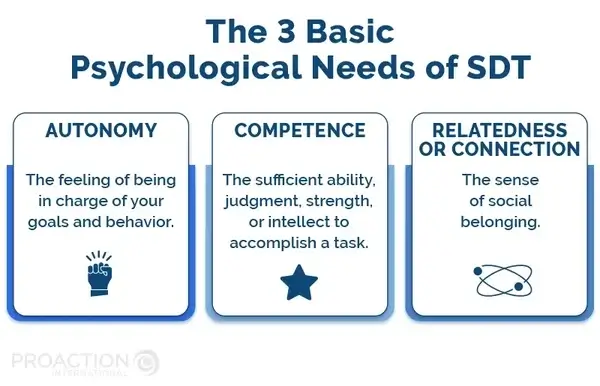
The three core needs of SDT are Autonomy, Competence, and Relatedness. Think of them as the essential psychological nutrients for growth and motivation, similar to how a plant needs water, sunlight, and soil.
This image provides a great visual summary of the three needs, which we will now explore one by one.
For a clear set of written definitions, we'll draw from The Decision Lab, a publication that specializes in breaking down concepts from behavioral science.
Self-Determination Theory - The Decision Lab
This brief excerpt from The Decision Lab's article on Self-Determination Theory provides clear and concise definitions for each of the three needs.
Please read the three numbered points that define Autonomy, Relatedness, and Competence. These definitions are short and direct.
Now, let's elaborate on each one.
1. Autonomy
- What it is: The need to feel you are the causal agent of your own life, acting in harmony with your values and interests. It’s the feeling of volition, choice, and self-endorsement of your actions.
- Why it matters for performance: When you feel autonomous, you "own" your actions. This sense of ownership is the difference between enthusiastically pursuing a goal you set for yourself and grudgingly completing a task someone else assigned to you. High autonomy leads to greater persistence, creativity, and deeper engagement.
- Example: Imagine you need to write an essay. If the teacher assigns a rigid topic you find boring, your need for autonomy is thwarted. If, instead, you are allowed to choose a topic that genuinely interests you within the subject, your need for autonomy is satisfied, and your motivation to write a great essay will likely be much higher.
2. Competence
- What it is: The need to feel effective in your interactions with the environment. It’s the sense of mastery, of being capable, and of developing your skills and abilities.
- Why it matters for performance: We are motivated by activities where we feel we can succeed and make progress. Feeling incompetent is a major source of procrastination and avoidance. The satisfaction of overcoming a challenge and seeing your skills improve is a powerful intrinsic reward.
- Example: When learning a new video game, you start with simple tasks. As you master them (feeling competent), the game presents slightly harder challenges. This "challenge-skill balance" keeps you engaged for hours because it continuously satisfies your need for competence.
3. Relatedness
- What it is: The need to feel connected to, and cared for by, others. It’s the sense of belonging and mattering to a group or another individual.
- Why it matters for performance: While it might seem less direct, relatedness is crucial. Feeling part of a supportive team, having a mentor who believes in you, or even working towards a goal that will help others can be a profound source of motivation. Feeling isolated or like an outsider can drain your mental energy and drive.
- Example: You might push yourself harder in a team sport than you would training alone because you don't want to let your teammates down, and you share the joy of victory with them. That sense of shared purpose and connection fuels your effort.
Part 3: Your Turn to Analyze
Understanding these needs intellectually is the first step. The next is to recognize them in your own life. Doing so gives you a powerful diagnostic tool to understand your own motivational state.
To see the importance of these needs, consider what happens when they are not met. The following short clip illustrates this well.
Self-Determination Theory Explained
This animated video from Sprouts provides a clear example of how motivation breaks down when the three needs are frustrated.
Please watch from 01:44 to 02:11. Notice how the character Anton's motivation plummets because his needs for competence and autonomy are not being met.
Now, let's apply this to your own experience.
Exercise: Diagnosing Your Motivation
Take a few minutes to reflect and write down your thoughts on the following prompts.
-
A Time of High Motivation:
- Think of a specific project, hobby, or period in your life where you felt incredibly motivated, engaged, and energized.
- Describe the situation briefly.
- Analyze it through the lens of SDT: How were your needs for Autonomy, Competence, and Relatedness being satisfied in that situation? Be specific. (e.g., "When preparing for my debate competition, I had autonomy in choosing my arguments, I felt my competence grow with each practice round, and I felt a strong sense of relatedness with my debate partner.")
-
A Time of Low Motivation (Amotivation):
- Think of a task or situation where you felt completely unmotivated, disengaged, or even resistant.
- Describe the situation briefly.
- Analyze it through the lens of SDT: Which of the three needs were being thwarted or unfulfilled? How? (e.g., "In my required math class, I felt I had no autonomy over the pace, my need for competence was thwarted because I felt constantly confused, and I didn't feel any relatedness to the teacher or the subject matter.")
This exercise will help you move from simply knowing the theory to using it as a practical framework for understanding what drives you.
Conclusion
Today we explored the core of Self-Determination Theory. You now have a scientifically-backed model to explain the "why" behind intrinsic motivation.
Here are your key takeaways:
- Self-Determination Theory (SDT) states that high-quality, autonomous motivation arises when our three universal psychological needs are met.
- The three needs are:
- Autonomy: The need for volition and control over our own actions.
- Competence: The need to feel effective and master challenges.
- Relatedness: The need for social connection and belonging.
- When these needs are supported, we thrive. When they are thwarted, our motivation and well-being decline.
You now understand the internal conditions necessary for intrinsic motivation. In our next lesson, we will examine how external factors can impact these needs. Specifically, we will explore the 'overjustification effect,' a fascinating phenomenon where offering external rewards (like money or prizes) for an already enjoyable activity can paradoxically decrease your intrinsic motivation by undermining your sense of autonomy.