Hello! Welcome to the first lesson in our module on Strategic Goal Setting.
In our last module, we established a strong foundation in the science of motivation. We used Self-Determination Theory to understand that the quality of our motivation—the 'why' behind our goals—is critical for sustained effort and well-being. We learned that fostering autonomy, competence, and relatedness helps shift our drive from being controlled by external factors to being genuinely self-determined.
Now, we move from the 'why' of motivation to the 'what' and 'how' of effective goals. If motivation is the engine, then a well-defined goal is the steering wheel, directing that energy toward a specific destination. Your ambition to achieve "immense results" requires not just powerful drive, but also precision targeting.
Today, we will address a cornerstone principle of performance psychology. Our learning outcome is to: Explain why specific, challenging goals outperform vague or easy goals, citing relevant research.
We will explore the foundational Goal-Setting Theory and examine the psychological and even physiological mechanisms that make this principle so powerful.
1. The Core Principle: Specificity and Challenge
For decades, researchers have studied what makes a goal effective. The most consistent and powerful finding is that goals that are both specific and challenging lead to significantly higher performance than goals that are vague (e.g., "do your best") or easy.
To begin, let's go straight to the source of this insight. The foundational research in this area comes from psychologists Edwin Locke and Gary Latham.
Locke and Latham's Five-Principle Framework for Goal Setting
This article summarizes Locke and Latham's key findings after decades of research into what makes goals effective.
Please read the section under the heading 'Key Findings By Locke and Latham.' Focus on the two points: 'There is a linear relation between goal difficulty and performance' and 'Specific, difficult goals lead to higher performance than vague, “do best” goals.'
As the reading states, this isn't a small effect. In some studies, performance for those with difficult goals was over 250% higher than for those with the easiest goals.
But why is "do your best" so ineffective? Because it's ambiguous. It provides no clear target to aim for and no standard against which to measure progress. A specific, high goal eliminates this ambiguity and clarifies what success looks like.
Let's see this principle in a real-world context.
[PDF] The Motivational Benefits of Goal-Setting
To see this principle in action, let's look at a classic study described by one of the theory's founders, Gary Latham. This short text illustrates the dramatic difference between telling people to 'do your best' versus giving them a specific, challenging target.
Read the section titled 'Applications of Goal-Setting Theory,' which details the study with pulpwood producers. Pay attention to how a specific goal transformed the workers' experience of their task and their subsequent productivity.
The pulpwood logger study is a perfect illustration. The specific, high goal didn't just increase productivity; it instilled a sense of purpose, challenge, and meaning into a task that was previously seen as tedious. This is the power of a well-defined objective.
2. The Mechanisms: How Do Goals Exert Their Influence?
So, we know that specific, difficult goals work. But how do they actually influence our behavior and focus our minds? Locke and Latham identified four specific psychological mechanisms.
Locke and Latham's Five-Principle Framework for Goal Setting
Now we'll dig into the 'why'. This next section from the same article breaks down the four distinct ways that goals affect our performance.
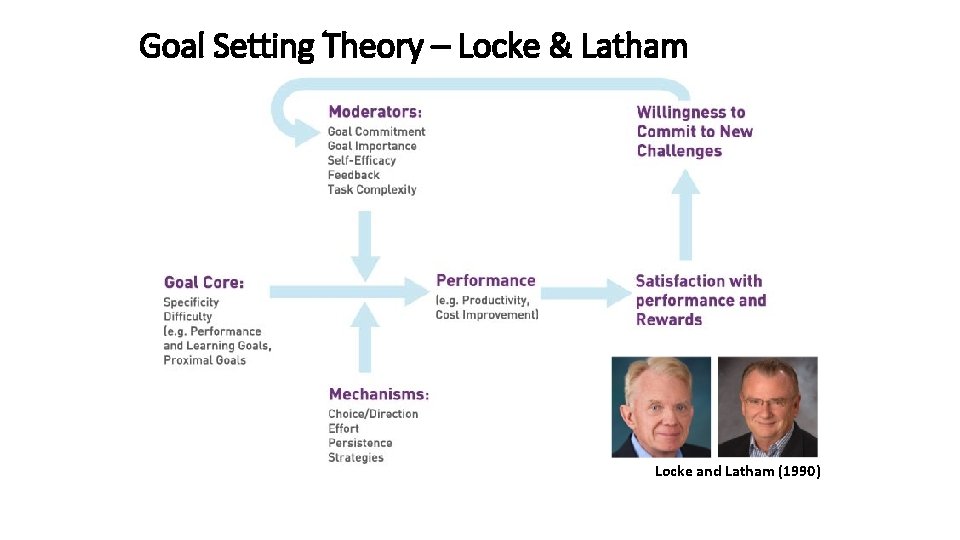
Read the section 'How Goals Affect Performance' to understand the four mechanisms: the directive function, the energizing function, how goals affect persistence, and how they affect action.
Let's break down these four mechanisms:
- Directive Function: Goals act like a spotlight. They direct our attention and effort toward goal-relevant activities and away from distractions. A specific goal tells your brain exactly what to focus on.
- Energizing Function: High goals lead to greater effort than low goals. A challenge creates a sense of urgency and mobilizes our energy reserves. An easy goal doesn't require us to "power up."
- Persistence: Challenging goals prolong effort. When faced with a difficult but achievable target, we are more likely to persevere through obstacles and spend more time on the task.
- Action & Strategy: Goals motivate us to use the knowledge and skills we already have. If our current skills aren't enough, a clear goal pushes us to actively search for, discover, and implement new strategies to succeed.
This diagram provides a great visual summary of the entire theory, showing how these pieces fit together.
3. The "Goldilocks Zone" of Goal Difficulty
The principle isn't simply "the harder, the better." There is an optimal level of difficulty—a "Goldilocks zone" where goals are not too easy, not too hard, but just right to maximize motivation and learning.
Neuroscientist Andrew Huberman provides a modern perspective on this, grounding it in the biology of learning and performance. He refers to this optimal zone as the "85% Rule."
The Science of Setting & Achieving Goals
In this clip, Dr. Huberman discusses the '85% Rule' for optimal learning, which provides a powerful, research-backed guideline for how to calibrate the difficulty of your goals.
Watch from 02:29 to 05:44. Focus on why making errors is crucial for learning and how the 85% success rate (or 15% error rate) defines the optimal level of difficulty.
This 15% error rate is a sign that you are operating at the edge of your current abilities—the most fertile ground for growth.
But what is happening in our bodies and brains that makes this specific level of challenge so effective? The answer lies in how goals engage our autonomic nervous system, which controls our state of readiness and arousal.
The Science of Setting & Achieving Goals
Why do goals that are too easy or seem impossible fail to motivate us? This next clip explains the physiological response to goals of varying difficulty, linking it directly to engagement of our nervous system.
Watch from 01:07:15 to 01:13:04. Pay close attention to the role of systolic blood pressure and how moderately difficult goals are the most effective at recruiting our body's readiness to act.
This is a critical insight into the "why":
- Too Easy: An easy goal doesn't create enough physiological arousal. Your brain and body don't perceive a need to mobilize significant energy, so you remain unmotivated.
- Too Hard (Impossible): A goal perceived as impossible can be demotivating. Your system may interpret it as an overwhelming threat or a pointless endeavor, leading to a shutdown of effort.
- Just Right (Challenging but Achievable): A goal that is just outside your current grasp is the sweet spot. It triggers an optimal level of arousal—the good kind of stress or "eustress"—that energizes you and focuses your system for sustained action.
The potential for failure inherent in a challenging goal is a key part of its motivational power. In fact, research shows that strategically thinking about the negative consequences of not achieving the goal ("foreshadowing failure") is a far more potent and sustainable motivator than simply visualizing success. A challenging goal gives you something meaningful to move away from, which powerfully engages our brain's avoidance circuits.
Conclusion
In this lesson, we have moved beyond the vague notion of "being motivated" and into the mechanics of how to direct that motivation with precision.
Key Takeaways:
- Specificity removes ambiguity: It tells you exactly where to direct your focus and effort, making it far superior to vague goals like "do your best."
- Challenge provides energy: A difficult-but-achievable goal engages your nervous system, energizes effort, and promotes persistence in the face of obstacles.
- The "Goldilocks Zone" is key: Goals must be calibrated to the edge of your abilities (~85% success rate). Goals that are too easy fail to engage you, while goals that are perceived as impossible can cause you to disengage.
- This is grounded in robust research: These principles are based on decades of psychological research by pioneers like Locke and Latham, and they are supported by modern neuroscience.
Now that we understand why specific and challenging goals are so effective, our next lesson will focus on how to structure them. We'll learn to distinguish between different types of goals—outcome, performance, and process—and see how to build a powerful goal hierarchy that connects your daily actions to your ultimate ambitions.