In our previous lessons, we explored how the operating system manages multiple processes, scheduling them to share the CPU. We treated these processes as independent entities, but in real-world software engineering, a single application is often composed of many cooperating processes. This modularity is key to building robust and scalable systems. The natural question that follows is: if processes operate in isolated memory spaces by default, how do they communicate and coordinate their actions?
Today's lesson delves into the answer: Inter-Process Communication (IPC). Our goal is to compare the fundamental IPC mechanisms—pipes, shared memory, and message passing—and identify practical use cases for each. Understanding these mechanisms is not just an academic exercise; it's a critical skill for designing efficient, decoupled, and maintainable software architectures, from simple command-line tools to complex distributed systems.
The Two Philosophies of Communication
At the highest level, IPC is divided into two fundamental models: sharing memory or passing messages. The choice between them represents a core trade-off between performance and complexity.
To get a clear conceptual overview of these two approaches, the following video provides an excellent introduction.
IPC: To Share Memory Or To Send Messages
This video from the Core Dumped channel clearly articulates the "why" behind IPC and then explains the core ideas of both shared memory and message passing.
Please watch the following segments: The introduction, which explains why cooperating processes need IPC and introduces the two main models. The section on shared memory, which details how it works and the responsibilities it places on the programmer. The section on message passing, which explains how the kernel facilitates communication without sharing address space. Finally, watch the performance comparison, which summarizes the critical trade-off.
The video highlights the essential difference:
-
Shared Memory: This is the highest performance model. The operating system maps a region of physical memory into the virtual address space of two or more processes. Once set up, processes can read and write to this memory directly, at native memory speeds, with no further kernel involvement. The downside is significant: the processes themselves are fully responsible for managing this shared space, including data consistency and preventing race conditions using synchronization primitives like mutexes or semaphores.
-
Message Passing: This model is generally safer and easier to manage. Processes do not share their address space. Instead, they ask the kernel to pass messages for them. This involves system calls (
send/receive) and data copying: from the sender's memory into a kernel buffer, and then from the kernel buffer into the receiver's memory. The kernel handles the synchronization, but this safety comes at the cost of performance due to the overhead of system calls and data copies.
The following diagram provides a stark visual contrast between these two models.
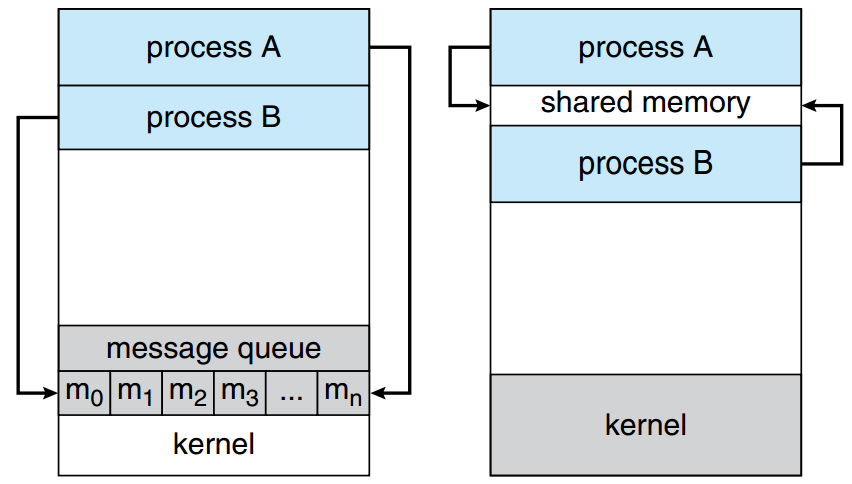
Now, let's explore the specific mechanisms that implement these models.
A Deeper Look at Core IPC Mechanisms
The learning outcome asks us to compare pipes, message queues (a specific form of message passing), and shared memory.
1. Pipes: The Original Unix Stream
Pipes are the simplest form of message passing. A pipe is a unidirectional, kernel-buffered channel for a stream of bytes. Think of it as an in-memory file.
There are two kinds of pipes:
- Anonymous Pipes: These can only be used between related processes, typically a parent and a child created via
fork(). When a process forks, the child inherits the parent's file descriptors, including those for the pipe, establishing the communication channel. This is the mechanism that powers the shell's|operator, connecting the standard output of one command to the standard input of another (e.g.,ls -l | grep 'my_file'). - Named Pipes (FIFOs): These have a presence in the filesystem. Any process with the correct permissions can open the named pipe file to read from or write to it, allowing communication between unrelated processes.
To see how a simple anonymous pipe works in practice, the following video provides a concise code walkthrough.
Communicating between processes (using pipes) in C
This video from CodeVault demonstrates how to create and use an anonymous pipe to send data from a child process to a parent process in C.
Watch the following key segments: Creating a pipe: This part explains the pipe() system call and the concept of read/write file descriptors. Forking and inheritance: Understand how file descriptors are inherited by the child process. Writing to the pipe: See how the child process uses write() to send data. Reading from the pipe: Observe how the parent process uses read() to receive the data.
Key Characteristics of Pipes:
- Mechanism: Message Passing (byte-stream).
- Performance: Medium. Involves kernel buffering and data copying.
- Use Case: Ideal for simple, one-way data streaming between two processes. The classic example is chaining command-line utilities.
2. Message Queues: Structured Message Passing
While pipes are simple, they treat data as an unstructured stream of bytes. If you send three distinct messages, the reader sees one continuous flow of data and must implement its own logic to determine where one message ends and the next begins.
Message Queues are a more advanced form of message passing that solves this problem. A message queue is a list of messages maintained by the kernel.
Key Characteristics of Message Queues:
- Structured: The kernel preserves message boundaries. If you send three messages, the receiver can read them as three distinct units.
- Asynchronous: Processes do not need to be running at the same time. A producer can add messages to the queue, and a consumer can retrieve them later.
- Features: Modern (POSIX) message queues can support message priorities and asynchronous notifications (e.g., via signals) when a new message arrives.
- Mechanism: Message Passing (message-based).
- Performance: Medium-High. Faster than pipes in some implementations but still involves kernel mediation and data copies.
- Use Case: Excellent for command-and-control systems or task distribution. For instance, a web server process can place "jobs" (e.g., "process this image," "send this email") into a message queue, and a pool of separate worker processes can consume these jobs asynchronously. This decouples the web front-end from the back-end processing.
3. Shared Memory: The High-Speed Lane
As we've discussed, shared memory provides the fastest possible IPC by eliminating data copies and system calls for data transfer.
Inter-Process Communication (IPC): Overview of Mechanisms
This article provides a clear explanation of shared memory and the crucial role of synchronization.
Please read the section The Need for Speed: Shared Memory. Pay close attention to the description of how it eliminates data copies and why this introduces the risk of race conditions. Then, read the following section, The Traffic Cop: Semaphores and Mutexes, which explains how synchronization primitives are used to solve this problem.
Key Characteristics of Shared Memory:
- Mechanism: Direct Memory Access.
- Performance: Fastest. Communication happens at the speed of memory access (zero-copy).
- Complexity: High. Requires manual synchronization using mutexes or semaphores to prevent data corruption from race conditions. This is a significant engineering responsibility.
- Use Case: The go-to choice for high-bandwidth, low-latency applications. Examples include:
- Video Processing: A process capturing video frames can place them in a shared buffer, and a separate processing/encoding process can access them directly without costly copies.
- Database Systems: The buffer pool of a database engine is often implemented as a large shared memory segment, allowing multiple worker processes to access cached data pages efficiently.
- High-Frequency Trading (HFT): Systems that need to process market data with microsecond-level latency rely heavily on shared memory.
A Framework for Choosing the Right Tool
As a senior engineering manager, your role often involves making architectural decisions. Choosing the right IPC mechanism is a classic design trade-off. The following resources provide an excellent framework for making this decision.
Inter-Process Communication (IPC) in C++: Complete Guide
This guide contains two particularly useful tools for comparing IPC mechanisms and selecting the right one for a given scenario.
First, review the comparison table at the beginning of the article. It provides a dense summary of trade-offs. Then, focus on "Part 4: Choosing the Right IPC Mechanism." Study the Selection Flowchart. Try to trace a path for a couple of scenarios: "I need maximum performance for large data on the same machine" versus "I need to connect two unrelated processes locally with a simple stream." Finally, examine the Selection Matrix by Scenario, which maps common engineering problems to the best-fit IPC solution.
Let's summarize the key decision points from that framework:
| Scenario | Best Choice | Why? |
|---|---|---|
| Simple parent-child data stream | Anonymous Pipe | Extremely simple to set up, minimal overhead for this specific use case. |
| Connecting two unrelated local processes | Named Pipe (FIFO) | Simple file-based interface, good for stream-oriented data. |
| Asynchronous task/event distribution | Message Queue | Preserves message boundaries, supports decoupling and asynchronous workers. |
| High-frequency, low-latency data sharing | Shared Memory | Fastest possible communication by eliminating kernel copies. |
| Local client-server architecture | Unix Domain Socket* | Provides a flexible, bidirectional, connection-oriented model (like TCP). |
* Note: Unix Domain Sockets are another powerful message-passing mechanism that we briefly touched upon. They are faster than TCP/IP on the same machine and are excellent for building local services.
Conclusion
In this lesson, we've dissected the world of Inter-Process Communication, moving from high-level concepts to specific mechanisms and practical decision-making.
The key takeaways are:
- IPC is built on a fundamental trade-off: Shared Memory offers maximum performance at the cost of high complexity and programmer responsibility for synchronization. Message Passing provides a safer, more straightforward abstraction at the cost of performance overhead from system calls and data copies.
- Pipes are your tool for simple, stream-based communication, especially between related processes (e.g., in shell scripts).
- Message Queues are a robust choice for structured, message-based communication, enabling decoupled, asynchronous architectures like worker queues.
- Shared Memory is the specialized tool for high-bandwidth, low-latency scenarios where performance is the absolute priority, such as in scientific computing, finance, or multimedia applications.
We've just seen how processes can break their isolation to cooperate. In our next lesson, we will step back and explore how this isolation is created and maintained by the operating system in the first place. We will dive into virtual memory, explaining how it gives each process the illusion of having its own private, contiguous memory space, and the benefits this provides.