Introduction
Welcome to our next lesson in the "Improve" phase of the DMAIC process. In our previous session, we used Response Surface Methodology (RSM) and optimization tools to identify the ideal process settings that would maximize performance. This gave us a powerful, data-driven proposed solution.
However, in many real-world Six Sigma projects, you'll find that your team generates several potential solutions. These might come from brainstorming sessions, alternative experiments, new technologies, or supplier suggestions. Your RSM result is one excellent candidate, but how do you objectively compare it against other viable options, like using a new raw material or a different machine setup?
Today, we'll learn how to do just that. This lesson addresses the learning outcome: Evaluate and select proposed solutions using a Pugh matrix for objective comparison. The Pugh matrix, also known as a decision matrix, is a structured tool that helps a team move beyond personal preferences and gut feelings to select the best overall solution based on a common set of criteria.
1. What is a Pugh Matrix?
At its core, a Pugh matrix is a scoring system used to evaluate multiple options against a list of important criteria. Its primary goal is to make the decision-making process more objective by forcing a systematic comparison. This is fundamental to the Six Sigma principle of making decisions based on data and structured analysis, rather than opinion.
The key components of any Pugh matrix are:
- Alternatives: The potential solutions you want to compare.
- Criteria: The requirements or standards used to judge the alternatives. In Six Sigma, these are typically derived from your Voice of the Customer (VOC) and Critical-to-Quality (CTQ) requirements.
- Baseline (or Datum): A reference point against which all other options are compared. This is often the current process or the most well-understood solution.
- Scoring System: A method for rating how well each alternative meets each criterion relative to the baseline.
To get a concise overview of the concept, please watch the first part of this introductory video.
What is Pugh matrix | How to construct Pugh matrix ? Pugh Matrix construction explained with example
This video from 'Digital E-Learning' introduces the Pugh matrix and its purpose in concept selection.
Please watch from the beginning to 03:15. Focus on understanding what a Pugh matrix is, its typical applications, and the six basic steps involved in its construction.
2. The Basic Pugh Matrix: A Simple Comparison
The simplest form of the Pugh matrix uses a three-level scoring system relative to the baseline or "datum". This is an excellent tool for a first-pass analysis to quickly narrow down a long list of ideas.
Let's walk through the steps, framing them within a manufacturing project context.
-
List Alternatives: Across the top of your matrix, list the solutions you are considering. For example:
- Solution A: Current process (our Baseline)
- Solution B: New settings from RSM study
- Solution C: Use new raw material from Supplier X
- Solution D: Modify a machine fixture
-
Define Criteria: Down the left side, list the critical criteria. These should be your project's CTQs. For a manufacturing project, this might include:
- Reduces Defect Rate
- Cycle Time
- Implementation Cost
- Ease of Implementation
- Operator Safety
-
Score the Alternatives: Go through the matrix criterion by criterion. For each alternative, compare it to the baseline and assign a score:
- +1: Better than the baseline
- -1: Worse than the baseline
- 0 or S: Same as the baseline
-
Calculate Totals: For each alternative, sum the scores. The alternative with the highest score is, in theory, the strongest candidate.
This method provides a structured way to capture the team's collective judgment. To see this process in the context of a full decision-making framework, please review the following article.
Quick, Quality Decision-Making Using Six Sigma Tools
This article from iSixSigma, titled 'Quick, Quality Decision-Making Using Six Sigma Tools', places the Pugh matrix within a four-step process that starts with the Voice of the Customer. This context is crucial for a Green Belt or Black Belt.
Please read the sections titled 'Four Steps to the Best Solution' and 'Step 4'. Focus on how the critical-to-success factors (our criteria) are used in the Pugh matrix (Figure 3) and how the '+, -, S' scoring is applied to reach a decision.
This simple format is fast and effective, but it has one major limitation: it treats all criteria as equally important. In your 11 years of experience, you know that a 10% cost reduction is often more critical than a minor improvement in ease of implementation. This is where the weighted matrix comes in.
3. The Weighted Pugh Matrix: A More Robust Decision
A weighted Pugh matrix is a more advanced and common version that provides a more nuanced and realistic evaluation. It accounts for the fact that some criteria are more important than others.
The process is similar, but with two key differences:
- Criteria are weighted: Each criterion is assigned a weight, typically on a scale of 1 to 10, reflecting its relative importance to the project's success.
- Scoring is scaled: Instead of just
+/-/0, each alternative is scored on a numerical scale (e.g., 1 to 5) for how well it meets each criterion. The baseline is no longer strictly necessary, as each option is scored on its own merits.
The final score for each alternative is the sum of (Score × Weight) for all criteria.
Let's watch a video that clearly explains the difference between the simple and weighted matrix and provides a business example.
This video, 'Decision Matrix Analysis' from EPM, provides a clear demonstration of both the simple and weighted decision matrix.
Watch from 01:31 to 07:16. Pay close attention to: The limitation of the simple matrix (01:31 - 03:40). How to add weights and calculate the weighted score (03:40 - 05:21). The business example of selecting a supplier, which shows how a weighted matrix can lead to a non-obvious, better decision (05:21 - 07:16).
To solidify this, let's look at a detailed text guide and a practical engineering example.
Pugh Matrix and its use within Quality Function Deployment (QFD)
The article 'Pugh Matrix and its use within Quality Function Deployment (QFD)' provides detailed steps for creating a weighted matrix.
Please read the section 'How to create a Pugh Matrix'. Focus on Step 4 (Establish Weights for each CTQ) and Step 6 (Calculate). This reinforces the method you just saw in the video.
Now, let's see what a completed, professional weighted Pugh matrix looks like in a manufacturing/engineering context.
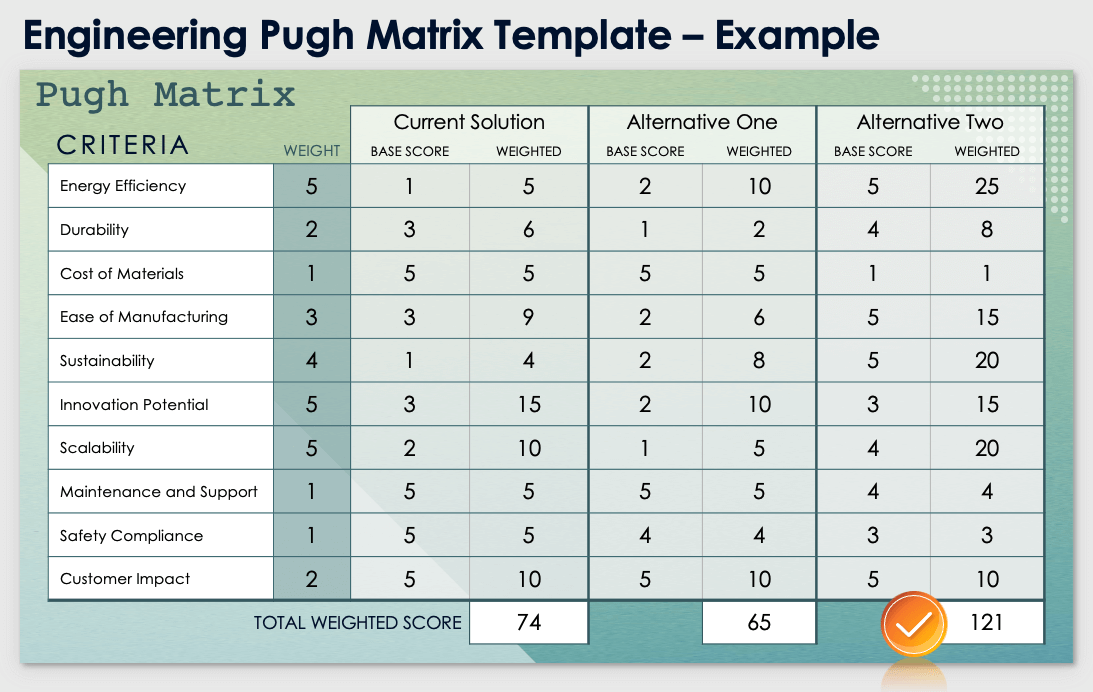
As you can see, this format is clear, comprehensive, and creates a powerful, transparent rationale for your final decision. The result is easy to communicate to project stakeholders and leadership.
4. Practical Considerations and Limitations
While the Pugh matrix is a powerful tool, it's not infallible. It is a model to guide decision-making, not replace critical thinking. As a practitioner, you must be aware of its potential pitfalls.
The most important principle is GIGO: Garbage In, Garbage Out. The usefulness of the matrix depends entirely on the quality of your inputs.
- Are the criteria relevant? Ensure they truly reflect the CTQs of the project.
- Are the weights appropriate? The team must agree on the relative importance of each criterion. A poorly weighted matrix will lead to a poor decision.
- Are the scores objective? While scores are based on estimates and expert opinion, they should be informed by data wherever possible. Discuss each score as a team to build consensus and reduce individual bias.
For a summary of these limitations, please read the final section of the Six Sigma Material article.
Pugh Matrix and its use within Quality Function Deployment (QFD)
This final reading covers the potential disadvantages of using a Pugh Matrix.
Read the section titled 'Disadvantages of a Pugh Matrix'. This will help you use the tool critically and defend your decisions.
Always treat the result of a Pugh matrix as a strong recommendation, not an absolute command. If the winning solution has a very close score to the runner-up, your team should discuss the trade-offs and sensitivities before making a final commitment.
Conclusion
In this lesson, you've learned how to bring structure and objectivity to one of the most critical parts of an improvement project: selecting the final solution. This is a key skill that distinguishes a formal Six Sigma practitioner.
Key Takeaways:
- The Pugh Matrix is a tool to systematically evaluate and select the best solution from a list of alternatives based on a set of weighted criteria.
- It helps remove subjectivity and personal bias from the decision-making process, aligning the team around an objective choice.
- The basic matrix uses a simple
+/-/Samescoring system against a baseline and is useful for initial screening. - The weighted matrix is more robust, assigning importance (weights) to each criterion and using a scaled scoring system to produce a more nuanced result.
- The quality of the decision depends on the quality of the inputs (criteria, weights, and scores).
Preview of the Next Lesson:
Now that we have used the Pugh matrix to select the most promising solution, we aren't quite ready to implement it. Before making changes to a live manufacturing process, it's crucial to anticipate what might go wrong. In our next lesson, you will learn how to conduct a Failure Mode and Effects Analysis (FMEA) on proposed solutions to proactively manage risks. This will ensure our chosen solution is not only effective but also robust and safe.