Introduction
Welcome back. In our previous lesson, we detailed how to create a formal Control Plan to lock in the gains of a process improvement project. We established that the most effective control strategy focuses on managing the critical process inputs (the X's) to guarantee the desired outputs (the Y's). We concluded by noting that the ultimate form of input control is to design the process in a way that makes errors impossible.
This lesson is a deep dive into that powerful concept. Today, you will learn how to apply mistake-proofing (Poka-Yoke) principles to sustain process improvements.
Poka-Yoke, a Japanese term meaning "mistake-proofing" or "error-proofing," is a fundamental Lean and Six Sigma technique. As an Industrial Engineer, you are likely familiar with designing processes for efficiency; Poka-Yoke extends this by designing processes for quality, building safeguards directly into the workflow to prevent human errors from becoming defects. It is one of the most robust methods you can document in your Control Plan to ensure improvements are permanent.
1. The Core Principles of Poka-Yoke
At its heart, Poka-Yoke is about acknowledging that humans will inevitably make mistakes (errors), but designing systems that prevent those mistakes from turning into product defects. The goal is to move from detecting defects after they happen to preventing them from ever occurring.
To get a comprehensive overview of the concept, its origins, and its main characteristics, please watch the following video.
Poka Yoke Tutorial for Beginners | Poka Yoke Explained with Examples | Poka Yoke for Error Proofing
This video, 'Poka Yoke Tutorial for Beginners,' provides a solid foundation by defining Poka-Yoke, explaining its purpose, and outlining its key characteristics and benefits.
Please watch the following segments: What is Poka Yoke? (01:31 - 04:14): Focus on the definition, the purpose of eliminating defects, and the distinction between the two main types: Control and Warning Poka-Yoke. Characteristics of Poka Yoke (07:32 - 09:12): Pay attention to the attributes that make Poka-Yoke solutions effective, such as being simple, cheap, and integrated at the point of error. Why Choose Poka Yoke? (09:12 - 10:33): This section reinforces the critical importance of preventing errors before they lead to costly defects.
The video introduces two key ways to categorize Poka-Yoke devices:
-
Control vs. Warning: A Control type physically stops a mistake from happening (e.g., a fixture that only allows a part to be inserted one way). A Warning type signals that a mistake has occurred, relying on the operator to correct it (e.g., a buzzer that sounds if a step is missed). Naturally, control types are more robust.
-
Prevention vs. Detection: This is another crucial distinction. A Prevention system makes it impossible for the error to occur in the first place. A Detection system identifies the error immediately after it's made but before it becomes a defect passed to the next stage.
The following flowchart clearly illustrates the difference between Prevention and Detection.
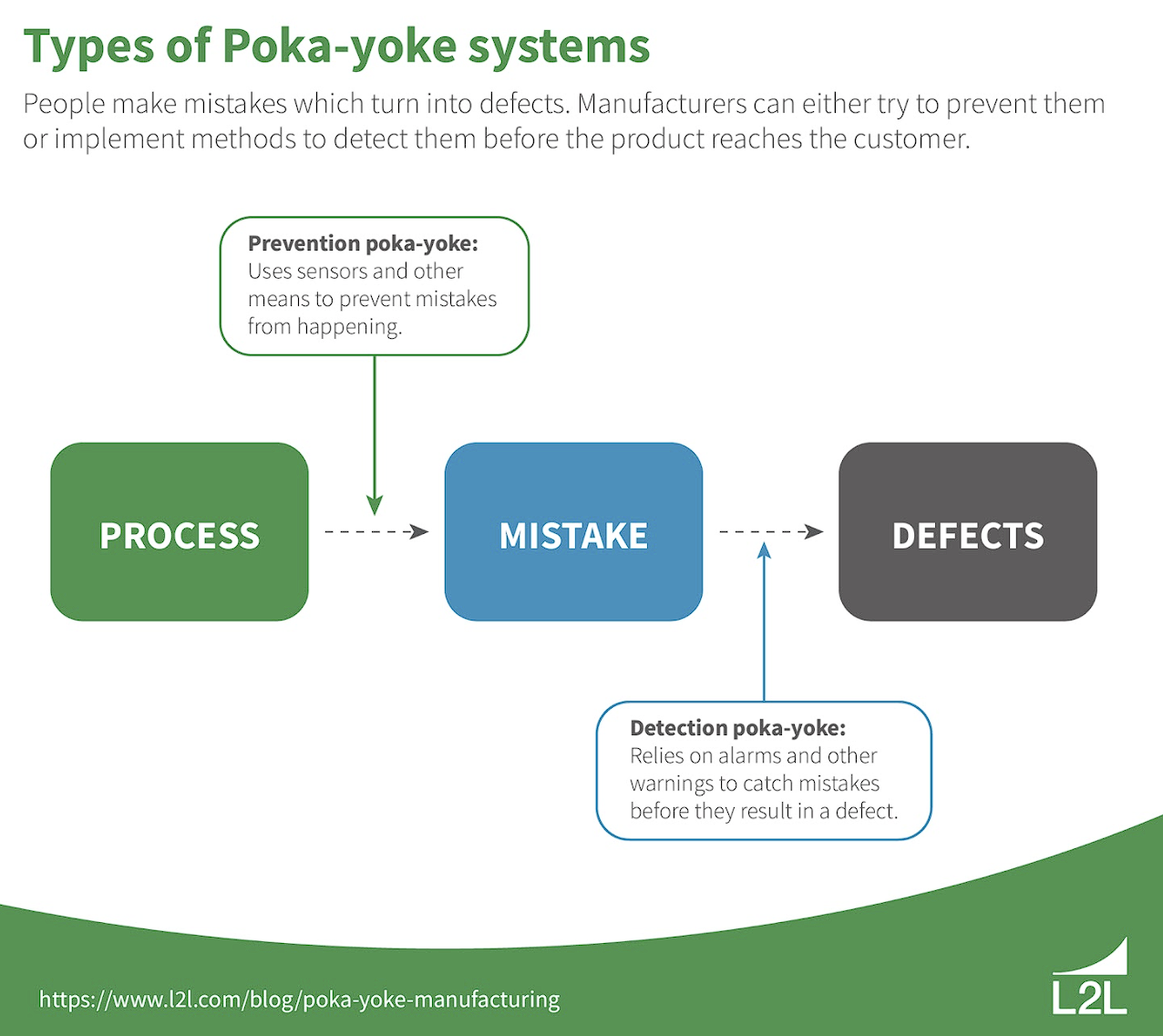
Your goal as a process designer should always be to implement a Control-based Prevention Poka-Yoke, as this is the most effective way to guarantee a zero-defect process.
2. Poka-Yoke in Action: A Manufacturing Case Study
Theory is useful, but seeing Poka-Yoke applied in a real manufacturing context makes the concept tangible. The following clip from a Toyota factory demonstrates the Kaizen (continuous improvement) mindset that leads to Poka-Yoke solutions.
The video 'Toyota Kaizen Clip' shows a simple but highly effective improvement on an assembly line.
Watch these two short clips: The Problem (02:14 - 02:38): Observe the operator struggling with a 'fiddly' task of picking up and installing screws. The Solution (03:44 - 04:23): Analyze the two simple devices introduced to mistake-proof this process and make it more efficient.
This example perfectly illustrates Poka-Yoke principles:
- The Screw Dispenser: This is an example of a fixed-value method. It presents the operator with exactly the number of screws required (two), preventing the error of missing a screw or grabbing too many.
- The Attached Screwdriver: This is a motion-step method. By tethering the tool to the workstation, it ensures the correct tool is always available and in the right sequence, eliminating wasted motion and the possibility of using the wrong tool.
Both solutions are simple, inexpensive, and directly address the root of the potential error.
3. A Framework for Applying Poka-Yoke in Manufacturing
To effectively apply Poka-Yoke, it's helpful to categorize the common types of manufacturing errors and match them with appropriate mistake-proofing techniques.
The following resource provides an excellent, structured overview of how Poka-Yoke can be used to prevent various error types on the shop floor.
Poka-Yoke in Manufacturing: Explanation and Use Cases
The article 'Poka-Yoke in Manufacturing: Explanation and Use Cases' by L2L categorizes common manufacturing errors and provides practical examples of mistake-proofing solutions for each.
Please read the section titled 'Use Cases and Examples of Poka-Yoke in Manufacturing'. Focus on how different Poka-Yoke techniques are applied to prevent processing errors, setup errors, missing parts, improper parts, operational errors, and measurement errors.
Diving Deeper: Engineering-Grade Examples
For a more in-depth look at Poka-Yoke from an engineering design perspective, the following document is an exceptional resource. It is packed with specific, practical examples from industrial settings.
This PDF document, 'Mistake Proofing' from OSTI.GOV, is a detailed presentation full of real-world manufacturing examples.
This is a detailed slide deck. Please focus your reading on these two highly practical sections: 'Examples of Defects and Mistake Proofing' (slides 13-29): Review the various examples, such as the grenade pin solution (omitted part), using color to make loose bolts obvious, asymmetric design to prevent wrong orientation, and the use of 'dog-point' bolts to prevent cross-threading (damaged part). 'Example' Solutions (slides 92-120): This section contains a wealth of specific manufacturing solutions. Pay close attention to how asymmetry, fixtures, sensors, kitting, and master weights are used to solve problems like incorrect orientation, wire cutting errors, asymmetric plate installation, and complex encapsulation weighing.
As you review these examples, notice how many of them are not high-tech, complex solutions. Often, the most effective Poka-Yoke is a simple mechanical feature: a guide pin, an asymmetric shape, a color code, or a specifically designed fixture. The power of Poka-Yoke lies in the thoughtful design of the process, not necessarily in expensive technology.
4. A Systematic Approach to Implementing Poka-Yoke
Applying Poka-Yoke isn't just about having a good idea; it's a systematic process that fits perfectly within the DMAIC framework. The following steps provide a roadmap for identifying a need and implementing a solution.
- Identify the Operation or Process: Observe the production floor and use data (defect reports, operator feedback) to pinpoint where mistakes are happening.
- Find the Root Cause: Use tools you're already familiar with, like the 5 Whys or a Fishbone diagram, to understand why the mistake is being made. Is it due to operator fatigue, poor workstation layout, confusing instructions, or similar-looking parts?
- Brainstorm and Design a Poka-Yoke Solution: Based on the root cause, design a potential solution. Consider the different types and methods:
- Can you prevent the error with a control device (e.g., a fixture that forces correct orientation)? This is the ideal.
- If not, can you detect the error with a warning device (e.g., a sensor and light that indicates a missing component)?
- Test and Validate the Solution: Implement the Poka-Yoke device, perhaps as a small-scale pilot. Measure its effectiveness. Does it truly prevent the error? Does it introduce any new problems?
- Train and Standardize: Once validated, train all relevant operators on the new process. Crucially, update the formal documentation—like the Control Plan and Standard Operating Procedures (SOPs)—to reflect the new, mistake-proofed method.
This systematic approach ensures that your solutions are effective, well-integrated, and sustainable.
Conclusion
In this lesson, you have explored the principles and application of Poka-Yoke as a powerful tool for sustaining process improvements. By building error-proofing directly into your manufacturing processes, you shift from a reactive mode of inspecting for defects to a proactive mode of preventing them.
Key Takeaways:
- Poka-Yoke's Goal: To prevent inevitable human mistakes from becoming costly defects.
- Hierarchy of Effectiveness: A Control type Poka-Yoke that Prevents an error is superior to a Warning type that merely Detects it.
- Practical Application: Effective solutions are often simple, inexpensive mechanical or procedural changes integrated at the point where the error occurs.
- Systematic Implementation: Applying Poka-Yoke follows a logical sequence: identify the error, find the root cause, design and test a solution, and standardize the new process in your Control Plan and SOPs.
Preview of the Next Lesson:
We just mentioned that the final step of implementing a Poka-Yoke solution is to document the new method in your formal procedures. In our next lesson, we will focus on exactly that. The learning outcome will be: Create standard operating procedures (SOPs) for the new process. You will learn how to write clear, concise, and effective SOPs that ensure everyone performs the improved process consistently and correctly.