Introduction
Welcome back. In our last lesson, we focused on a critical step in the Control phase: establishing new, statistically-derived control limits after an improvement has been made to a process. We saw how a staged control chart can powerfully visualize the "before" and "after" states, proving the project's impact.
This lesson builds directly on that foundation. Knowing the new limits of your process is essential, but to ensure those gains are permanent, you need to formalize all the procedures that will keep the process in its improved state. This is accomplished through a Control Plan.
Today, you will learn how to develop a formal Control Plan, identifying key process variables, control methods, and reaction plans. This document is the capstone of a Six Sigma project, translating your hard-won process knowledge into a daily operational reality. It serves as a blueprint for the process owner and operators, ensuring that improvements are sustained long after the project team disbands.
The Philosophy of a Control Plan: Control vs. Inspection
Before we dive into the template and its columns, it's crucial to understand the fundamental mindset behind an effective Control Plan. Many organizations mistakenly create "inspection plans" where they diligently measure and sort outputs, separating the good from the bad. A true Control Plan is profoundly different.
The core idea, rooted in the Y = f(X) equation you've seen throughout DMAIC, is to control the inputs (the X's) to guarantee the output (the Y). If you rigorously manage the vital few process inputs, the output will consistently meet customer requirements, making extensive final inspection redundant.
The following video from Paul Allen, a manufacturing consultant, explains this distinction with excellent clarity. His "money-making machine" analogy is a perfect fit for a manufacturing environment.
Use a control Plan! Not inspection plan!
This video, titled 'Use a control Plan! Not inspection plan!', will help you understand the core philosophy of focusing on process inputs.
Please watch the following two segments: The 'Money-Making Machine' (01:27 - 03:37): Pay attention to the distinction between process inputs (like speed, feed, maintenance) and outputs (like dimensions, hardness). The Core Message (04:51 - 08:14): Focus on why a plan that only measures outputs is an 'inspection plan,' and how a true 'control plan' focuses on fixing and maintaining the inputs.
As the video emphasizes, a Control Plan isn't about catching defects; it's about preventing them from ever occurring. Control is achieved by standardizing and auditing the critical inputs: machine settings, material specifications, maintenance procedures, and operator methods. While you will still monitor key outputs (often with the SPC charts we've been studying), the primary focus shifts from the result to the cause.
The Anatomy of a Formal Control Plan
Now that we have the philosophy straight, let's look at the structure of the document itself. A Control Plan is a living document that systematically outlines the methods for keeping a process in a state of control.
To get a quick overview of the typical format and its elements, watch this short video.
Process Control Plan - The Best Way to Control Processes
The video 'Process Control Plan - The Best Way to Control Processes' by LeanVlog provides a concise walkthrough of the standard components using a simple, non-manufacturing example.
Watch from the beginning until 02:23. This will introduce you to the key columns you'll find in a standard Control Plan template, such as what to control, how, frequency, and the reaction plan.
The video introduces the basic structure. Now, for a comprehensive breakdown of what goes into a professional Six Sigma Control Plan, please read the following article.
Six Sigma Control Plan: Blueprint for Sustained Process Excellence
This article, 'Six Sigma Control Plan: Blueprint for Sustained Process Excellence,' provides a detailed guide to the purpose and components of a Control Plan within the DMAIC framework.
Please read the following sections: Start with 'What is a Six Sigma Control Plan?' to get a formal definition. Read 'Key Elements of a Strong Six Sigma Control Plan' for a detailed list of what the document must contain. Finally, review 'Developing an Effective Six Sigma Control Plan' for a step-by-step guide to creating one. Focus on how the plan documents the critical X's and Y's, the measurement systems, the control methods, and the reaction plans.
Putting It All Together: The Key Elements in Practice
Let's synthesize what you've just read into the three core components mentioned in our learning outcome. A robust Control Plan provides clear, unambiguous answers to the following:
1. Key Process Variables (The "What")
This section documents the Y and the vital X's from your Y = f(X) equation.
- Product/Process Characteristics: These are the critical variables you will monitor. They fall into two categories:
- Key Process Output Variables (KPOVs or Y's): These are the critical-to-quality characteristics of the final product that matter to the customer (e.g., final diameter, surface finish, tensile strength). You monitor these to verify that the process is in control.
- Key Process Input Variables (KPIVs or X's): These are the critical process parameters that you discovered have a significant impact on the KPOVs (e.g., oven temperature, spindle speed, coolant concentration). These are the variables you will actively control.
2. Control Methods (The "How")
This details the specific methods, tools, and standards used to monitor and control the key variables.
- Specification/Tolerance: The required range for each characteristic (e.g., Temperature: 180°C ± 2°C; Diameter: 25mm ± 0.05mm).
- Measurement System: The specific tool or gage used for measurement (e.g., thermocouple, digital caliper, go/no-go gauge). It should also reference the Measurement System Analysis (MSA) that proved the system is reliable.
- Sample Size & Frequency: How many parts to measure and how often (e.g., 5 pieces per hour; first part of every batch).
- Control Method: This is the heart of the plan. It specifies how control is maintained.
- For inputs (X's), this often involves checklists, setup verification sheets, preventative maintenance schedules, and standard operating procedures (SOPs).
- For outputs (Y's), this is typically a Statistical Process Control (SPC) chart (e.g., "X-bar & R Chart," "I-MR Chart"). The control limits you learned to calculate in the last lesson would be applied here.
3. Reaction Plan (The "What If")
This is arguably the most important part of a functional Control Plan. It removes guesswork and ensures a swift, consistent response when the process deviates.
- The "If-Then" Logic: The reaction plan, also known as an Out-of-Control Action Plan (OCAP), must clearly state what to do when a measurement is out of specification or an SPC chart shows an out-of-control signal.
- Specific Actions: It should detail immediate steps like stopping the process, quarantining suspect material, and who to notify (e.g., "Stop machine, segregate all parts since last check, contact shift supervisor immediately").
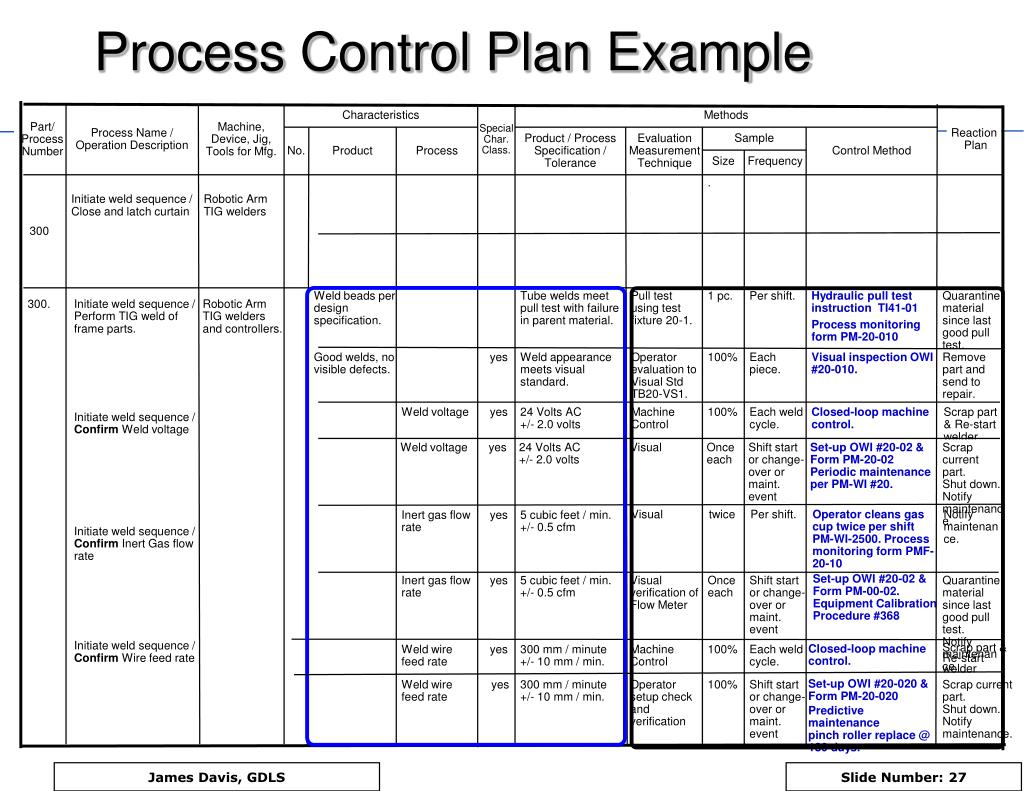
The image below shows a detailed Control Plan for a robotic TIG welding operation. Notice how it populates these exact columns for each characteristic being controlled, from the process inputs (like gas flow rate) to the product outputs (like weld bead profile).
Conclusion
Today you have learned how to structure a formal Control Plan, the critical document for sustaining the gains from a Lean Six Sigma project. By creating this plan, you provide process owners and operators with a clear roadmap for success, shifting the focus from reactive inspection to proactive control.
Key Takeaways:
- A Control Plan's primary goal is to control the critical inputs (X's) to ensure the desired outputs (Y's), not just to inspect the outputs.
- The plan must be a living document, updated whenever the process or measurement systems change.
- Every Control Plan must clearly define three core elements for each characteristic it monitors:
- Key Process Variables: The specific product (Y) and process (X) characteristics to be monitored.
- Control Methods: The tools, techniques, sample plan, and specifications for monitoring.
- Reaction Plans: The specific "if-then" actions to be taken if the process deviates from the standard.
Preview of the Next Lesson:
In this lesson, we noted that a key method for controlling inputs (X's) is to design the process in a way that prevents errors from occurring in the first place. In our next lesson, we will dive deep into this powerful technique. The learning outcome will be: Apply mistake-proofing (Poka-Yoke) principles to sustain process improvements. You will learn how to build controls directly into the process, making it physically impossible for certain errors to happen.