Introduction
Welcome to the final lesson in our module on Control Planning and Project Closure. In our last session, we built a robust process audit plan to ensure the improvements you implement are sustained over time. We've now established how to control the process. The final, critical step is to answer the question, "Was it all worth it?"
Today's lesson focuses on a crucial skill for any successful Six Sigma practitioner: quantifying the success of your project in the language of business—finance. Our learning outcome is to calculate the financial impact of the project, differentiating between hard and soft savings.
As an Industrial Engineer, you're an expert at improving process efficiency. This lesson will equip you to translate those operational improvements into the dollars and cents that leadership uses to evaluate success. Mastering this skill is essential for demonstrating the value of your work, justifying your project's existence, and securing resources for future initiatives. This is a core competency as you move towards a Black Belt role.
1. The Language of Finance: Hard vs. Soft Savings
When you report the financial benefits of a project, not all savings are created equal. The most important distinction you must make is between hard savings and soft savings. Your credibility with the finance department and senior leadership depends on getting this right.
- Hard Savings: These are tangible, verifiable reductions in expenses or increases in revenue that directly impact the company's Profit and Loss (P&L) statement. They represent real cash. Finance can track these savings through the accounting system.
- Soft Savings: These are gains from cost avoidance, productivity improvements, or efficiency increases that do not immediately result in cash flow. They are still valuable but are often more difficult to quantify and may not be fully credited by finance.
To begin, let's get a clear definition and some examples of each.
Calculating ROI of Continuous Improvement: Hard vs Soft Savings
The article 'Calculating ROI of Continuous Improvement: Hard vs Soft Savings' provides an excellent explanation of this fundamental concept. It clarifies why the distinction is so important for financial evaluation.
Please read the section titled 'Hard Savings Versus Soft Savings in Six Sigma Projects'. Pay close attention to the examples provided for both categories.
To reinforce these ideas, the following PDF from the School of Six Sigma offers a slightly different perspective, introducing the concept of "cost avoidance" and warning against claiming "Monopoly Money."
This guide from the School of Six Sigma, titled 'Calculating Savings,' emphasizes the importance of working with a financial lead and distinguishes between hard savings, cost avoidance, and soft savings.
Read from the 'Overview' to the end of the 'Cost Benefits' section. Note the advice about having a finance lead and the warning against trying to monetize things like 5S scores directly.
Here is a simple visual that summarizes the difference:
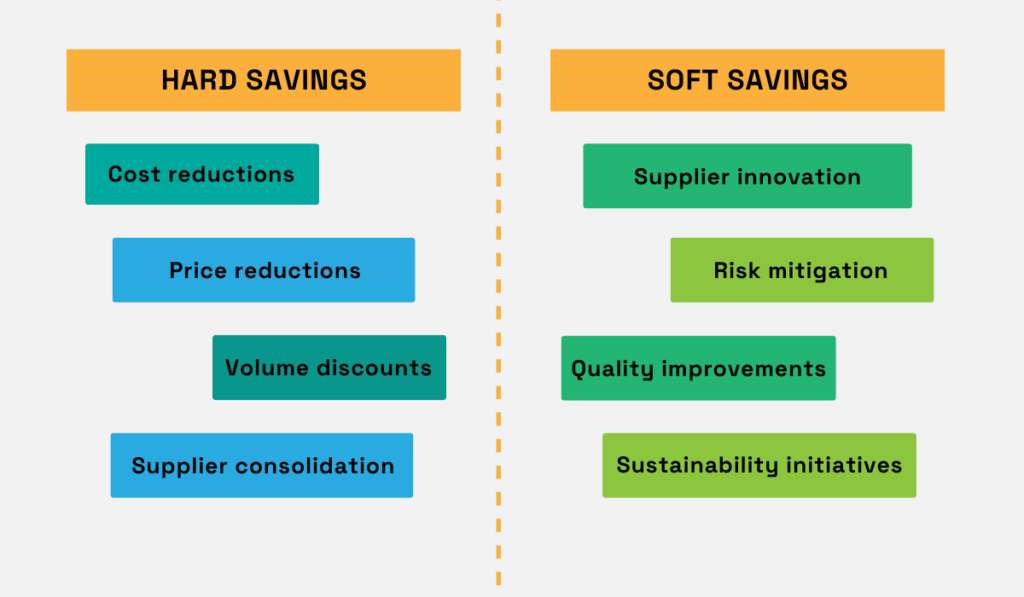
In summary, a project that reduces scrap material generates hard savings because the company spends less cash on raw materials. A project that saves an employee one hour per day generates soft savings (cost avoidance) unless that employee's time is redeployed to another value-added task that generates revenue, or if it leads to a reduction in paid overtime.
2. Formulas for Quantifying Savings
Now, let's move from definitions to application. To build a credible business case, you must convert your process improvements into specific dollar amounts using accepted formulas. We'll focus on the most common calculations in a manufacturing environment.
This next reading provides a set of practical formulas. We will walk through the most critical ones together.
Calculating ROI of Continuous Improvement: Hard vs Soft Savings
Let's return to the Air Academy Associates article. This section provides the mathematical foundation for translating improvements into financial terms.
Please read the section 'Formulas for Converting Process Improvements Into Financial Returns.' Focus on understanding the formulas for defect reduction, labor savings, cycle time, and inventory reduction. We will review them below.
Let's break down the key formulas from that reading.
a) Defect Reduction Savings (Hard Savings)
This is one of the most direct and undeniable financial benefits. Reducing defects lowers the Cost of Poor Quality (COPQ).
- Formula:
- Components:
- Cost per Defect: This includes the cost of scrapped material, the labor cost for rework or repair, and any warranty or shipping costs for external failures.
- Example: A project reduces weld cracks from 50 per month to 5 per month (a reduction of 45/month or 540/year). Each crack costs $10 in scrapped material and $25 in rework labor ($35 total).
b) Inventory Reduction Savings (Hard Savings)
Excess inventory ties up cash and incurs costs. Reducing it provides a direct, hard saving.
- Formula:
- Components:
- Inventory Carrying Cost: This percentage (often 20-30%) represents the cost of holding inventory, including warehousing, insurance, taxes, obsolescence risk, and the cost of capital. Your finance department will have a standard rate.
- Example: A Kanban implementation project reduces Work-in-Process (WIP) inventory by $200,000. The company's carrying cost is 25%.
This is in addition to the one-time cash benefit from freeing up $200,000 in working capital.
c) Labor Savings (Soft, potentially Hard)
This is the most common area for soft savings claims and requires careful handling.
- Formula:
- Components:
- Fully Burdened Labor Rate: This is more than just wages. It includes payroll taxes, insurance, benefits, and other overhead. Again, finance will have this number.
- The Conversion: The savings are soft if the employee simply has more free time. The savings become hard only if the organization acts to realize the cash benefit. This can happen in two ways:
- Overtime Reduction: If the improvement directly reduces 100 hours of paid overtime per year, this is a clear hard saving.
- Headcount Reduction or Redeployment: If the time saved allows the company to reduce headcount or avoid a new hire, it becomes a hard saving.
d) Cycle Time Reduction (Soft, potentially Hard)
Improving throughput at a bottleneck process creates capacity. The value of this capacity depends on whether you can use it.
- Formula:
- The Conversion:
- Soft Saving: If you reduce cycle time but there is no additional market demand, you have simply created idle capacity. This is a soft saving (cost avoidance for future capacity expansion).
- Hard Saving: If sales can sell the additional units produced with the new capacity, the resulting profit is a hard saving.
3. Calculating ROI and Presenting the Business Case
Once you've calculated the financial benefits, you must compare them to the project's costs to determine the Return on Investment (ROI). This is the ultimate measure of your project's financial success.
Let's watch a short video that frames this benefit vs. cost calculation in the context of a Six Sigma project.
Lean Six Sigma Project Example with DMAIC - Green Belt Training
This clip from the Six Sigma Global Institute discusses the Cost of Poor Quality (COPQ) and shows a simple calculation comparing project benefits to costs.
Please watch from 02:25 to 04:50. Notice how they estimate the lost revenue (a form of COPQ) and then weigh the potential savings against the project costs to justify the initiative.
As the video illustrates, the core idea is simple. The standard formula for ROI is:
- Project Costs: Include the labor hours of the project team, training costs, software, materials used for experiments, and any capital investment for the solution.
- Total Annual Financial Benefits: Typically, this includes 12 months of hard savings plus any soft savings that the finance department has formally agreed to recognize.
Manufacturing Case Study
Let's see how this works in practice by looking at a real-world example.
Calculating ROI of Continuous Improvement: Hard vs Soft Savings
We'll use the case study from the Air Academy article to see a completed ROI calculation. It provides a perfect, practical example of a manufacturing project's financial validation.
Please read the 'Case Study: Manufacturing ROI From Lean Six Sigma Implementation' section, focusing on 'Project 1: Defect Reduction in Critical Machining'.
As you saw in the case study:
- Benefit 1 (Hard): Reduced rework labor by 320 hrs/month. At a burdened rate of $52/hr, this equated to $199,680/year.
- Benefit 2 (Hard): Reduced scrap expense by $185,000/year.
- Total Annual Hard Savings: $199,680 + $185,000 = $384,680.
- Project Cost: $48,000.
Plugging this into the formula:
A 701% ROI is an extremely compelling result that powerfully demonstrates the value of the project.
Finally, remember that to get your numbers approved, you must present a "CFO-ready" business case. This means working with finance early, agreeing on the rules for savings classification, using credible baseline data, and not double-counting benefits. The CFO Approval Checklist in the Air Academy article you read earlier is an excellent guide for this.
Conclusion
Today, we've translated process improvement into financial impact, a skill that separates good project leaders from great ones. You've completed the journey from identifying a problem to proving its solution delivered tangible value.
Key Takeaways:
- Hard vs. Soft Savings: Hard savings are direct P&L impacts (e.g., reduced scrap, material costs), while soft savings are cost avoidances or productivity gains (e.g., freed-up time). Credibility with finance depends on this distinction.
- Key Formulas: You can calculate hard savings from defect reduction, inventory reduction, and realized labor savings (like reduced overtime).
- Convert Soft to Hard: Soft savings from cycle time or labor efficiency become hard savings only when the freed-up capacity or time is converted into additional revenue or direct cost reductions.
- ROI is the Goal: The ultimate measure of a project's financial success is its Return on Investment (ROI), which compares the financial benefits to the project's costs.
Preview of the Next Lesson:
You have now covered all the core technical competencies of the DMAIC methodology, from project definition right through to financial validation. Congratulations!
Our next module, Leading Six Sigma Projects, shifts focus from the technical tools to the people and leadership skills required to drive change effectively. In the first lesson, you will learn how to conduct a stakeholder analysis to identify sponsors, champions, and potential resistors. This is a foundational step in managing the human dynamics that are just as critical to a project's success as any statistical analysis.