Welcome back! In our last lesson, we traced the buyer's journey from awareness to purchase, looking at it from the customer's perspective. A key insight was that in B2B SaaS, this journey is rarely taken by a single person. Today, we'll dive into the cast of characters who collectively make a purchasing decision.
This lesson directly addresses the learning outcome: Identify the key roles in a B2B buying decision (champion, decision-maker, influencer) for a given product scenario. As an engineer, you've likely seen new tools adopted by your team or company. You know that it's rarely one person's call; it often involves input from developers who will use the tool, managers who control the budget, and IT who check for security and compatibility. We're going to formalize that understanding from a marketing perspective.
By the end of this lesson, you'll be able to identify the distinct roles people play in a B2B purchase and understand their different motivations.
Why You're Selling to a Committee, Not a Person
In B2B, especially when selling technical products, the decision to buy is a collective one. The products are often expensive, solve complex problems, and require changes to how a team works. This inherent risk and complexity mean that multiple stakeholders need to weigh in before a decision is made. This group is often called the buying committee or decision-making unit (DMU).
Let's watch a quick video that sets the stage for why B2B sales are a team sport.
B2B Sales for Startups Strategies, Tactics & Tradecraft - Session 1 || Harvard Alumni Entrepreneurs
This video from Harvard Alumni Entrepreneurs explains the nature of B2B sales and introduces the concept of the decision-making unit.
Watch these two short clips: B2B sales characteristics: The speaker outlines why B2B sales involve complex problems, higher prices, and organizational change. Pay attention to his point that it's "very seldom that an enterprise sale the same person will evaluate the offering, make the decision, and write the check." The decision-making unit: This clip formally defines the group of people inside an organization who make, influence, and approve decisions.
This context is key. As a marketer, your job isn't to convince one person; it's to provide the right information to the right people across the entire buying committee to help them build consensus.
The Key Players: A Framework for Understanding Roles
Now that we know we're dealing with a committee, let's meet the key players. While titles vary from company to company, the roles people play are surprisingly consistent. A helpful framework for this is the MUTE acronym, which we'll explore in the next video.
4 Types Buyers in B2B Sales - Decision Influencers
This video from Victor Antonio breaks down four common buyer types in a B2B deal. He uses the acronym MUTE to make them memorable.
Watch the following segments to understand each role: MUTE acronym: An introduction to the four buyer types: Management, User, Technical, and Economic. Management Buyer: This person is concerned with high-level strategy, competitive advantage, and long-term benefits. User Buyer: This is the person who will use your product daily. Their primary concern is, "Will this make my job easier?" Technical Buyer: This person is focused on implementation, compatibility, security, and reliability. This is a role your engineering background gives you a unique intuition for. Economic Buyer: This person holds the purse strings. They are focused on price, ROI, and the total cost of ownership.
The MUTE framework is a great starting point. Let's map these roles back to the terms in our learning outcome:
- Decision-Maker: This is typically the Economic Buyer (who controls the budget) and/or the Management Buyer (who has executive authority). They give the final "yes" or "no."
- Influencer: The User Buyer and the Technical Buyer are classic influencers. They may not sign the check, but their opinion carries significant weight and can absolutely make or break a deal.
- Champion: A champion is a specific type of influencer, often a User Buyer, who is so convinced of your product's value that they actively advocate for it internally. They become your salesperson when you're not in the room.
A More Complete Picture: Summarizing the Archetypes
Different marketing and sales experts use slightly different labels for these roles. It's useful to be familiar with the common variations. The image below presents another common set of archetypes you'll encounter.
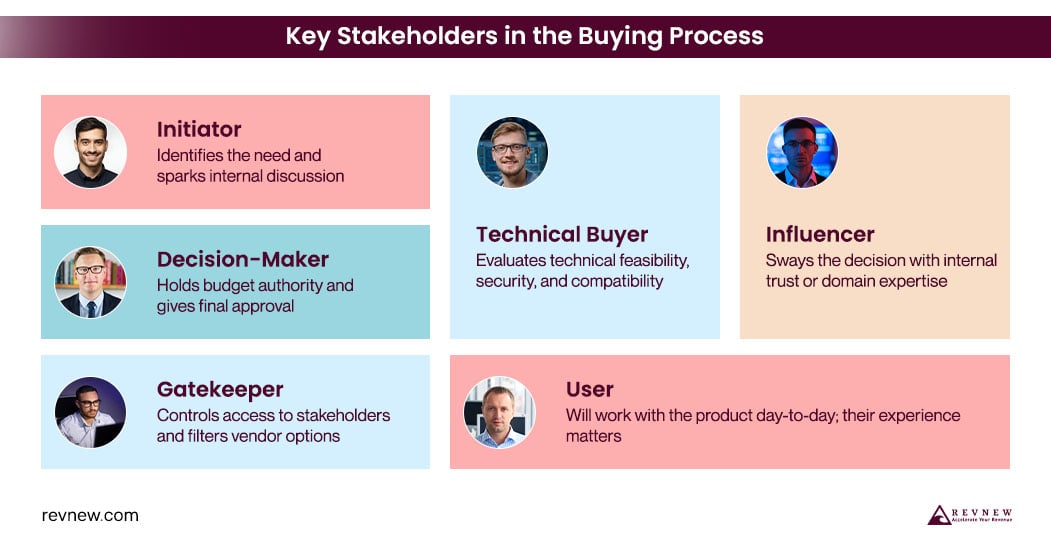
To bring all this together, let's look at one more resource that provides a very clear, consolidated view and introduces a final important role: the Blocker.
Buying Committee Marketing: ABM for 11-Stakeholder Deals
This article from Smarketers provides a fantastic summary table of the key buying committee archetypes.
Focus on the section "The 5 Buying Committee Roles (And What Each One Needs to See)" and study the table. It clearly defines the Champion, Economic Buyer, Technical Buyer, End User, and the Blocker/Skeptic, along with their primary concerns and what they need from marketing.
The "Blocker" or "Skeptic" is a crucial role to understand. This person isn't necessarily against your product, but they are focused on risk and defending the status quo. Their concerns (e.g., "This seems too disruptive," or "Our current solution works fine") must be addressed.
The image below shows how these roles might appear within a company's org chart.

Applying the Concepts: A Real-World Scenario
Let's solidify this knowledge by analyzing a concrete example. Imagine you're selling a cybersecurity training platform to a large company. Who needs to be involved?
5 types of B2B decision makers (& how to sell to each one)
This article from Dock walks through a hypothetical scenario of selling a product called Hoxhunt to DocuSign.
Read the section "Example decision-makers in a deal." It clearly identifies the role each executive plays in the decision: The CISO as the Champion. The CFO as the Economic Buyer. The CTO as the Technical Buyer. The company's employees as the End Users. The CEO as the ultimate Executive Decision-Maker.
This example perfectly illustrates how the abstract roles we've discussed map to real job titles and responsibilities. The CISO sees the security benefit, the CFO scrutinizes the cost, the CTO worries about integration, and the CEO ensures it aligns with company strategy. A successful GTM strategy must provide the right arguments and evidence for each of them.
Conclusion
Today, we've moved beyond the idea of a single buyer and delved into the complex reality of the B2B buying committee.
Here are your key takeaways:
- B2B purchases almost always involve a buying committee because they are high-stakes decisions impacting multiple parts of an organization.
- The key roles can be defined as the Decision-Maker (often an Economic or Executive buyer who gives the final approval), the Influencer (like a Technical or User buyer whose opinion is critical), and the Champion (an internal advocate who sells on your behalf).
- Each role has distinct motivations: the Economic Buyer cares about ROI, the Technical Buyer cares about integration and security, and the User cares about ease of use.
- Effective GTM marketing requires identifying these individuals and tailoring your messaging and content to address their specific concerns.
In our next lesson, we will complete this foundational module by defining what a go-to-market strategy is and how it acts as the master plan that connects product, marketing, and sales to navigate the buyer journey and the buying committee we've just discussed.