Welcome back! In our previous lesson, we established the three pillars of a GTM team: product marketing, demand generation, and brand marketing. Now, we'll explore the foundational framework that all these functions use to guide their strategies: the buyer journey.
Today's learning outcome is to map the stages of a B2B SaaS buyer journey (awareness to purchase) using a real-world product example. Understanding this journey is like understanding a user flow in an application; it shows the path someone takes to achieve a goal. For a marketing team, this "map" ensures that every interaction—from a blog post to a sales call—is delivered to the right person at the right time.
By the end of this lesson, you'll be able to trace a customer's path from identifying a problem to purchasing a software solution.
The Anatomy of a Journey
At its core, the buyer journey is the active research process a potential customer goes through before making a purchase. In B2B SaaS, this process is fundamentally different from a typical consumer purchase (like buying a pair of headphones). It's often longer, involves more people, and is based on a rigorous evaluation of business value.
For SaaS companies, the relationship doesn't end at the purchase; it's a continuous cycle. This is why it's useful to distinguish between the buyer journey (pre-purchase) and the customer journey (the entire lifecycle).
B2B SaaS Customer Journey: Stages, Map, Metrics & Strategy
This article from RightLeft Agency clearly outlines the difference between the buyer journey and the full customer journey.
Read the section titled "How Does the SaaS Buyer Journey Differ from the Customer Journey?" Pay close attention to the comparison table. It's a concise summary of the scope, goals, and teams involved in each phase.
While our main focus today is the pre-purchase buyer journey, understanding this broader context is crucial in the SaaS world, where long-term customer success is paramount.
The Three Core Stages of the Buyer Journey
The buyer journey is traditionally broken down into three main stages. A great way to understand them is to think about how you might debug a performance issue in a system you manage.
To get a clear definition of these stages, let's watch a video from HubSpot, a leader in marketing education.
How to Create a Great Buyer's Journey (For Beginners)
This video provides a foundational overview of the buyer's journey.
Watch the following three segments that define each stage: The Awareness Stage: This is when the buyer first realizes they have a problem. The Consideration Stage: The buyer has defined their problem and is now researching different types of solutions. The Decision Stage: The buyer has chosen a solution category and is comparing specific vendors. As you watch, notice the different keywords and questions the buyer uses at each stage.
Let's recap with an engineering analogy:
- Awareness: A developer notices that her team's deployments are slow and frequently fail. She starts searching for "why are our CI/CD builds so slow?" or "how to reduce deployment failures." She's defining her problem.
- Consideration: She's identified that their homegrown Jenkins setup is the bottleneck. She's now researching different approaches: "self-hosted vs. cloud CI/CD," or "benefits of serverless deployment pipelines." She's evaluating solution categories.
- Decision: She has decided that a managed, cloud-native CI/CD platform is the right approach. Now, she's actively comparing vendors like CircleCI, GitHub Actions, and our fictional "DeployZen." She's looking at pricing, reading reviews, and signing up for free trials.
Mapping the Journey: A Real-World B2B SaaS Example
Theory is useful, but seeing the journey in practice makes it concrete. We'll use a detailed example of a project manager, "Emelie," who is looking for a new software tool for her team. This is a classic B2B SaaS buying scenario.
A journey map is the visual representation of this entire process. It can look complex, but it's just a structured way to capture the customer's actions, thoughts, and feelings at each step.
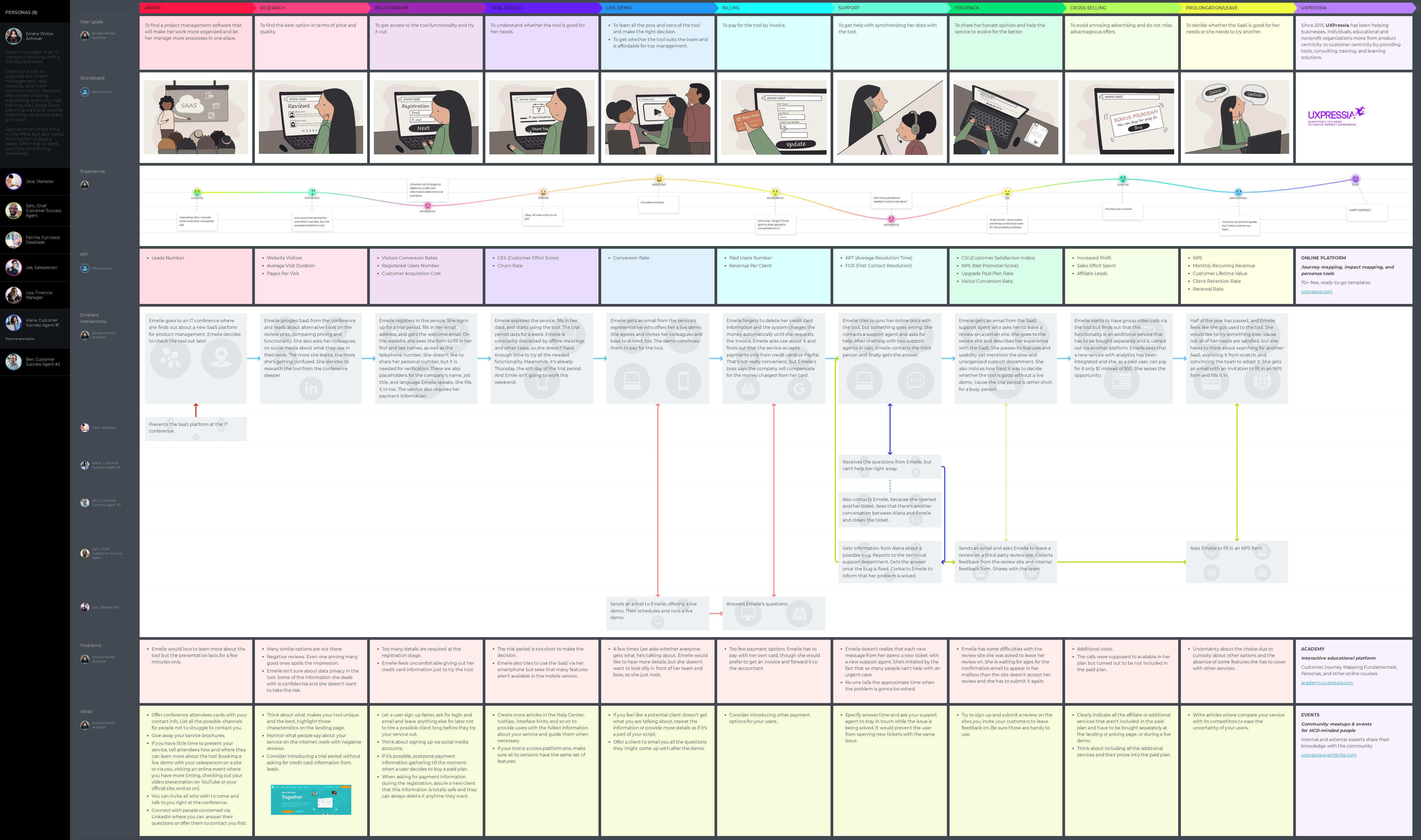
Now, let's trace Emelie's path step-by-step.
SaaS Buyer Journey Mapping - Guide + Free Template - UXPressia
This guide from UXPressia provides the detailed story behind the journey map you just saw. It walks through each stage of Emelie's experience with a project management tool.
Read the section "SaaS buyer journey stages," starting from "Aware" and continuing through "Billing." This will give you a detailed, practical look at how the three core stages (Awareness, Consideration, Decision) break down into more specific actions in a real SaaS context: Awareness: Emelie learns about the tool at a conference. Research (Consideration): She talks to friends and checks the tool's reputation. Registration & Trial (Consideration/Decision): She signs up and starts using the product. Live Demo (Decision): She involves her team and management to evaluate the tool. Billing (Purchase): The team decides to buy, but she hits a snag with the payment process. For each stage, notice Emelie's goals, her actions, and her pain points.
As you can see, the real-world journey isn't always a clean, linear path. It involves research, testing, getting buy-in from others, and navigating administrative hurdles like billing.
The Company's Perspective: The Sales Pipeline
While the buyer is on their journey, the SaaS company isn't just passively waiting. Internally, the sales and marketing teams are actively guiding this process through what's called a sales pipeline. These are two sides of the same coin: the buyer's journey is the external experience, and the sales pipeline is the internal process.
Let's watch a short video that breaks down the typical stages of a SaaS sales pipeline.
How To Build High Performing SaaS Sales Pipelines
In this video, Rob Walling explains the components of a high-performing SaaS sales pipeline.
Watch the segments that cover the first four components of the pipeline: Leads: The businesses that show initial interest. Qualification: Determining if the lead is a good fit. Presentation or Demo: Showcasing the product's value. The Close: Finalizing the purchase. As you watch, try to map these internal sales stages to the buyer journey stages we've discussed.
Here is how they typically align:
| Buyer Journey Stage (Customer's View) | Sales Pipeline Stage (Company's View) |
|---|---|
| Awareness | Leads (Inbound or Outbound) |
| Consideration | Qualification |
| Decision | Presentation/Demo & The Close |
| (Post-Purchase) | Onboarding |
Understanding this parallel structure is a key insight for any GTM marketer. Your job is to create marketing activities that help buyers move through their journey, which in turn moves them through the company's sales pipeline toward a purchase.
Conclusion
In this lesson, we've deconstructed the B2B SaaS buyer journey, transforming it from an abstract concept into a practical map that guides marketing and sales efforts.
Here are your key takeaways:
- The buyer journey is the customer's path from Awareness (having a problem), to Consideration (researching solutions), to Decision (choosing a specific product).
- In B2B SaaS, this journey is rarely linear. It's a detailed process that can include research, trials, demos, and getting team buy-in, as we saw with Emelie's story.
- The buyer journey is the customer-facing view, while the sales pipeline is the company's internal process for managing that journey.
- Mapping this journey allows marketing and sales teams to create targeted content and interactions that meet the buyer's needs at each specific stage.
In our next lesson, we will zoom in on a critical aspect of the B2B journey: the key roles in a buying decision. You're rarely selling to just one person, and we'll explore the different players involved, such as the champion, decision-maker, and influencer.