Welcome to your first lesson! We're kicking off your journey from backend engineering to go-to-market (GTM) marketing by building a solid foundation. This lesson will help you understand the core functions of a modern marketing team and how they work together.
Today's goal is to differentiate between product marketing, demand generation, and brand marketing. Think of these as the three core services in a marketing team's architecture. Just as you'd need to understand the roles of the authentication service, the database service, and the API gateway to build a robust application, you need to understand these three marketing pillars to build a successful GTM strategy.
By the end of this lesson, you'll be able to identify the unique responsibilities of each function and see how they collaborate, using a B2B SaaS company as our main example.
The Three Pillars of Marketing
In the world of B2B SaaS, marketing isn't a single, monolithic department. It's a combination of specialized functions working toward a common goal: business growth. The three most critical functions you'll encounter are:
- Product Marketing: The voice of the product in the market and the voice of the market to the product team.
- Brand Marketing: The guardian of the company's identity and long-term reputation.
- Demand Generation: The engine that drives customer acquisition and revenue.
Let's start with a short video that introduces these concepts.
Best SaaS Marketing Strategies For 2026
Watch this first clip from TK Kader's "Best SaaS Marketing Strategies" to get a quick overview of the three disciplines.
Pay attention to how he introduces and separates the three disciplines of marketing. Note his point about which two are most critical for startups.
Now, let's break down each of these areas in more detail.
1. Product Marketing: The Bridge Between Product and Market
Product Marketing (often called PMM) is arguably the role that most directly leverages a technical background. It acts as a critical translator between the team that builds the product (engineering) and the teams that sell and market it (sales, demand gen), all while focusing on the customer.
Think of it this way: as a backend engineer, you build and maintain the API. The Product Marketer is the one who writes the clear, compelling API documentation, creates the "Getting Started" guides, and presents at conferences to show developers not just how to use the API, but why it will solve their problems better than any other solution.
To get a clearer picture of Product Marketing's role and how it differs from Brand Marketing, let's dive into an article.
Product Marketing vs Brand Marketing: A Guide for SaaS Growth
This article from Mick-Mar Consulting does an excellent job of breaking down the core differences between product and brand marketing. It uses clear analogies and provides concrete examples.
Start by reading the introduction to grasp the core question: are you selling what you do or who you are? Read the section "The Core Difference Between Product and Brand Marketing" and pay close attention to the rocket launch analogy and the "at a glance" comparison table. Continue to "A Tale of Two Marketers." Focus on the specific goals and audience for Product Marketing. The example of Adobe Photoshop is a great illustration. Finally, review "A Tactical Breakdown of Key Metrics and Activities," focusing on the "Measuring Product Success" part. Note the KPIs like MQLs, SQLs, and CAC. We'll cover these in more detail in a later module.
Key takeaways for Product Marketing:
- Focus: The product itself—its features, benefits, and value.
- Goal: Drive demand, adoption, and revenue for a specific product.
- Core Activities: Go-to-market (GTM) strategy, product launches, positioning, competitive analysis, and sales enablement (creating materials that help salespeople sell).
2. Brand Marketing: Building the Company's Identity
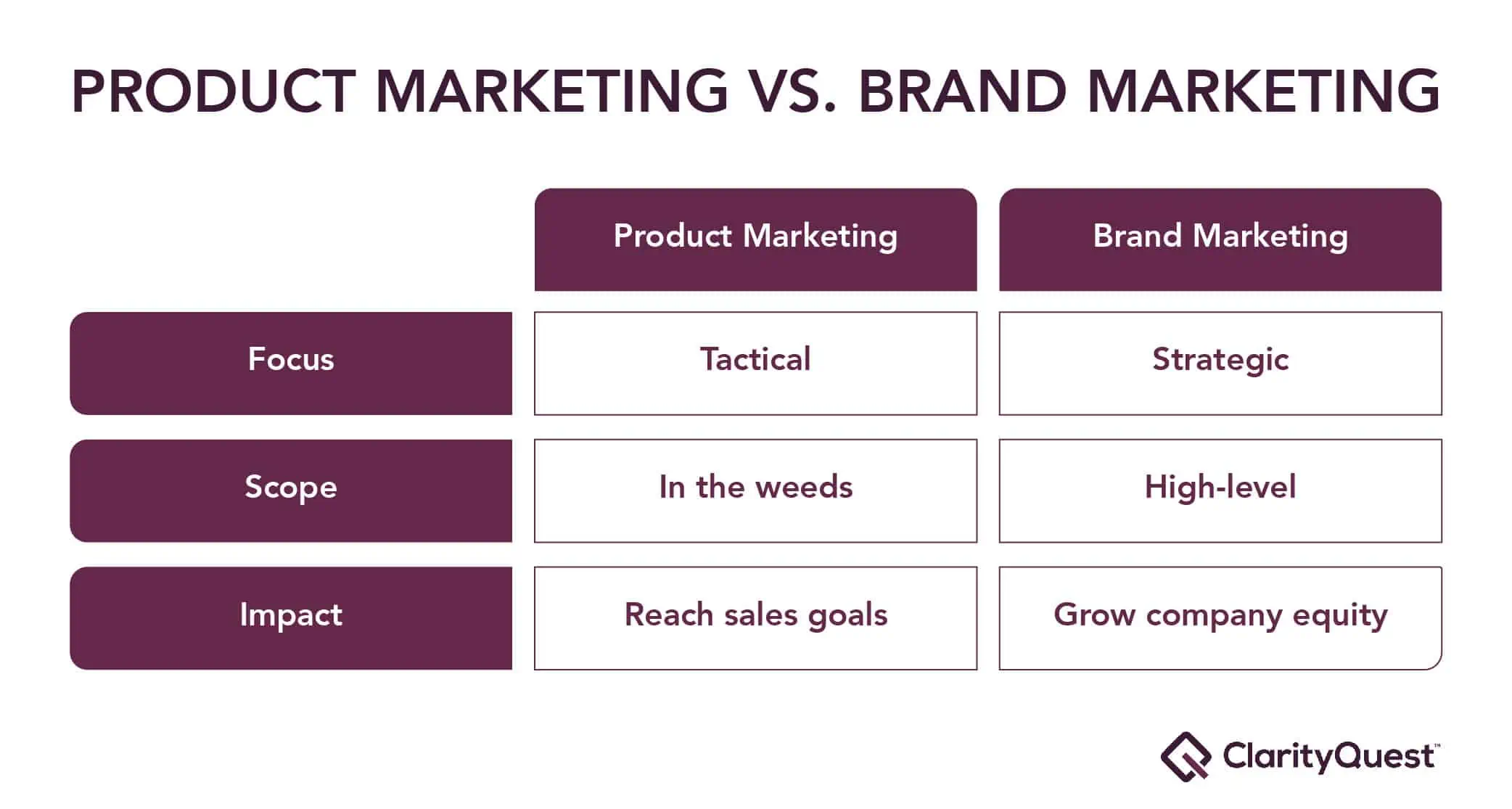
While product marketing is tactical and product-focused, brand marketing is strategic and company-focused. It's less about selling a specific product today and more about building a reputation that makes selling all products easier tomorrow.
To use our engineering analogy again: if the product is your API, the brand is your company's reputation in the open-source community or on sites like GitHub and Stack Overflow. It's the trust, goodwill, and recognition you've built that makes developers want to try your new projects.
Now, let's revisit the article to understand the brand marketing side of the equation.
Product Marketing vs Brand Marketing: A Guide for SaaS Growth
You've already read parts of this article. Now, go back and focus specifically on the Brand Marketing aspects.
In the sections "The Core Difference" and "A Tale of Two Marketers," reread the parts describing Brand Marketing. Pay attention to the Adobe "Creativity for All" campaign example. In "A Tactical Breakdown," review the KPIs for "Gauging Brand Impact," such as brand awareness and share of voice. Finally, read the section "How Team Structures and Workflows Compare" to understand how the organizational placement of these teams reflects their function.
This image provides a concise summary of the differences.
Key takeaways for Brand Marketing:
- Focus: The company's mission, values, and overall story.
- Goal: Build brand awareness, reputation, loyalty, and trust.
- Core Activities: Broad storytelling, public relations (PR), and shaping the company's identity and culture.
3. Demand Generation: Fueling the Growth Engine
If product marketing defines the message and brand marketing builds the reputation, demand generation (or "demand gen") executes the programs that turn that message and reputation into a pipeline of potential customers. This function is highly data-driven and focused on measurable results.
For an engineer, demand gen is like the process of driving traffic and sign-ups for your API. It involves creating tutorials and blog posts optimized for search engines (SEO), running targeted ads on developer forums, and setting up automated email workflows to guide users from their first API call to becoming a paying customer.
The following video clip introduces a great framework for thinking about demand generation activities.
Best SaaS Marketing Strategies For 2026
Let's return to the TK Kader video to learn about demand generation. He uses a memorable "Broadway show" analogy.
Watch the segment on demand generation marketing. Notice how he defines it in terms of generating pipeline and revenue and outlines a sequence of activities from organic social media to paid ads and events. This is the core of demand generation.
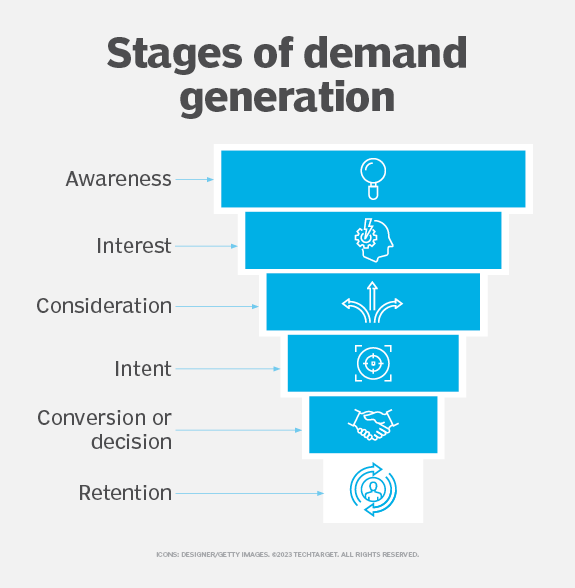
The process of guiding a potential customer from not knowing you exist to becoming a paying client is often visualized as a funnel.
Key takeaways for Demand Generation:
- Focus: Creating and capturing interest to fill the sales funnel.
- Goal: Generate qualified leads, pipeline, and revenue.
- Core Activities: SEO, content marketing, paid advertising (social, search), email marketing, and marketing operations (the tech stack).
Putting It All Together: A B2B SaaS Example
Let's imagine a fictional B2B SaaS company, "DeployZen," which offers a CI/CD platform for serverless applications. Here’s how the three marketing functions would work together:
-
Product Marketing would first conduct research and define the Ideal Customer Profile (ICP): Series A to C startups with 15-50 engineers who are building on AWS Lambda. They'd then craft the core positioning: "DeployZen is the CI/CD platform for serverless-first teams, reducing deployment times by 80% while eliminating configuration drift." They also create a sales battlecard comparing DeployZen to AWS's native tools and other competitors.
-
Demand Generation takes this positioning and builds campaigns. They create a blog post titled "5 Common Pitfalls of Serverless CI/CD on AWS" optimized for search engines. They run LinkedIn ads targeting "Senior Software Engineers" and "CTOs" at companies matching the ICP, promoting an ebook on "Best Practices for Serverless Deployment." When someone downloads the ebook, they enter an automated email sequence that nurtures them toward signing up for a free trial.
-
Brand Marketing works to establish DeployZen as a thought leader in the serverless space. They secure a speaking slot for the CEO at the AWS re:Invent conference, create a high-level video campaign about "The Future of Cloud-Native Development," and build relationships with key influencers in the serverless community. Their goal is to make "DeployZen" synonymous with "expert serverless CI/CD."
The article below provides an excellent real-world case study of Slack, illustrating this symbiotic relationship perfectly.
Product Marketing vs Brand Marketing: A Guide for SaaS Growth
This final section of the Mick-Mar article explains how these functions work together.
Read the section "Integrating Both Strategies for Maximum Growth", paying close attention to the "Case Study: The Symbiotic Growth of Slack." It shows how sharp product marketing and aspirational brand marketing worked in perfect harmony.
Conclusion
You've just taken your first major step into the world of GTM marketing. We've defined the three core pillars and seen how they function both independently and together.
Here are the key takeaways:
- Product Marketing is about the product. It defines the "what" and "for whom," focusing on positioning, launches, and sales enablement to drive adoption.
- Demand Generation is about pipeline. It executes measurable campaigns (the "how") to generate leads and revenue.
- Brand Marketing is about the company. It shapes the "why," building long-term reputation, trust, and awareness.
As a backend engineer, your analytical skills, systems thinking, and deep product understanding give you a unique advantage in all three areas, but especially in product marketing.
In our next lesson, we will explore the B2B SaaS buyer journey. This is a fundamental concept that all three marketing functions use to map out their strategies and understand how customers discover, evaluate, and purchase products.