Hello! Welcome back to our study of Vasanta Ritu.
In our previous lesson, we established a comprehensive strategy for managing the aggravated Kapha dosha of spring through diet (Ahara) and lifestyle (Vihara). This approach, known as Shamana or palliative therapy, is crucial for day-to-day balance. Today, we will explore Ayurveda's more definitive solution for seasonal imbalances.
Our learning outcome is to justify the selection of Vamana (therapeutic emesis) as the primary Shodhana (purification) for Vasanta Ritu based on the dosha state. We will connect the seasonal pathology we've already studied to the selection of a specific, powerful clinical intervention.
From Management to Elimination: The Role of Shodhana
Ayurvedic therapeutics operates on two levels:
- Shamana (Pacification): This involves managing doshas through diet, lifestyle, and herbs that pacify the imbalance without expelling it from the body. This is what we covered in our last lesson. It's like calming a bubbling pot.
- Shodhana (Purification): This is a more profound approach that aims to eliminate the excess, vitiated doshas from the body entirely. This is like emptying the pot to prevent it from boiling over again.
When a dosha is in its Prakopa stage (severe aggravation), as Kapha is in Vasanta, the classical texts strongly advise Shodhana as the most definitive treatment. It removes the root cause of the imbalance, cleanses the channels (srotas), restores Agni, and prevents the recurrence of disease.
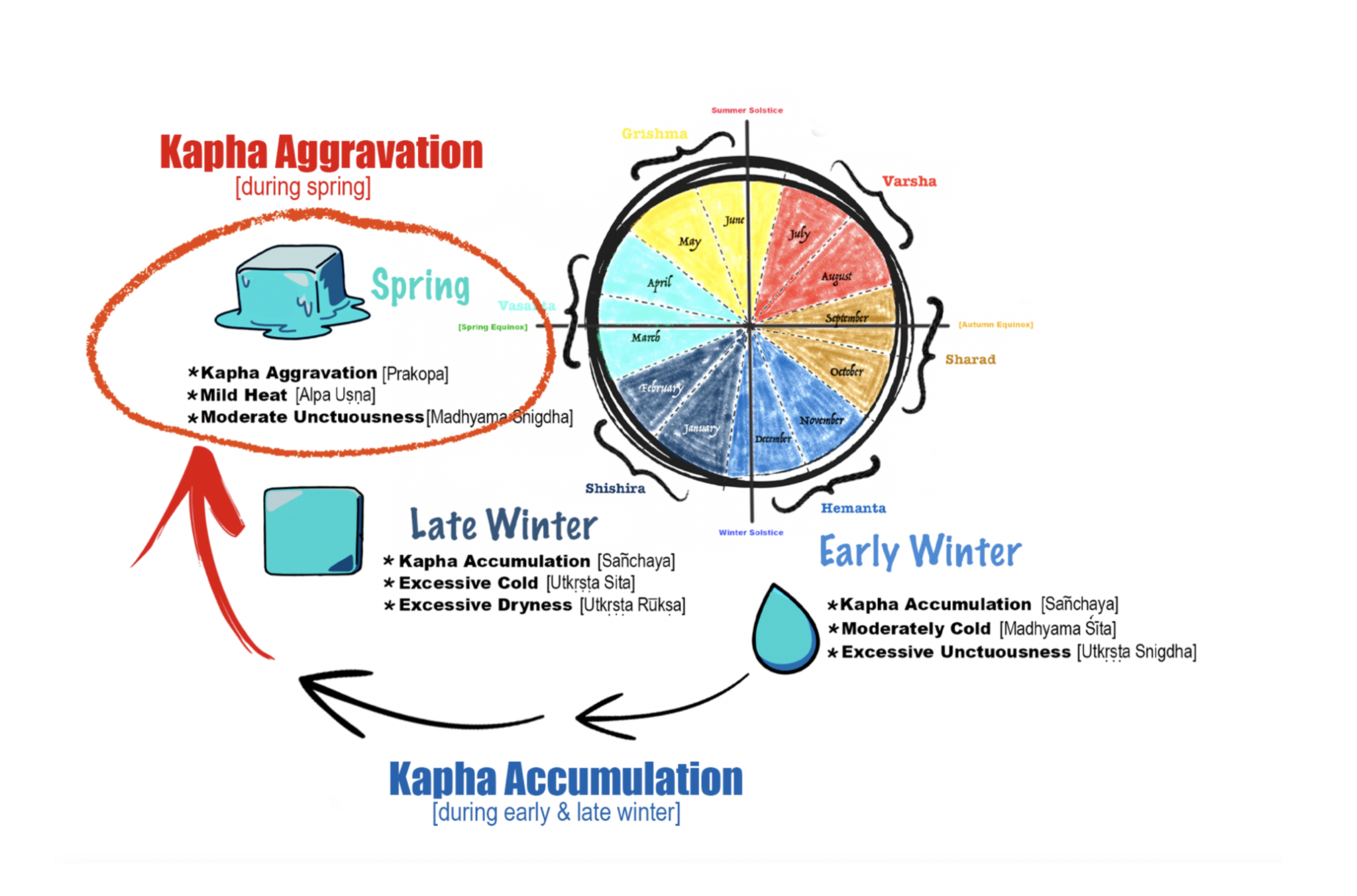
The Logic of Vamana: The Right Procedure for the Right Dosha
Panchakarma, the cornerstone of Shodhana, provides specific procedures for each dosha. For Kapha dosha, the primary therapy is Vamana.
The rationale is based on the natural pathways of the body. Each dosha has a primary seat (sthana) and a preferred route of expulsion. Charaka Samhita states that Vamana is the procedure for eliminating doshas from the upper parts of the body (urdhvabhaga), which is the principal seat of Kapha dosha.
A study on Vasantika Vamana (therapeutic emesis in ...
Let's begin by understanding the fundamental principles from a modern research perspective. This article clearly defines Vamana and its primary target.
Please read the introduction and the subsection titled 'Definition of Vamana'. Focus on two key points: 1) The general principle that Vamana is the primary therapy for Kapha Dosha. 2) The definition of Vamana as a procedure to eliminate doshas through the upper channels (mouth).
By performing Vamana, we are not forcing the body to do something unnatural. Instead, we are assisting it in expelling the excess Kapha through its most direct and efficient exit route.
The Logic of Vasanta: The Right Time for the Right Procedure
Now we connect the what (Vamana) with the when (Vasanta). The justification for Vasantika Vamana (Vamana in spring) rests on the precise physiological state of Kapha dosha during this season.
1. The Liquefaction of Kapha
As we have established, the Sheeta (cold) and Guru (heavy) qualities of winter cause Kapha dosha to accumulate and solidify (sanchaya). The increasing warmth of the sun in Vasanta Ritu then liquefies this solidified Kapha.
To visualize this critical process, let's watch a short video that uses a powerful analogy.
ĀYURVEDA: [Rtucharyā] ... Guidelines for Spring Season [Vasanta]
This video from Vedic Sage provides an excellent analogy for the state of Kapha in spring.
Watch the segment from 00:20 to 01:27. Pay close attention to the comparison of liquefied Kapha to melting snow from the mountaintops flooding the valleys below. This perfectly illustrates how Kapha overflows from its sites and impairs Agni.
This liquefied Kapha moves from the tissues (Shakha) to the gastrointestinal tract (Koshta), specifically concentrating in the stomach (Amashaya), which is the main seat of Kapha. The body is now primed for expulsion.
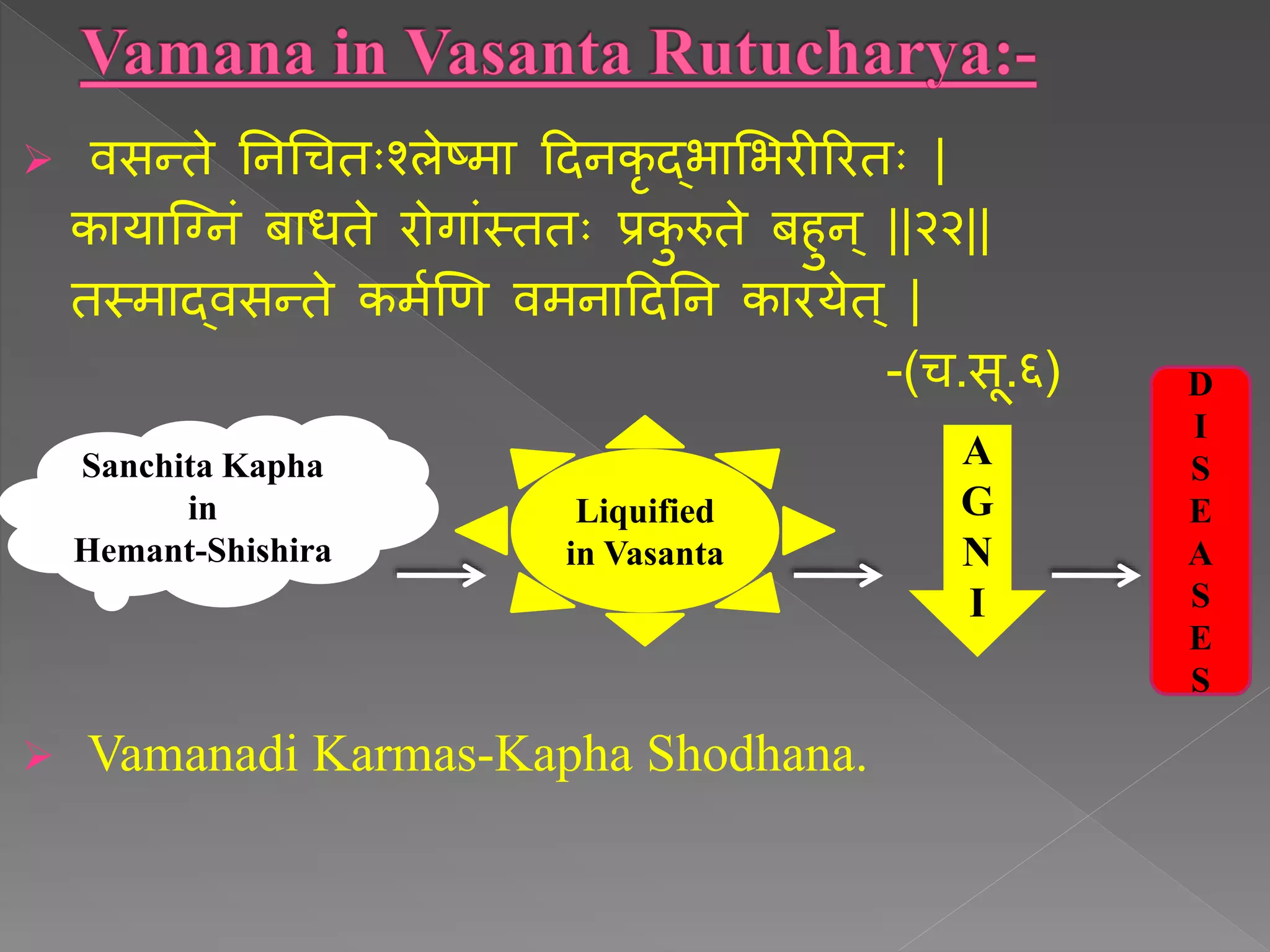
2. The Path of Least Resistance
With the aggravated, liquefied Kapha now residing in the upper GI tract, the principle of Shodhana becomes clear. The most direct, logical, and effective method to remove it is to expel it upwards, through the oral cavity.
VASANTA RITUCHARYA: THE AYURVEDIC GUIDE FOR ...
This text provides the final piece of the justification, explaining the anatomical and physiological reasoning for choosing Vamana.
Please read the section titled 'Discussion'. Focus on the sentence that begins, 'Kapha sthana is thorax and above...'. This is the core of the justification: because Kapha's seat is in the upper body, the nearest and most logical exit route is the mouth.
Therefore, performing Vamana in Vasanta is not just a treatment; it is a seasonal "reset" that aligns with the body's natural tendencies. We are utilizing the seasonal liquefaction of Kapha to our advantage, making its elimination easier and more complete.
Test your understanding!
A patient with a Kapha constitution suffers from severe spring allergies, heaviness after meals, and a constant dull headache every March and April. They have followed the Vasanta Ahara and Vihara with some relief, but the symptoms always return the following year. Based on today's lesson, what is the next level of treatment you would consider, and how would you justify it to the patient?
Show answer
The next level of treatment to consider is Vasantika Vamana.
Justification for the patient: "The diet and lifestyle changes we made are helping manage your symptoms by pacifying the excess Kapha in your system. However, the symptoms return each spring because the root cause—the large amount of Kapha that accumulated during winter—is still in your body. This accumulated Kapha melts every spring, causing your allergies and heaviness. Vamana is a purification therapy designed to completely remove this excess, liquefied Kapha from its main location in your stomach and chest. By eliminating the root cause, we can prevent these symptoms from recurring each year and truly reset your system for the season."
Conclusion: The Synthesis of Vasantika Vamana
You can now justify the selection of Vamana as the primary Shodhana for Vasanta Ritu based on a clear, deductive logic rooted in Dosha theory.
Key Takeaways:
- Shodhana (purification) is the definitive treatment for a dosha in a state of Prakopa (aggravation), as it removes the excess dosha from the body.
- Vamana (therapeutic emesis) is the primary Shodhana therapy for Kapha dosha because its main seat (sthana) is in the upper body (urdhvabhaga), and emesis is the most direct route of expulsion.
- Vasanta Ritu is the season of natural Kapha Prakopa, where the dosha becomes liquefied by the sun's heat and accumulates in the stomach (Amashaya).
- Therefore, Vasantika Vamana is the ideal intervention. It leverages the season's natural effect on the dosha to facilitate its complete removal, restoring Agni and preventing Kaphaja diseases.
Preview of the Next Lesson:
Having purged the body of excess Kapha and navigated spring, we now move into the peak of Adana Kala—the Grishma Ritu (summer). The sun's power is at its maximum, which introduces a new set of physiological challenges and dosha states. In our next lesson, we will deduce the Ahara and Vihara recommendations for Grishma to pacify Vata and manage heat, preparing the body for the most intense season of the year.