Hello! Welcome to your lesson on crafting a clinical strategy for the spring season.
In our last session, we established the core physiological event of Vasanta Ritu: the sun's increasing intensity liquefies the Kapha dosha that was accumulated and solidified during winter. This leads to Kapha Prakopa (aggravation), which overflows the body's channels (srotas) and dampens the digestive fire (agni), causing a host of ailments.
Today, we will build directly on that understanding. Our learning outcome is to deduce the appropriate Ahara (diet) and Vihara (lifestyle) recommendations for Vasanta Ritu to pacify this aggravated Kapha. We will move from the "why" of the pathology to the "how" of its clinical management, using classical principles to derive a logical and effective regimen.
The Guiding Principle: Samanya-Vishesha in Action
The cornerstone of Ayurvedic therapeutics is the principle of Samanya-Vishesha—like increases like, and opposites decrease. To pacify the aggravated Kapha, we must systematically apply therapies, foods, and activities that possess qualities opposite to it.
Recall the primary qualities (gunas) of Kapha dosha:
- Guru (heavy)
- Sheeta (cold)
- Snigdha (unctuous, oily)
- Manda (dull, slow)
- Sthira (stable, static)
- Slakshna (smooth)
Therefore, our entire regimen for Vasanta must be built around the opposing qualities:
- Laghu (light)
- Ushna (hot)
- Ruksha (dry)
- Tikshna (sharp, penetrating)
- Chala (mobile)
- Khara (rough)

Deducing the Vasanta Ahara (Dietary Regimen)
Our dietary strategy has two aims: to pacify the excess Kapha and to rekindle the suppressed Agni. This is achieved by selecting foods and tastes that embody the Laghu, Ruksha, and Ushna qualities.
1. Choosing the Right Tastes (Rasa)
The tastes we consume have a profound effect on the doshas. For Vasanta, the classical texts are unanimous.
Ashtanga Hrudaya Sutra Sthana Chapter 3: Ritucharya ...
Let's consult Ashtanga Hrudaya for the definitive guidance on which tastes to emphasize during spring. This is a foundational rule for constructing the Vasanta diet.
Please read the section titled 'Use of taste as per season'. Focus on the line that specifies the tastes for Vasanta: 'During Vasanta (spring season) – Tikta (Bitter), Katu (pungent) and Kashaya (astringent) tastes should be used more.'
The reason for this recommendation is that these three tastes—bitter, pungent, and astringent—are predominantly composed of the elements (Mahabhutas) that create the qualities needed to pacify Kapha and stimulate Agni. For instance, Katu Rasa (pungent) is rich in Agni (Fire) and Vayu (Air), making it hot, light, and drying.
Conversely, the tastes to be avoided are sweet (Madhura), sour (Amla), and salty (Lavana), as these are Kapha-aggravating.
2. Selecting Specific Foods and Drinks
With these principles of guna and rasa in mind, we can deduce the ideal foods. The goal is to move away from the heavy, nourishing diet of winter towards lighter fare.
To explore this in detail, let's turn to a couple of excellent video resources that explain these concepts practically.
03 | Ritucharya | Basics of Ayurveda | Dr. Gitanjali
First, watch this section from Dr. Gitanjali's video on Ritucharya. She clearly explains the pathology and then outlines the necessary changes in diet and lifestyle.
Watch the segment from 18:26 to 25:01. Pay close attention to the shift in diet she describes—from the heavy foods of winter to the 'ruksham' (dry) and easy-to-digest foods of spring. Note the specific examples she provides, like barley, millets, and honey.
ĀYURVEDA: [Rtucharyā] ... Guidelines for Spring Season [Vasanta]
Next, this video from Vedic Sage provides another clear perspective, emphasizing the qualities of food and recommended tastes.
Watch the clip from 01:45 to 03:08. Focus on how it links the impairment of Agni to the need for food that is 'light, dry and easy to digest' and predominantly 'bitter, pungent and astringent in taste'.
Synthesizing this information, we can build a clear list of indicated (Sevaniya) and contraindicated (Varjya) foods.
| Category | Indicated (Sevaniya) | Rationale (Why?) | Contraindicated (Varjya) |
|---|---|---|---|
| Grains | Old barley (Purana Yava), wheat (Godhuma), millets | Old grains are lighter (Laghu) and drier (Ruksha) than new grains. | New grains, heavy breads. |
| Vegetables | Bitter gourd (Karavellaka), pointed gourd (Patola), neem, roasted or steamed vegetables | Primarily Tikta (bitter) and Kashaya (astringent) tastes; light and easy to digest. | Heavy, starchy root vegetables like potatoes and sweet potatoes. |
| Pulses | Green gram (Mudga), lentils | Lighter and more astringent than other pulses. | Heavy pulses like black gram (Masha). |
| Sweeteners | Honey (Madhu) | Unique exception. Though sweet, its Ruksha (dry) and Lekhana (scraping) qualities make it excellent for pacifying Kapha. | Sugar, jaggery (unless old), and other heavy sweeteners. |
| Drinks | Warm water, water boiled with ginger (Shunti) or Musta, fermented drinks (Asava, Arishta), water with honey. | Ushna and Tikshna qualities stimulate Agni and help liquefy and move Kapha. | Cold water, cold drinks, milk products (especially yogurt/curd), sugary juices. |
| Meats | Meat of jungle animals (Jangala Mamsa), roasted meats (Shulya Mamsa) | These are considered lighter and drier than meat from marshy land animals. | Heavy, fatty meats. |
Test your understanding!
A patient asks if they can continue their winter habit of having a large bowl of oatmeal cooked with milk, sweetened with maple syrup, and topped with banana for breakfast during Vasanta. Based on the principles of guna and rasa, how would you advise them and why?
Show answer
You should advise against this breakfast. Here's the deductive reasoning:
- Oatmeal: Guru (heavy) and Snigdha (unctuous).
- Milk: Guru, Sheeta (cold), and Snigdha.
- Maple Syrup: Madhura (sweet) and Guru.
- Banana: Madhura (sweet) and Guru.
Every component of this meal possesses qualities that are the same as or similar to Kapha. This breakfast will directly increase the already aggravated Kapha dosha and further suppress the weakened Agni. A better alternative would be a savory dish made from barley or millet, seasoned with pungent spices.
Deducing the Vasanta Vihara (Lifestyle Regimen)
Lifestyle modifications are equally critical. The goal is to counter Kapha's Sthira (static) and Manda (slow) nature with activities that are dynamic (Chala) and stimulating (Tikshna).
1. Physical Activity (Vyayama)
This is non-negotiable in Vasanta. Vigorous physical exercise is essential to increase metabolism, generate heat, and promote circulation, preventing stagnation.
- Recommended: Brisk walking/jogging, wrestling (niyuddha), weight lifting, and other challenging exercises.
- Rationale: Counters the heavy, static nature of Kapha.
2. Body Care
- Udvartana (Powder Massage): Instead of an oil massage (Abhyanga), which is Snigdha, Vasanta calls for massage with dry, herbal powders. This imparts a Ruksha (dry) and Khara (rough) quality, directly opposing Kapha's oiliness.
- Bathing: Use warm water.
- Anulepana (Application of Pastes): After bathing, apply pastes of substances like camphor (Karpura), sandalwood (Chandana), and saffron (Kumkuma). This helps manage the external heat of the season without adding to the internal coldness or dampness of Kapha.
3. Critical Contraindications
- Divaswapna (Day Sleep): This is strictly forbidden. Sleeping during the day is one of the primary causes of Kapha aggravation. It increases the Snigdha and Guru qualities and leads to channel obstruction (srotorodha).
- Sedentary Lifestyle: Avoid inactivity, as it promotes the stagnation inherent to Kapha.
For a comprehensive list of these recommendations from classical sources, you can review the following text.
VASANTA RITUCHARYA: THE AYURVEDIC GUIDE FOR ...
This article, 'VASANTA RITUCHARYA', provides a well-organized summary of both the indicated and contraindicated lifestyle practices, drawing from multiple classical texts.
Please read section '2. Vihara (Lifestyle)', paying attention to both the 'Indications' (like vyayama) and the 'Contraindications' (like day sleep). This will reinforce the Vihara plan.
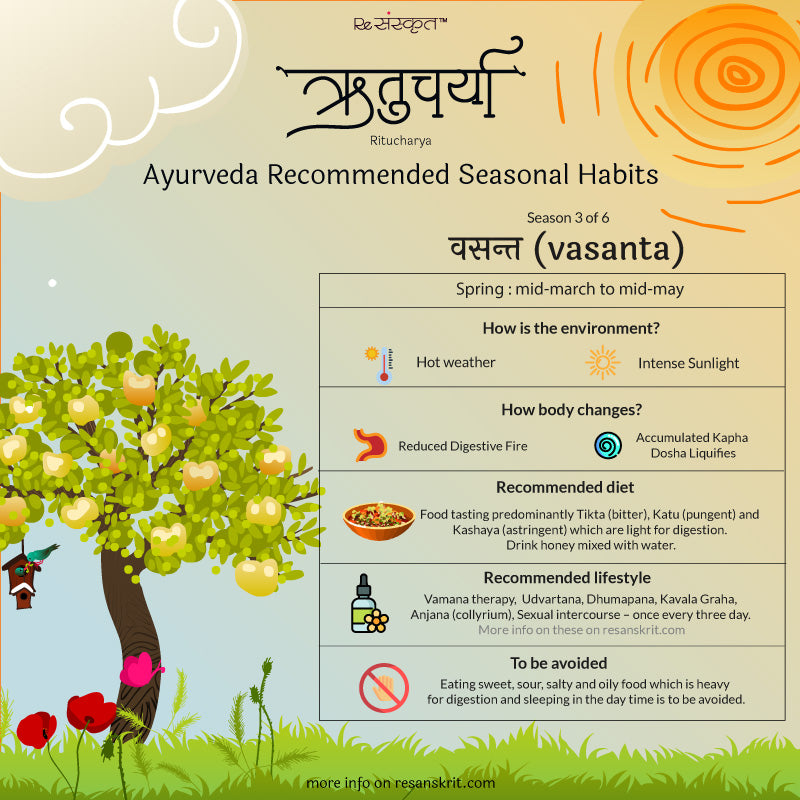
This summary image provides a great visual overview of the entire strategy we have discussed.
Conclusion
You can now see how the Ahara and Vihara for Vasanta Ritu are not an arbitrary list of rules but a logical, deductive clinical strategy. By understanding the pathology of Kapha Prakopa, you can derive the entire regimen from the single principle of applying opposing qualities.
Key Takeaways:
- The regimen for Vasanta Ritu is designed to counter the qualities of aggravated Kapha: it must be light, dry, warm, sharp, and mobile.
- Ahara (Diet): Emphasize foods with bitter (Tikta), pungent (Katu), and astringent (Kashaya) tastes. Old barley, light vegetables, honey, and warm, spiced water are ideal. Avoid heavy, oily, cold foods and sweet, sour, and salty tastes.
- Vihara (Lifestyle): Incorporate vigorous exercise (Vyayama) and dry powder massage (Udvartana). Strictly avoid sleeping during the day (Divaswapna).
Preview of the Next Lesson:
While these dietary and lifestyle changes are crucial for managing Kapha, Ayurveda also has a more powerful tool for eliminating the aggravated dosha from the body entirely: Shodhana (purification). In our next lesson, we will justify the selection of Vamana (therapeutic emesis) as the primary Shodhana for Vasanta Ritu, completing your clinical toolkit for the spring season.