Hello! Welcome back to our journey through the seasons.
In our last few lessons, we navigated Vasanta Ritu, understanding the aggravation of Kapha and culminating in the justification for Vamana as the definitive purification therapy. Now, we leave the dampness of spring behind and step into the full intensity of summer.
This lesson focuses on Grishma Ritu, the peak of Adana Kala. Our learning outcome is to deduce the Ahara (diet) and Vihara (lifestyle) recommendations for Grishma to pacify Vata and manage the intense heat. This is not about memorizing lists, but about understanding the physiological principles that dictate a safe and healthy passage through the hottest time of the year.
The Astronomical and Physiological Setting of Grishma
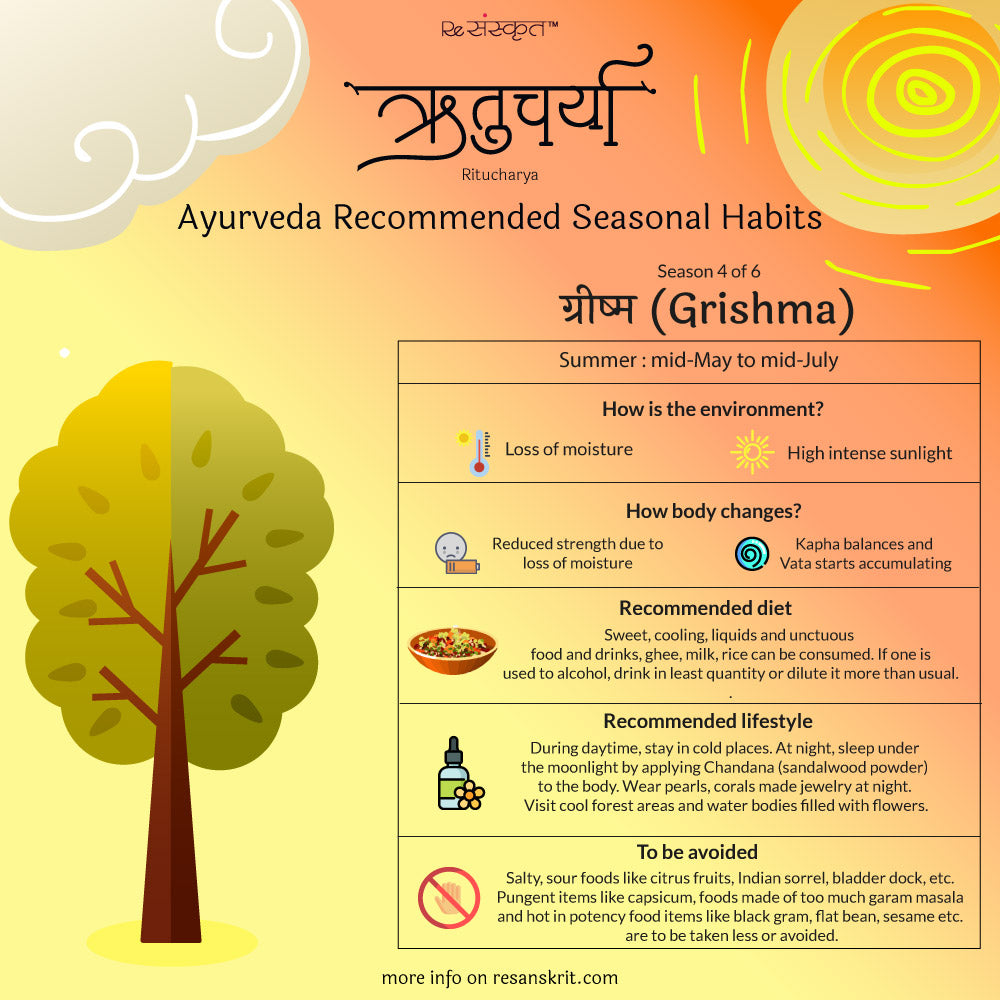
As we've established, Ritucharya is fundamentally a response to the sun's journey. Grishma Ritu, corresponding to the sun's transit through the Rashis of Vrishabha (Taurus) and Mithuna (Gemini), represents the zenith of Uttarayana. The sun reaches its maximum northern declination, resulting in the longest days, the most direct solar radiation, and the most intense heat and dryness.
This intense solar energy (Adana Shakti) has a profound effect on the body, creating a unique physiological environment. To deduce the correct regimen, we must first understand this internal landscape.
Lifestyle and Dietary Guidelines in Summer season
This paper provides a concise summary of the environmental and bodily changes during Grishma. It will help us establish the core principles for our regimen.
Please read the section 'Characteristics of the Rutu (season) In General' and the subsection 'Changes in the Body'. Focus on how the environmental qualities (intense heat) translate into bodily changes: the depletion of moisture (Jaleeya tatva), the decrease in strength (Deha Bala), the mild state of digestive fire (Agni), and the resulting Dosha states.
From this reading, we can identify three primary physiological challenges in Grishma:
- Depletion of Soumya Guna: The sun's intense heat (Ushna) and dryness (Ruksha) evaporate the cooling, moist, and unctuous qualities (Soumya Guna or Jaleeya Amsha) from the environment and, by extension, from our bodies.
- Resulting Dosha Imbalance: This leads to a pacification (Shamana) of the naturally moist Kapha Dosha and, critically, an accumulation (Sanchaya) of Vata Dosha, which is characterized by dryness and lightness.
- Weakened Bala and Agni: The loss of Kapha (which provides substance and strength) and the general depletion caused by the heat result in a natural decrease in physical strength (Bala). Furthermore, the body’s energy and fluids are drawn to the periphery to cool the skin, leaving the core digestive fire (Jatharagni) in a mild state (Mandagni).
Our entire regimen for Grishma is a logical response to these three points.
Deducing the Grishma Ahara (Diet)
The Principle: The diet must counteract heat and dryness, replenish fluids, and be easy to digest. Therefore, we must favor foods with Madhura (sweet), Snigdha (unctuous), Sheeta (cold), and Drava (liquid) qualities.
- Madhura Rasa is naturally cooling, nourishing (Brimhana), and pacifies Vata.
- Snigdha Guna counteracts the pervasive dryness (Rukshata) of the season.
- Sheeta Guna directly counters the environmental heat.
- Drava Guna is essential to replenish the fluids lost through sweat.
Lifestyle and Dietary Guidelines in Summer season
Now let's look at the specific dietary applications of these principles.
Read the subsections 'Hitakar Ahar (Compatible diet)' and 'Ahitkara Ahar (Non compatible diet)'. Note the examples of recommended foods and drinks, and critically, the tastes that should be avoided.
What to Favor (Hitakar Ahara):
- Grains and Proteins: Rice and lentils that are light to digest.
- Fats: Ghee is particularly recommended for its cooling and Vata-pacifying properties.
- Dairy: Milk is nourishing and cooling. Buttermilk (Takra) is an excellent digestive and hydrating drink. Sour curd, however, should be avoided as it is heavy and can block channels (Abhishyandi).
- Fruits & Sweeteners: Sweet fruits like mangoes and grapes are ideal. Sugar candy (Mishri) can be used.
- Liquids: This is paramount. Copious intake of cool water, fruit juices (Panaka), and gruels like Saktu (roasted grain flour mixed with water and sugar) is advised. These not only hydrate but also replenish electrolytes and provide instant energy.
What to Avoid (Ahitkar Ahara):
- Tastes: Foods that are predominantly Amla (sour), Lavana (salty), and Katu (pungent) should be avoided. These tastes are heating and can aggravate dryness.
- Alcohol: Should be avoided or taken in very small quantities, heavily diluted with water. It is intensely heating and dehydrating, leading to burning sensations and inflammation.
Deducing the Grishma Vihara (Lifestyle)
The Principle: The lifestyle must focus on conserving energy (Bala) and actively cooling the body, protecting it from the harsh external environment.
Let's explore the classical recommendations and the scientific reasoning behind them.
Heat Adaptability mechanisms & measures of Greeshma Ritu
This research paper provides a brilliant bridge between ancient recommendations and modern physiology, particularly regarding thermoregulation. It helps us understand why the Vihara works.
First, quickly read the general recommendations in the section starting with 'Greeshma Ritucharya (Regimens of summer season)'. Next, read the 'Discussion on Heat adaptive measures in Greeshma Ritu' (section 1), focusing on how the body loses heat via conduction, convection, and evaporation. Finally, read the section 'Vyayama, Vyavaya and Nidra in Greeshma Ritu' (section 3) to understand the logic behind activity modification.
By combining the classical advice with modern physiology, we can deduce the following:
1. Actively Cool the Body:
- Cold Water Baths: Promote heat loss through conduction and convection.
- Applying Chandana Lepa (Sandalwood Paste): The paste is naturally cooling. As it warms on the skin, it absorbs body heat through conduction.
- Wearing Light, Thin Clothes: This allows for better air circulation and facilitates heat loss through convection and the evaporation of sweat.
- Staying in Cool Places: Spending time in gardens, near lakes, or in a Shita Griha (a naturally or artificially cooled room) uses the principle of convection, as the surrounding cool air continuously draws heat away from the body. Sleeping on an open-air terrace at night takes advantage of the cool night air and moonlight.
2. Conserve Energy:
- Avoid Vyayama (Strenuous Exercise): As we know, Bala is at its lowest. Exercise drastically increases core body temperature and places a dual demand on the cardiovascular system: supplying the muscles and sending blood to the skin for cooling. In the heat of summer, this can lead to a dangerous rise in core temperature, dehydration, and exhaustion.
- Limit Vyavaya (Sexual Intercourse): This is an energy-depleting activity and should be limited to once a fortnight to preserve Bala.
- Embrace Divaswapna (Day Sleep): Grishma is the only season where day sleep is recommended for healthy individuals. The nights are short, and the days are long and draining. A short nap during the day helps to replenish lost energy, calm the accumulating Vata, and compensate for shorter nights.
Test your understanding!
A patient who works as a construction site supervisor in a hot climate complains of constant fatigue, irritability, dry skin, and a poor appetite during the summer months. They mention they are trying to "sweat it out" by jogging after work and drinking salty energy drinks to rehydrate.
Based on the principles of Grishma Ritucharya, identify two flawed approaches in their current routine and propose two corresponding corrective actions, explaining your reasoning.
Show answer
Flawed Approach 1: Strenuous jogging after work.
-
Reasoning: In Grishma, Bala (strength) is naturally low, and the body is already under heat stress. Strenuous exercise further depletes energy, increases core body temperature, and exacerbates dehydration, leading to fatigue, not health.
-
Corrective Action: Advise them to stop jogging and instead engage in gentle, cooling activities like a slow walk in a park during the evening or spending time near water. Day sleep is also recommended to restore energy.
Flawed Approach 2: Drinking salty energy drinks.
-
Reasoning: The Lavana (salty) taste is heating and will worsen the effects of the summer heat. While electrolytes are needed, commercial energy drinks are often not the ideal solution.
-
Corrective Action: Advise them to replace the salty drinks with naturally cooling and hydrating liquids like sweet buttermilk (takra), tender coconut water, or a homemade drink of water with a little sugar candy (mishri) and lemon. These provide fluids and minerals without the heating quality of excess salt.
Conclusion
You can now see how the complete regimen for Grishma Ritu is a logical and internally consistent system designed to manage the specific challenges of the season. It is not an arbitrary list of rules but a sophisticated strategy to maintain homeostasis.
Key Takeaways:
- Grishma Ritu is the peak of Adana Kala, characterized by intense environmental heat (Ushna) and dryness (Ruksha).
- This leads to a depletion of the body's cooling qualities (Soumya Guna), accumulation of Vata Dosha, and a natural decrease in strength (Bala) and digestive fire (Agni).
- The recommended Ahara is based on Madhura, Snigdha, Sheeta, and Drava properties to nourish, cool, and hydrate.
- The recommended Vihara is based on conserving energy (avoiding exercise, limiting sex) and actively cooling the body (baths, cool environments, day sleep).
Preview of the Next Lesson:
We have established that strenuous activities are contraindicated in Grishma due to low Bala. But what exactly is the physiological mechanism behind this loss of strength? In our next lesson, we will delve deeper and explain the contraindication of strenuous activities during Grishma based on low Bala (strength), connecting the classical Ayurvedic concept to modern physiological understanding of thermoregulation and exertion.