Welcome back. In our previous lesson, we used the resource-based view and the VRIO framework to pinpoint which specific HR capabilities can create a sustainable competitive advantage for an organization. This gave us a method for identifying what is strategically important within the HR function.
Today, we will address the next critical question for any senior HR leader: how do we connect these strategic HR practices to the overarching goals of the business? We will explore two powerful frameworks for this purpose: the HR Value Chain and the Balanced Scorecard. Mastering these tools will enable you to articulate and measure HR's contribution in a language that resonates with the C-suite, moving the conversation from HR as a cost center to HR as a strategic partner.
The HR Value Chain: Tracing the Path from Activity to Impact
Before we can measure HR's impact, we need a clear model of how it creates value. The HR Value Chain provides exactly this. It's a conceptual model that illustrates the cause-and-effect chain, starting from foundational HR capabilities and ending with tangible business results.
Let's examine a modern interpretation of this concept.
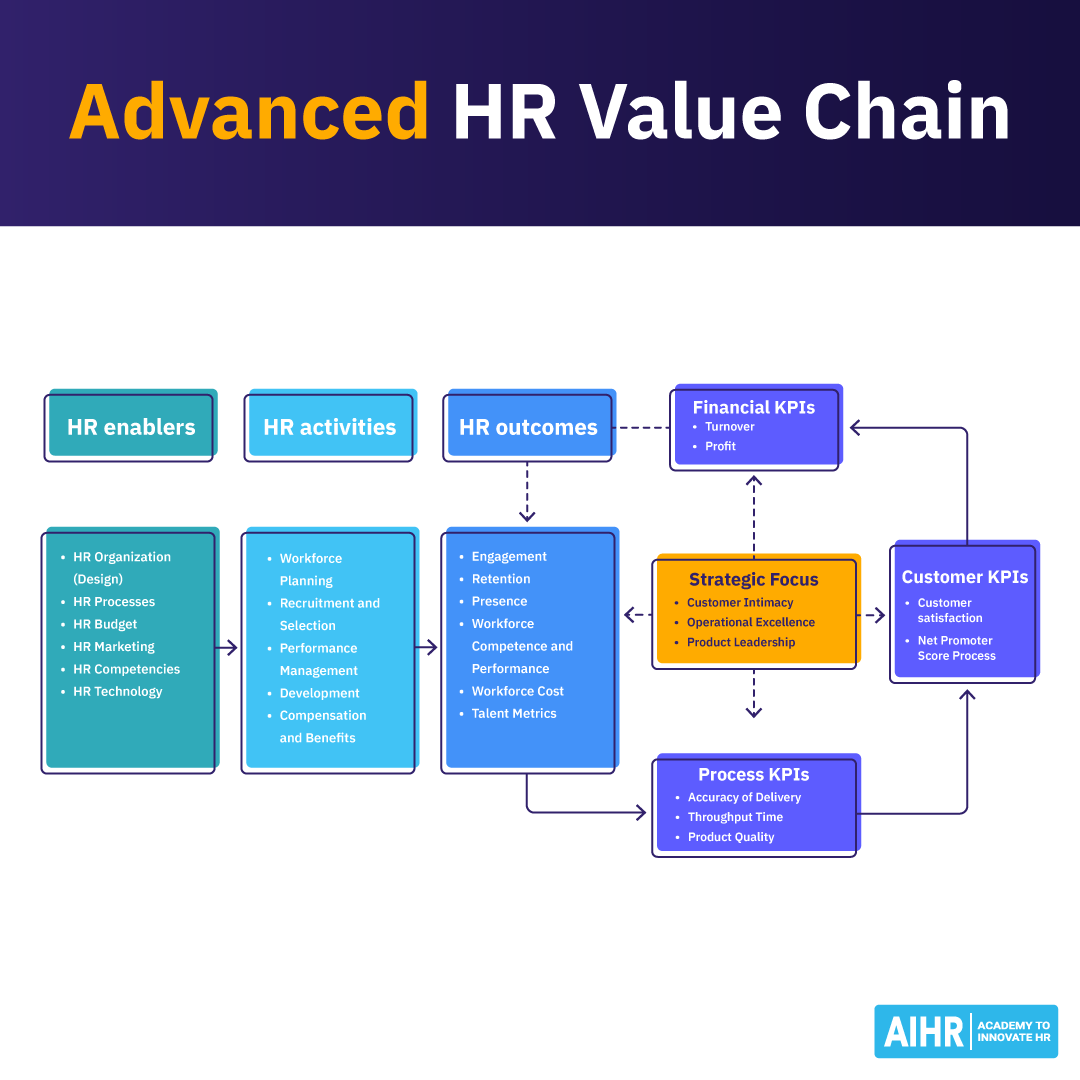
As you can see, the model outlines a clear progression:
- HR Enablers: These are the foundational resources that HR needs to operate effectively, such as the design of the HR organization, its budget, technology (HRIS), and the competencies of the HR team itself. This is the organizational capacity we discussed in the VRIO lesson—the "O" for "Organized to capture value."
- HR Activities: These are the core processes and practices that HR executes. This is where the valuable, rare, and inimitable capabilities you identified with VRIO—like a unique recruitment process or a high-impact development program—come into play.
- HR Outcomes: These are the direct results of your HR activities. They are the leading indicators of business performance and include metrics you are familiar with, such as employee engagement, retention, workforce competence, and talent metrics.
- Business KPIs: This is the final link in the chain, where HR outcomes translate into measurable business impact across Financial, Customer, and Process Key Performance Indicators (KPIs). Notice how the "Strategic Focus" (e.g., Customer Intimacy, Operational Excellence, Product Leadership) dictates which KPIs are most important, ensuring that HR's efforts are aligned with the company's competitive strategy.
This value chain provides a logical narrative for your strategic contribution. For instance, by investing in an HR enabler (e.g., a new applicant tracking system), you can improve an HR activity (e.g., recruitment), which leads to a better HR outcome (e.g., improved quality-of-hire), which ultimately drives a Business KPI (e.g., higher sales productivity or improved customer satisfaction).
The Balanced Scorecard: A Holistic Framework for Strategy
While the value chain shows the flow, the Balanced Scorecard (BSC), developed by Robert Kaplan and David Norton, provides a robust framework for measuring and managing strategic performance. Its core innovation was to encourage organizations to look beyond lagging financial indicators and "balance" them with metrics from three other crucial perspectives.
To get a firm grasp of this foundational framework, let's watch a short video.
The Balanced Scorecard Explained with Examples
This video from the EPM channel provides a clear, concise overview of the Balanced Scorecard framework.
Please watch the first part, which explains what a balanced scorecard is and its key characteristics. Then, continue through the section that details each of the four perspectives: Financial, Customer, Internal, and Learning & Growth.
As the video explained, the four perspectives provide a comprehensive view of organizational performance:
- Financial Perspective: How do we look to shareholders? (e.g., profitability, revenue growth)
- Customer Perspective: How do customers see us? (e.g., satisfaction, market share)
- Internal Business Process Perspective: What must we excel at? (e.g., operational efficiency, quality)
- Learning and Growth Perspective: How can we continue to improve and create value? (e.g., employee skills, technology, culture)
The true power of the BSC lies in the cause-and-effect relationships between these perspectives. The logic flows from the bottom up: investments in Learning and Growth (e.g., employee training) enable improvements in Internal Processes (e.g., faster product development), which in turn lead to better outcomes for the Customer (e.g., innovative products), ultimately driving superior Financial results.
Creating an HR-Specific Balanced Scorecard
The Balanced Scorecard is a corporate-level framework, but it can be effectively adapted to create a scorecard for the HR function itself. An HR Scorecard translates the four perspectives to demonstrate how HR contributes to the overall business strategy.

Let's dive into a detailed, practical example of what a well-developed HR Balanced Scorecard looks like.
HR Balanced Scorecard: Full Guide with KPIs
This guide from BSC Designer provides a comprehensive, worked example of an HR Scorecard, complete with goals, metrics, and initiatives.
Please read the section titled "An Example of the Balanced Scorecard for HR". As you review the breakdown for each of the four perspectives (Customer, Internal, Learning & Growth, and Financial), focus on the following: Strategic Goal: The high-level objective within that perspective. Metrics: The distinction between lagging indicators (outcome measures) and leading indicators (driver measures). Initiatives: The specific actions or projects designed to achieve the goal.
This example makes the theoretical framework tangible. Notice the clear cause-and-effect logic flowing upwards through the perspectives in the example:
- Learning & Growth: The strategy starts here, with goals like "Understand Diversity and Inclusion" and "Formulate New Recruitment Principles." This builds the necessary skills and infrastructure.
- Internal Processes: This foundation allows HR to improve key processes, such as "Recruitment programs improvement" and "Diversity and inclusion" initiatives.
- Customer: The "customers" of HR are the other business units and the organization as a whole. Improved internal HR processes lead to better service for these customers, helping them "Improve talent attraction" and "Widen the potential talent pool."
- Financial: The culmination of these efforts is a tangible financial impact, where "Teams Create More Value at Lower Cost," measured by KPIs like "Revenue per employee."
By structuring your HR strategy in this way, you create a clear, compelling narrative that connects your team's day-to-day work directly to the company's bottom line.
Conclusion
In this lesson, we have equipped you with two of the most critical frameworks for strategic HR management. You now have the tools to not only identify strategic capabilities but also to map their contribution to business success in a structured and measurable way.
Key Takeaways:
- The HR Value Chain models the cause-and-effect flow from HR activities to HR outcomes and finally to business KPIs.
- The Balanced Scorecard (BSC) is a strategic management framework that measures performance across four balanced perspectives: Financial, Customer, Internal Processes, and Learning & Growth.
- An HR Scorecard adapts the BSC to the HR function, defining specific goals, metrics (KPIs), and initiatives within each perspective to demonstrate HR's strategic alignment and contribution.
- The logic of the BSC flows from the bottom up: investments in Learning & Growth drive improvements in Internal Processes, which satisfy Customers and ultimately yield Financial results.
These frameworks provide the blueprint for demonstrating HR's strategic value. In our next lesson, we will bring this blueprint to life by learning how to construct an HR strategy map. This visual tool connects the dots between the goals on your scorecard, creating a powerful one-page story of your HR strategy that is perfect for communicating with senior leadership.