Hello! Welcome back.
In our last lesson, we learned how to build an HR strategy map, creating a powerful visual story that links HR initiatives to business outcomes. A map, however, is only as good as the vehicle you use to travel the proposed route. Today, we focus on building that high-performance vehicle.
This lesson addresses the concept of a High-Performance Work System (HPWS). We will define what constitutes an HPWS and, more importantly, learn how to evaluate your own HR system against its core principles. The goal is to equip you with a framework for assessing two critical dimensions: strategic fit (does your HR system support your company's strategy?) and internal consistency (do your HR practices work together, or do they contradict each other?). For an aspiring senior HR leader, being able to conduct this kind of systemic audit is a fundamental strategic capability.
Defining the "High Road"
The idea of a High-Performance Work System is best understood by contrasting two fundamentally different approaches to managing people, often termed the "high road" and the "low road." You are likely familiar with companies that embody both philosophies. The "low road" strategy treats labor as a cost to be minimized, often leading to high turnover, low wages, and minimal investment in employee skills. The "high road," in contrast, treats employees as a source of value to be maximized, investing in their skills, engagement, and well-being to drive innovation, quality, and long-term profitability.
To see this contrast in action, let's watch a segment from an MIT course that uses the classic examples of Walmart and Costco to illustrate these different paths. It then outlines the key components that define a high-road, high-performance system.
This video from MIT OpenCourseWare provides a clear, practical introduction to High-Performance Work Systems by contrasting "high-road" and "low-road" business strategies.
Please watch from the beginning of the comparison between Walmart and Costco. This clearly illustrates the two competing philosophies. Then, pay close attention to the next segment, which lists the specific HR practices that constitute a high-performance, "high-road" system. These are the criteria we will use for our evaluation.
As the video explains, a High-Performance Work System is not a single initiative but a bundle of interconnected HR practices. The key takeaway is that their power comes from their synergy. The core components, or High-Performance Work Practices (HPWPs), typically include:
- Selective Hiring: Rigorous processes to hire for both technical skills and cultural fit.
- Extensive Training: Continuous investment in developing employee skills and capabilities.
- Empowered Teams: Decentralizing decision-making and encouraging employee involvement.
- Performance-Based Pay: Compensation systems that align employee incentives with organizational performance.
- Information Sharing: Transparency about business performance and strategy.
- Employment Security: A commitment to job security that fosters trust and loyalty.
An HR system achieves "high performance" when these practices are woven together to enhance employees' Abilities, Motivation, and Opportunities to contribute (a common framework known as AMO).
Evaluating an HR System: Fit and Consistency
Now that we have the criteria, how do we use them to evaluate an HR system? We look at two types of alignment.
-
Strategic Fit (Vertical Alignment): This measures how well the HR system supports the organization's overall business strategy. For example, if your company's strategy, as reflected in your strategy map from the last lesson, is to be an innovation leader, your HPWS must reinforce that. You would need HR practices that reward smart risk-taking, foster collaboration, and attract creative talent. A system designed for a low-cost, high-efficiency strategy would look very different. The "best" HR system is the one that fits the strategic context.
-
Internal Consistency (Horizontal Alignment): This measures how well individual HR practices reinforce each other. Do they send a consistent message to employees? For instance, it is internally inconsistent to spend heavily on a selective hiring process to recruit top talent, only to offer minimal training and a compensation system that doesn't differentiate high and low performers. This creates a system that works at cross-purposes with itself.
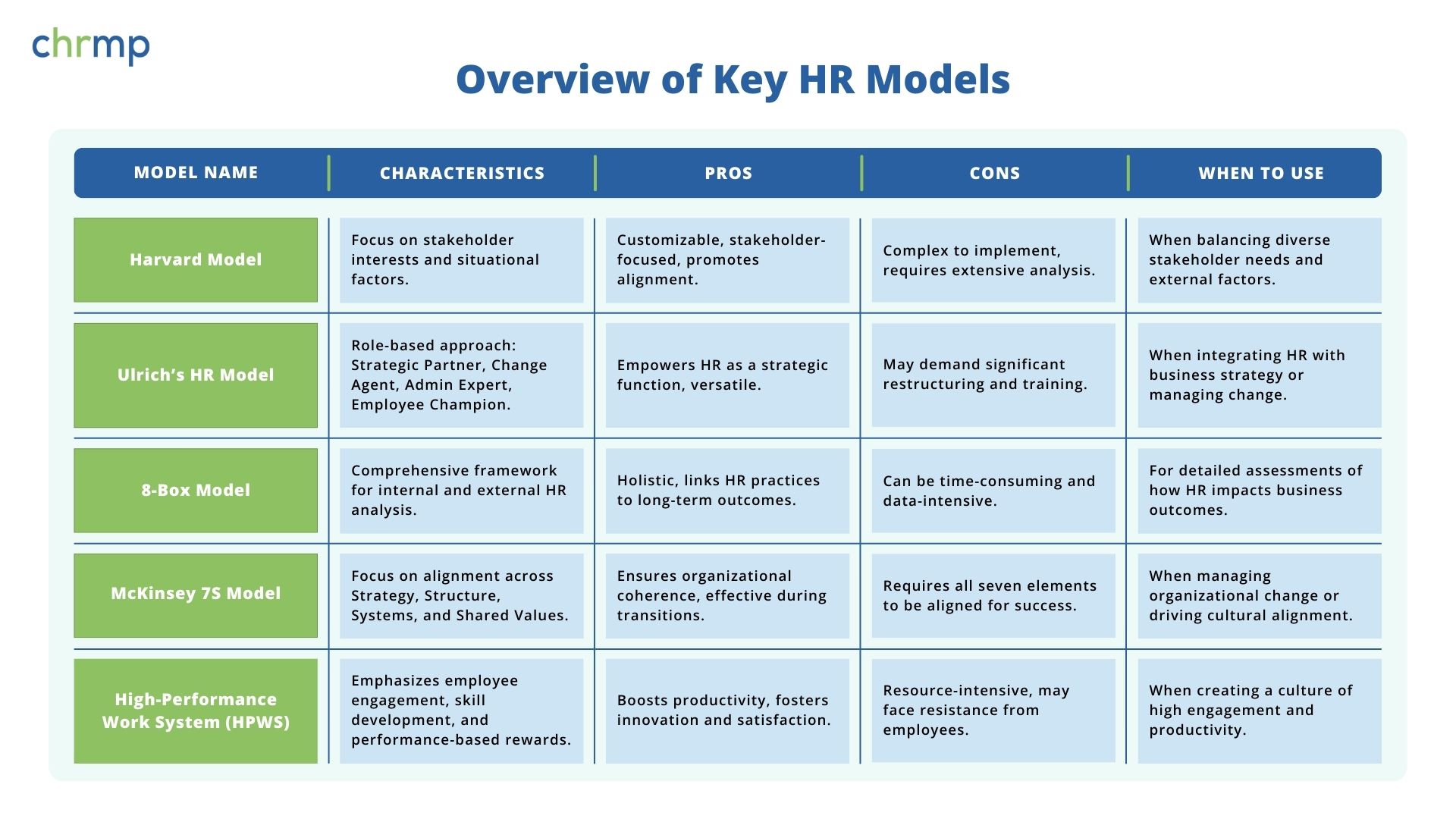
The following image provides a high-level view of the different HR models. As you can see, the High-Performance Work System is characterized by its emphasis on engagement, development, and performance, with the goal of boosting productivity and innovation.
HPWS in the Indian Context: A Case Study
Theoretical models are useful, but their application varies significantly across different cultural and economic contexts. This is particularly true in India. To make these concepts concrete, we'll examine a research paper that analyzes the HR practices of one of India's largest and most complex organizations: The Indian Railways.
This case study is valuable because it explores the "best practice" vs. "best fit" debate—the academic terms for the concepts we've just discussed. It investigates whether a universal set of HPWPs works everywhere ("best practice") or if practices must be adapted to the local context ("best fit").
[PDF] Human resource management and performance at the Indian railway
This paper provides a deep dive into the application of HPWP principles within a major Indian public-sector undertaking (PSU).
First, read the paragraph that introduces the 'best practice' vs. 'best fit' debate in the "Theoretical Background" section. This directly addresses the concept of strategic fit. Next, please read the "Results" section, starting from the heading. This section details the bundle of five HR practice areas identified in the Indian Railways: Recruitment and Selection Learning, Training and Development Compensation and Benefits Employment Relations Employee Welfare-Oriented Practices As you read, don't just look at each practice in isolation. Instead, analyze the internal consistency: how do these practices work together to create a coherent system that provides job security, extensive welfare, and clear career paths? Note the context-specific practices, like 'compassionate appointments', which are prime examples of the 'best fit' approach in action.
The Indian Railways case demonstrates that while many practices align with universal HPWP principles (e.g., extensive training, structured career progression), the system as a whole is uniquely adapted to its context as an Indian PSU. The emphasis on welfare and lifetime employment creates a powerful, internally consistent system geared towards stability, loyalty, and social responsibility—key strategic goals for that organization. This is a perfect example of strategic fit and internal consistency in a real-world, complex Indian organization.
This flowchart provides a simplified, practical roadmap for how you might go about building or refining such a system in your own organization.

Conclusion
Today, we've unpacked the concept of High-Performance Work Systems and established a clear method for evaluating the effectiveness of any HR system.
Key Takeaways:
- A High-Performance Work System (HPWS) is an interconnected bundle of HR practices designed to enhance employee skills, motivation, and opportunities to drive business performance.
- Evaluation of an HR system hinges on two key dimensions: Strategic Fit (vertical alignment with business strategy) and Internal Consistency (horizontal alignment between HR practices).
- The "best" HR system is not a universal template ("best practice") but one that is adapted to the organization's unique strategy and context ("best fit").
- The Indian Railways case study shows how core HPWP principles can be successfully adapted to a large-scale Indian public-sector context, creating a powerful and consistent system.
In our next lesson, we will move from strategic design to strategic justification. Having designed a powerful HR system or a new initiative, you will inevitably be asked, "What is the return on this investment?" We will tackle this head-on by learning how to calculate the ROI, payback period, and NPV for an HR initiative, giving you the financial language to build a compelling business case.