Hello! Welcome to our next lesson.
In our previous session, we established how to evaluate an HR system for strategic fit and internal consistency, using the High-Performance Work System (HPWS) as our benchmark. Designing a powerful HR initiative is a critical first step. The immediate next step, however, is securing the resources to implement it. To do this, you must be able to speak the language of the business—the language of finance.
Today, we will equip you with the tools to do just that. This lesson is dedicated to mastering three fundamental financial metrics used to evaluate any investment, including an investment in people. Our learning outcome is to calculate the Return on Investment (ROI), Payback Period, and Net Present Value (NPV) for an HR initiative. For an aspiring senior HR leader, proficiency in these metrics is non-negotiable; it's what transforms HR from a cost center into a value-creating business partner.
The Foundation: Why HR Needs Financial Acumen
Before we dive into calculations, it's essential to ground our thinking in the strategic context of the business. Every HR decision, from launching a new training program to overhauling the compensation structure, has financial implications. Understanding these implications is what allows you to align HR strategy with the firm's financial goals and create shareholder value.
The following reading from the book Financial Analysis for HR Managers sets the stage perfectly. It argues that financial analysis should precede all HR decisions and introduces the core concepts we'll be covering today.
[PDF] Financial Analysis for HR Managers - Pearsoncmg.com
This excerpt explains why financial concepts are critical for strategic HR management and provides an overview of the key topics relevant to our lesson.
In the sample chapter, please start by reading the section in Chapter 1 titled "What This Book Attempts to Do." Focus on the bulleted list of concepts, such as time value of money and ROI. This reinforces the importance of the tools we are about to learn. Then, browse the table of contents and note the structure of Chapter 7, "Capital Budgeting and Discounted Cash Flow Analysis," and Chapter 8, "Financial Analysis of Human Resource Initiatives." This will give you a sense of how our topics today—NPV and payback period—are applied directly to HR.
The key takeaway is that to make a compelling case for any initiative, you need to demonstrate its financial viability. This starts with a fundamental economic principle: the time value of money. Simply put, a rupee received today is worth more than a rupee received a year from now, because today's rupee can be invested and earn a return. This is the logic that underpins Net Present Value.
Metric 1: Net Present Value (NPV)
NPV is arguably the most powerful tool for investment appraisal. It calculates the total value a project will generate in today's money by comparing the present value of all its future cash inflows with the present value of its costs (outflows).
The formula looks complex, but the concept is straightforward:
Where:
- = Net cash flow during period
- = The discount rate (the company's cost of capital or required rate of return)
- = The time period
- The initial investment at time 0 is a negative cash flow.
The Decision Rule:
- If NPV > 0, the project is expected to generate more value than it costs. You should accept it.
- If NPV < 0, the project is expected to destroy value. You should reject it.
Let's look at a practical example. Imagine an HR initiative (e.g., a new sales training program) with an initial cost and projected annual returns.
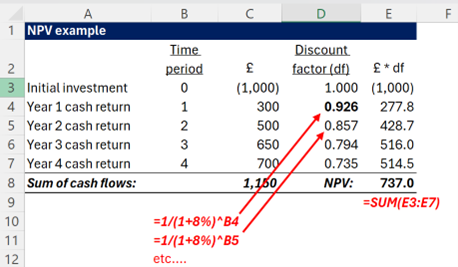
Given your proficiency in Excel, the best way to learn this is to see it in action. The following short video demonstrates exactly how to set up the cash flows and use Excel's built-in function to calculate NPV.
How to Calculate NPV and IRR in Excel
This video by Ryan O'Connell provides a clear, step-by-step guide to calculating NPV and a related metric, Internal Rate of Return (IRR), in Excel.
Watch the entire video. It's less than three minutes long. Pay attention to how the initial investment is represented as a negative cash flow at period 0. Observe how the built-in NPV function in Excel works. Note that the Excel NPV function only discounts future cash flows (from year 1 onwards), so the initial investment must be handled separately. The video also introduces the Internal Rate of Return (IRR). IRR is the discount rate at which the NPV of a project becomes zero. It's another useful metric to have in your toolkit.
Metric 2: Payback Period
The Payback Period is a simpler metric that answers a different question: "How long will it take to get our initial investment back?" It's a measure of risk and liquidity.
There are two ways to calculate it:
- Undiscounted Payback Period: You simply add up the future cash flows until the cumulative total equals the initial investment. This is easy but less accurate because it ignores the time value of money.
- Discounted Payback Period: You first find the present value of each future cash flow and then add them up until the cumulative total equals the initial investment. This is the more financially sound method.
The image below shows a model comparing both methods for the same project.

The Decision Rule: Companies often set a policy, such as "we only approve projects with a payback period of three years or less." Shorter is generally better.
However, the payback period has a significant flaw: it completely ignores any cash flows that occur after the payback period has been reached. A project could generate massive returns in its later years, but the payback metric would be blind to this.
Metric 3: Return on Investment (ROI)
ROI is perhaps the most widely known and intuitive financial metric. It expresses the net gain from an investment as a percentage of its cost.
The basic formula is:
For an HR initiative like a leadership development program, the calculation might look like this:
- Cost of Investment: Trainer fees, materials, participants' salaries for time spent in training.
- Gain from Investment: Monetized value of improved team performance, reduced employee turnover costs, increased promotion rates.
While simple and easy to communicate, the challenge with ROI lies in accurately quantifying the "Gain from Investment." This is often where HR analytics and rigorous measurement become crucial.
Bringing It All Together: A Scenario Analysis
These three metrics tell different parts of a project's financial story. NPV tells us about value creation, Payback tells us about risk, and ROI tells us about efficiency. A savvy leader uses all three to make a balanced decision.
This next video is excellent for synthesizing these concepts. It runs through several scenarios for a project, showing how changes in cost or benefits affect NPV, IRR, and the Payback Period.
NPV IRR Payback period scenarios
This video from The Finance Storyteller clearly illustrates the interplay between NPV, IRR, and Payback by analyzing different project scenarios.
Please watch the following segments: The Base Case: Understand the initial project assumptions and the resulting metrics. Scenario 1 (Lower Investment): See how reducing the initial cost dramatically improves all metrics. Scenario 2 (Higher Benefits): Observe the impact of increasing the project's returns. Scenario 3 (Extended Benefits): This part perfectly highlights the weakness of the payback method. Notice how the payback period doesn't change, even though the project is clearly more valuable. The Best Case: See the powerful cumulative effect of several small improvements.
This scenario-based approach is exactly what you will do in a real business setting—testing your assumptions to understand the potential range of financial outcomes for your proposed HR initiative.
Conclusion
Today we've added three essential financial analysis tools to your strategic HR toolkit. You are now equipped to start building the financial justification for your ideas.
Key Takeaways:
- Net Present Value (NPV): The gold standard for investment decisions. It measures how much value a project will create in today's money. A positive NPV is the goal.
- Payback Period: A measure of risk and liquidity that calculates how quickly an investment will be recouped. The discounted version is more accurate as it accounts for the time value of money.
- Return on Investment (ROI): An intuitive percentage return that is easy to communicate but can be challenging to calculate accurately for complex HR initiatives.
- Synthesis: These metrics should be used together to provide a holistic financial picture of a proposed initiative, telling a story of value, risk, and efficiency.
In our next lesson, we will build directly on these skills. We've learned the mechanics of the calculations; now we will focus on the art of building a complete business case for an HR initiative, integrating these financial metrics with a risk assessment to create a persuasive and robust proposal for senior leadership.