Hello! Let's get started with our final lesson in this module on strategic alignment.
In our last session, we mastered the mechanics of calculating three critical financial metrics: Net Present Value (NPV), Return on Investment (ROI), and Payback Period. You now have the quantitative tools to evaluate an HR initiative's financial viability. Today, we'll take the crucial next step: embedding those numbers into a compelling narrative that secures executive buy-in.
This lesson addresses the learning outcome: Build a business case for an HR initiative integrating financial metrics and a probability/impact risk assessment. We will construct the complete argument, moving from raw calculations to a persuasive, structured proposal. For an aspiring senior HR leader, this skill bridges the gap between having a good idea and getting the resources to make it a reality. It is the art of storytelling with data.
The Anatomy of a Winning Business Case
A business case is not just a request for money; it's a structured argument that demonstrates how an investment in a people-related initiative will solve a business problem and deliver tangible value. To be effective, it must follow a logical flow that any business leader can understand.
The image below provides an excellent template for a comprehensive HR business case. Think of these nine sections as the chapters of your story.
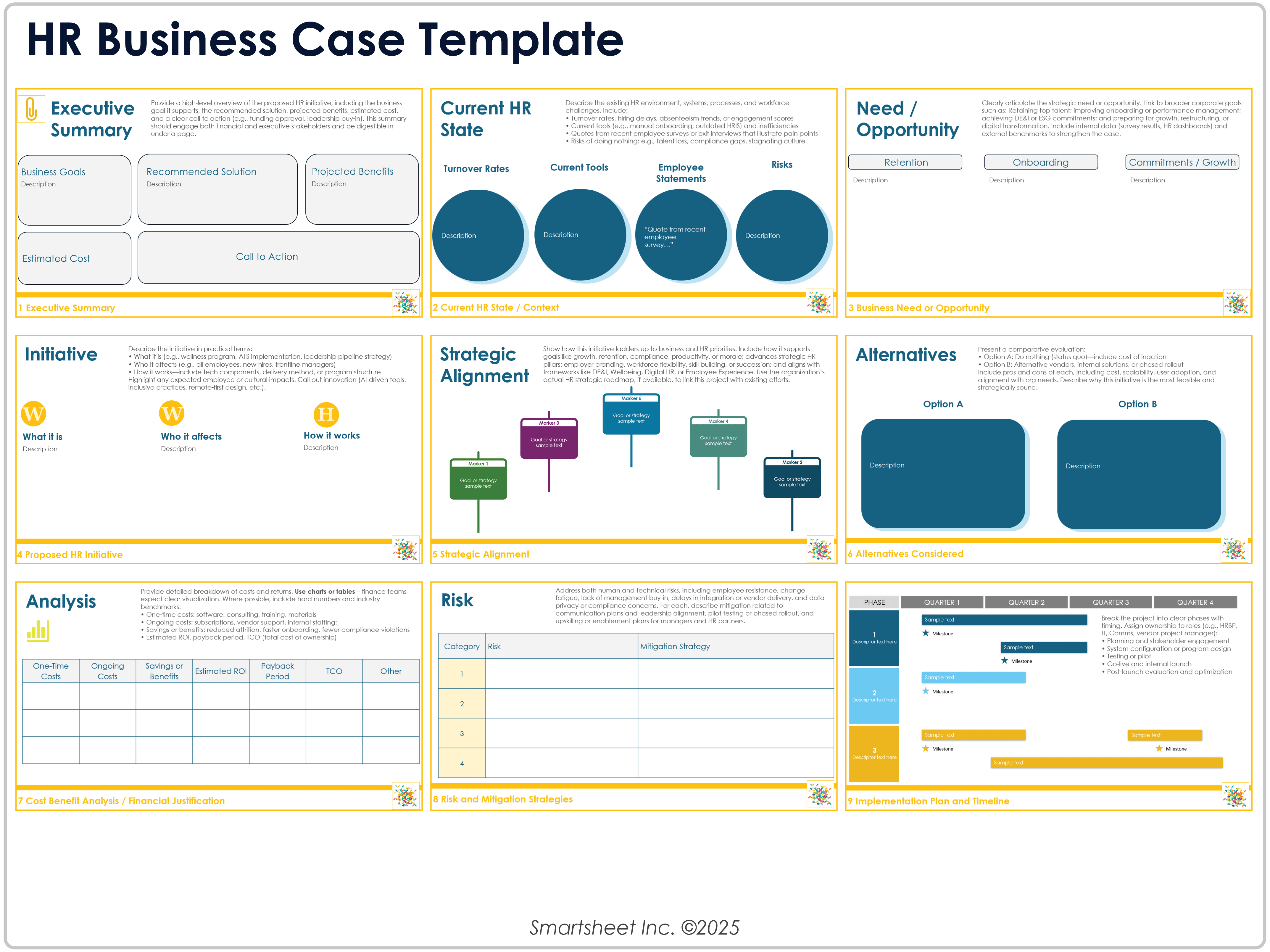
This structure takes your audience on a logical journey:
- The Problem: Current HR State, Need/Opportunity
- The Solution: Proposed Initiative, Strategic Alignment, Alternatives
- The Value & The Risks: Cost-Benefit Analysis, Risk & Mitigation
- The Execution: Implementation Plan & Timeline
Underpinning this entire process is what the Academy to Innovate HR (AIHR) calls a "commercial mindset." It's the ability to connect HR activities to the financial and strategic pulse of the organization. Before we dive deeper, this short video clip explains this crucial perspective.
5 HR Analytics Case Studies | AIHR [WEBINAR]
This clip from an AIHR webinar introduces the concept of a commercial mindset, which is the foundation for building a credible business case.
Please watch from the start of the segment. The speaker emphasizes understanding financial implications and being organizationally savvy—the core of what we are doing today.
Building the Financial Narrative
The "Cost-Benefit Analysis / Financial Justification" section is where your work from the last lesson comes to life. However, simply dropping in NPV and ROI figures is not enough. You must build a credible story around them by translating HR outcomes into financial impact.
The following article from Nestorup provides a superb, practical guide on how to do this. We will use it to break down the process.
Talent Management ROI Calculator: How to Justify Your Investment ...
This article details how to identify financially defensible HR metrics and how to model them in a way that resonates with a finance-oriented audience.
First, read the section The ROI drivers you can defend. Pay close attention to the five key drivers: reduced turnover, lower cost-per-hire, faster time-to-fill, productivity uplift, and optimized learning spend. This is how you convert familiar HR metrics into the language of money. Next, jump to the section Example scenario. The key takeaway here is the use of conservative, base, and stretch scenarios. This approach demonstrates financial prudence and acknowledges uncertainty, which significantly boosts your credibility with leadership.
As the reading highlights, your financial narrative should be built on three pillars:
- Defensible Drivers: Ground your benefits in concrete, measurable outcomes like turnover reduction or vacancy cost savings. Avoid relying on "soft" metrics like engagement scores as your primary justification.
- Conservative Assumptions: Use realistic, even cautious, improvement goals. Presenting a range of outcomes (conservative, base, stretch) shows you've done your homework and aren't over-promising.
- Integrated Metrics: Use ROI, NPV, and Payback Period together to tell a complete story.
- ROI is your headline number, easy to communicate.
- NPV is your proof of value creation in today's money.
- Payback Period is your answer to the risk-focused question, "How quickly do we get our money back?"
The AIHR webinar we looked at earlier provides a perfect real-world example of this in action.
5 HR Analytics Case Studies | AIHR [WEBINAR]
This segment from the AIHR webinar presents a case study from a retail company that built a successful business case for a new recruitment process.
Watch the case study described between these timestamps. Note how the HR team collaborated with Finance, used cash flow projections, and translated a reduction in attrition into a significant increase in profitability, which was then validated by the actual results.
Conducting a Probability/Impact Risk Assessment
No initiative is without risk. Acknowledging this and presenting a clear mitigation plan is not a sign of weakness; it's a sign of a seasoned professional. This is the purpose of the "Risk and Mitigation Strategies" section of your business case.
A standard tool for this is a Risk Matrix. You assess each potential risk along two dimensions:
- Likelihood: How probable is it that this risk will occur?
- Impact: If it occurs, how severe will the consequences be?
This allows you to prioritize which risks require the most attention.
For each significant risk you identify (e.g., low user adoption of a new system, key project members leaving, technology integration issues), you should plot it on this matrix and then outline a specific mitigation strategy. For example:
| Risk Category | Risk Description | Likelihood | Impact | Mitigation Strategy |
|---|---|---|---|---|
| Moderate | Low adoption of the new performance management tool by managers. | 3 | 4 | Develop a targeted change management plan, including manager training, "what's in it for me" communications, and executive sponsorship. |
| High | The project lead resigns mid-implementation. | 2 | 5 | Identify a "second in command" from the project start; document all processes and decisions in a central repository. |
To understand the full scope of what a risk analysis entails, the following video provides a solid overview. While not HR-specific, its principles are universal.
Business Case Example (How to Write a Business Case)
This video from The Business Analysis Doctor explains the key components of a risk analysis within a business case.
Watch the segment on risk analysis. It discusses identifying constraints, assumptions, and dependencies, all of which are potential sources of risk for your HR initiative.
Presenting Your Case to Leadership
You've done the analysis, calculated the financials, and assessed the risks. The final step is to package it into a concise and powerful presentation for the C-suite. The structure of your presentation should mirror the logic of the business case but be even more distilled.
The Nestorup article provides an excellent 7-slide framework for this.
Talent Management ROI Calculator: How to Justify Your Investment ...
This final reading provides a step-by-step guide to structuring your presentation for an executive audience.
Read the section titled Presenting the business case. Pay close attention to the flow of the slides, especially how it starts with the financial snapshot and explicitly includes a slide for "Risks and mitigation."
This presentation structure is powerful because it anticipates the questions of a senior audience:
- What's the bottom line? (Executive Snapshot: ROI, Payback, NPV)
- Why do we need to do this now? (The Cost of Doing Nothing)
- What are we actually doing? (The Initiative)
- Are the numbers credible? (The Financial Model with scenarios)
- What could go wrong? (Risks and Mitigation)
- Who is responsible and when will we see results? (Owners and Timeline)
- What do you need from us? (The Ask)
By following this structure, you frame your HR initiative not as a cost but as a prudent business investment designed to drive financial results and mitigate organizational risk.
Conclusion
In this lesson, we have assembled the complete puzzle of a strategic business case. You've learned how to move beyond just calculating financial metrics to integrating them into a structured, persuasive narrative that speaks the language of the business.
Key Takeaways:
- A business case is a structured story with a clear beginning (the problem), middle (the solution), and end (the value and execution plan).
- To build a credible financial narrative, you must translate HR outcomes (like turnover) into defensible financial drivers and present them using a range of scenarios.
- A robust risk assessment, using tools like a probability/impact matrix, demonstrates foresight and builds leadership confidence.
- Your final presentation should be a concise summary that leads with the financial bottom line and addresses key executive questions about value, risk, and accountability.
This lesson concludes our first module on Strategic HRM and Business Alignment. You are now equipped to connect HR strategy to business goals, justify initiatives with financial rigor, and build compelling cases for investment.
In our next lesson, we will begin a new module, Foundations of People Analytics. We'll start by defining the principles of evidence-based HRM. This is the perfect next step, as the business cases you've just learned to build are only as strong as the evidence they stand on. The next module will give you the foundational skills to generate and interpret that evidence systematically.