In our last lesson, we began developing your strategic lens by using PESTLE and SWOT analyses to scan the broad external and internal environments. This gave us a high-level map of the forces shaping HR strategy. Now, we'll sharpen our focus considerably.
Today's goal is to apply the resource-based view (RBV) of the firm, a powerful theory that helps us move beyond a simple list of "strengths" to pinpoint which specific organizational capabilities can create a sustainable competitive advantage. We will use the VRIO framework as our primary tool for this analysis. For you, as an aspiring senior HR leader, mastering this framework is essential. It provides the logic to justify strategic investments in people-related initiatives—from leadership development to unique compensation schemes—by demonstrating how they build value that competitors cannot easily replicate.
From Strengths to Strategic Resources: The Resource-Based View
In the previous lesson, we identified organizational Strengths as part of the SWOT analysis. The resource-based view (RBV) pushes us to ask a more profound question: which of these strengths are truly unique and durable enough to sustain high performance over the long term?
RBV proposes that a firm's competitive advantage is derived primarily from its unique bundle of internal resources and capabilities, rather than simply its positioning in the external market. Two core assumptions underpin this view:
- Heterogeneity: Firms possess different bundles of resources.
- Immobility: These differences can be long-lasting because some resources are difficult for competitors to acquire or develop.
To understand these foundational concepts more deeply, let's turn to a brief academic overview of Jay Barney's seminal 1991 paper, which established this field of thought.
Leading Strategy Paper Series: Barney 1991 "Firm Resources and Sustained Competitive Advantage"
This video from Glenn Parry's channel provides a concise summary of Barney's original paper, which is the cornerstone of the resource-based view.
Please watch the first two sections. The first part, "what are resources?", defines the three categories of resources: physical, human, and organizational. The second part explains the critical concepts of heterogeneity and immobility, which are the theoretical bedrock of why some resources can create a lasting advantage.
As the video explains, "human resources" (expertise, knowledge) and "organizational resources" (culture, routines, structures) are often the most likely sources of sustainable advantage precisely because they are difficult to see, quantify, and copy. This is the strategic heartland of HR.
The VRIO Framework: A Tool for Strategic Analysis
Jay Barney developed a practical framework to operationalize the RBV, known as VRIO. It's a set of four questions you ask about any given resource or capability to determine its strategic potential. A resource must be:
- Valuable
- Rare
- Inimitable (costly to imitate)
- Organized to capture value
The following video provides an excellent and clear explanation of each component.
VRIO Framework EXPLAINED | B2U | Business To You
This video from Business To You breaks down the VRIO framework into its essential components with clear examples.
Please watch the segments explaining each of the four criteria: Valuable: Does the resource enable the firm to exploit an opportunity or neutralize a threat? Notice how this directly connects to the O and T from our SWOT analysis. Rare: Is the resource controlled by only a small number of competing firms? Inimitable: Is it difficult for others to acquire, develop, or substitute? Pay close attention to the three reasons for inimitability: unique historical conditions, causal ambiguity, and social complexity. These are especially relevant to HR. Organized: Does the firm have the necessary policies and procedures in place to exploit the resource?
The power of VRIO lies in its diagnostic ability. The answers to these questions reveal the competitive implication of a resource, as shown in the table below, which is also demonstrated at the end of the video you just watched.
| Is the resource... | Valuable? | Rare? | Costly to Imitate? | Organized to Capture Value? | Competitive Implication |
|---|---|---|---|---|---|
| No | — | — | — | Competitive Disadvantage | |
| Yes | No | — | — | Competitive Parity | |
| Yes | Yes | No | — | Temporary Competitive Advantage | |
| Yes | Yes | Yes | No | Unused Competitive Advantage | |
| Yes | Yes | Yes | Yes | Sustained Competitive Advantage |
Let's look at a simple, concrete example.
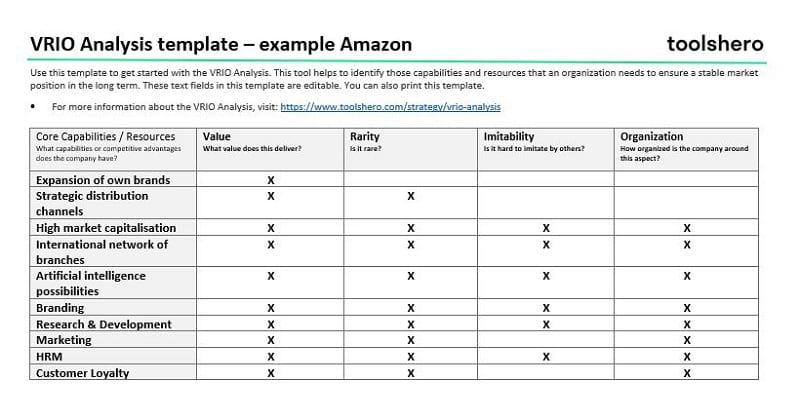
Consider Amazon's "International network of branches." It's Valuable (delivers products efficiently), Rare (few companies have such a scale), Inimitable (building it would cost billions and take years, a "unique historical condition"), and Amazon is clearly Organized to exploit it. This is a source of sustained competitive advantage. In contrast, "Expansion of own brands" is valuable, but not rare or inimitable. Many retailers have private-label brands. This leads to competitive parity, not a distinct advantage.
HR Practices as a Source of Inimitable Advantage: The Indian Context
Now, let's connect this theory directly to your work. How can specific HR practices become a source of sustained competitive advantage? The key lies in creating capabilities that are high in social complexity and causal ambiguity. A competitor can buy the same HR software, but they cannot easily replicate a high-trust culture, a deeply embedded leadership coaching program, or a network of highly collaborative teams.
The following research paper is particularly relevant as it examines "best" HR practices in leading Indian companies through the lens of the resource-based view.
[PDF] Identifying the “Best” Human Resource Management Practices in India
This paper by Pramila Rao provides case studies on how top-performing Indian companies use HRM to build competitive advantage, directly linking practice to theory.
First, read the section "Theory: The Resource-based View" (p. 70-71). This will reinforce the concepts from the video in an academic, HRM-focused context. Next, focus on the case study for "Company A: Information Technology" (p. 72-75). As you read about their practices in Recruitment, Training, Performance Management, and Compensation, identify one practice in each area that you believe is difficult to imitate. Think about why. Is it due to social complexity (e.g., the way leaders interact in workshops) or causal ambiguity (e.g., the combined effect of multiple practices creating a unique culture)? Finally, read the first three paragraphs of the "Discussion" section (p. 79-80) and review Table 2, "Model of Successful HRM practices." This section synthesizes the findings and explicitly states how practices like internal recruitment and in-house training programs create "inimitable" and "idiosyncratic" advantages.
The case studies in this paper provide tangible examples of the VRIO framework in action. Practices like an employee referral program that rewards families, in-house leadership workshops taught by senior executives, and a culture that values internal mobility all contribute to a complex social system. A competitor can't just copy these; they are interwoven with the company's history and culture, creating a powerful, inimitable advantage.
Conclusion
In this lesson, we moved from the broad strokes of a SWOT analysis to the fine-grained detail of the resource-based view and the VRIO framework. You've learned how to dissect an organization's resources and identify those with the potential to create a lasting competitive edge.
Key Takeaways:
- The Resource-Based View (RBV) posits that competitive advantage stems from unique, hard-to-replicate internal resources.
- The VRIO framework is a practical tool for evaluating resources against four criteria: Value, Rarity, Inimitability, and Organization.
- HR is uniquely positioned to build sources of sustained competitive advantage through practices that are high in social complexity and causal ambiguity, such as developing a unique organizational culture, leadership capabilities, and employee relationships.
- Meeting all four VRIO criteria is necessary for a sustained competitive advantage; failing to meet even one lowers the strategic value of a resource.
You now have a robust method for evaluating the strategic importance of HR initiatives. The next logical step is to connect these valuable, resource-building initiatives to overall business goals. In our next lesson, we will explore the HR Value Chain and the Balanced Scorecard, frameworks designed to do just that by mapping HR activities to concrete financial and customer outcomes.