Welcome to the third lesson in our first module. In the previous lesson, we created a six-week scorecard with specific, numerical targets for customer interviews, problem validation, prototype testing, and securing commitments. You now have a clear definition of what "progress" looks like for your venture experiment.
This lesson tackles the immediate, practical question: how do you execute this plan when you only have two hours per day? Your goal is to produce a realistic daily schedule that carves out dedicated time for the four essential activities of a founder: learning, outreach, building, and reviewing evidence. We'll move from your high-level targets to a concrete, repeatable weekly calendar that makes consistent progress possible.
The Founder's Four Hats and the Cost of Switching
As a solo founder, you have to do everything. This means you'll be wearing four different "hats," often on the same day. Each hat requires a completely different mindset and skillset.
🦸 The Solo-Founder Playbook 📘: Zero to Hero 🚀 - DEV Community
This reading introduces the four essential roles you'll play in your venture.
In the article, find the section "2.2 The four hats — and how they fight". Read the table and the paragraph that follows, from this introduction to the end of the section. Focus on understanding the distinct "mode" and "time horizon" of the Builder, Marketer, Seller, and Operator.
The key insight is that switching between these hats is mentally expensive. Moving from deep-focus coding (Builder) to making sales calls (Seller) and then to analyzing metrics (Operator) fragments your attention and kills your productivity. A typical, reactive day often looks like the left side of this image.
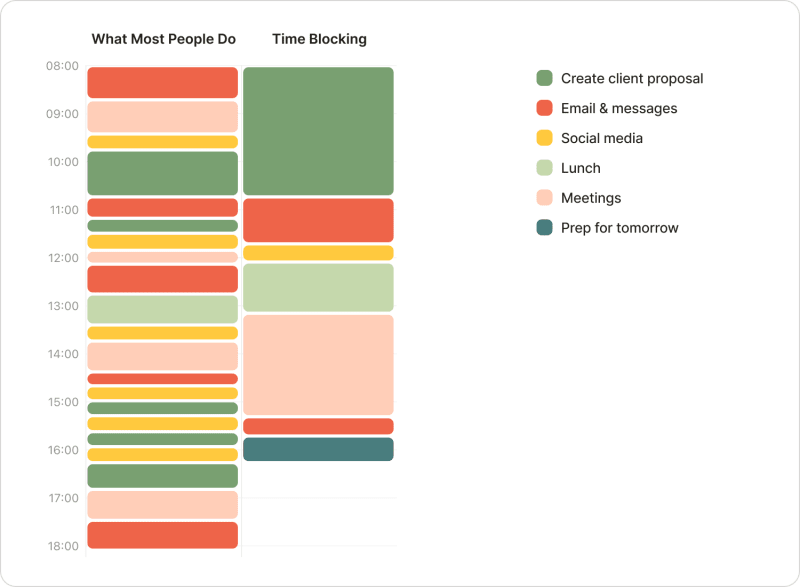
Your two hours per day are too valuable to be lost to this mental friction. The solution is a technique called time blocking, where you proactively schedule what you will work on and when.
Time Blocking: Your Strategy for a Two-Hour Day
Time blocking turns your abstract to-do list into a concrete plan on your calendar. Instead of just hoping to "make progress," you assign specific tasks to specific blocks of time.
Time Blocking: 7 Steps to Master Your Focus & Calendar (2026)
This guide explains the core principles of time blocking and a key related technique, task batching.
First, read the section "What is time blocking?" to get the formal definition. Then, skip to the section "Top 5 time blocking methods" and read about the first method, task batching. This is the most important technique for you, as it directly addresses the problem of switching between founder hats.
For your two-hour workday, task batching is your most powerful tool. It means dedicating each day, or a significant block of time, to wearing just one or two of your founder hats. This minimizes context switching and allows you to achieve a state of flow, even in a short period.
Designing Your 10-Hour Week
With only 10 hours per week (2 hours x 5 days), you must be ruthless about what you choose to do and, more importantly, what you choose not to do. The goal is not to do everything at once, but to focus your energy where it matters most for your current stage.
How I manage my time with full time job, freelance & side hustles ☕️
This video offers a great perspective on how to manage time when you're juggling multiple priorities. The creator's advice on focus and elimination is highly relevant to your situation.
Watch the following three short segments: From the beginning until the discussion on goals, where she explains why goals must be your compass. The section on eliminating tasks that don't contribute to your goals. The part on reducing context switching and planning around your energy.
Let's apply these principles to create a template for your 10-hour week. In the "pre-product" validation stage you're in now, the work is heavily skewed towards marketing (finding a problem and an audience) and selling (interviewing and getting commitments). Building is secondary.
The "Solo-Founder Playbook" provides an excellent operating cadence, which we can adapt for your schedule. It recommends the following split for the pre-product stage:
- Marketer: 50% (5 hours/week)
- Builder: 30% (3 hours/week)
- Seller: 10% (1 hour/week)
- Operator: 10% (1 hour/week)
Here is how you can translate that into a two-hour-per-day schedule:
| Day | Primary Hat(s) | Time | Example Activities (for Weeks 1-2: Customer Conversations) |
|---|---|---|---|
| Monday | Marketer | 2 hours | Identify 5 potential online communities where customers gather. |
| Tuesday | Marketer | 2 hours | Draft your outreach message for interview requests. |
| Wednesday | Builder | 2 hours | Learn how to use a free tool like Tally or Google Forms for scheduling. |
| Thursday | Seller / Marketer | 2 hours | Send 10 personalized outreach messages. Conduct 1 interview. |
| Friday | Operator / Builder | 2 hours | Organize interview notes. Perform your 30-minute weekly review. |
Important: The "Example Activities" will change each week to match your six-week scorecard.
- In Weeks 3-4, "Builder" time will be spent creating a landing page, and "Marketer" time will be spent driving traffic to it.
- In Weeks 4-5, "Operator" time will be spent manually delivering your Concierge MVP service.
To put this into practice, you can use a simple spreadsheet or a digital notebook. Here's what a blank template looks like. Your task is to fill this out for the upcoming week based on your primary goal from the six-week plan.

The Weekly Review: Your Non-Negotiable Check-In
With such limited time, you cannot afford to work on the wrong things. The most critical part of your schedule is the 30-minute weekly review, which you should block out for every Friday. This is where you stop doing and start thinking. It's how you ensure your daily actions are moving you toward your goals.
🦸 The Solo-Founder Playbook 📘: Zero to Hero 🚀 - DEV Community
This final reading provides a precise, actionable template for your weekly review.
Find the section "11.3 The week (review)". Read from the beginning of the section to the end. Commit to this process. It is the steering wheel for your entire venture.
This review forces you to confront the evidence you've gathered and make conscious decisions for the following week. It connects your daily execution back to the high-level targets we set in the last lesson.
Conclusion
In this lesson, we've designed a practical framework to make meaningful progress in just two hours a day. You've learned about the four founder hats and the importance of using time blocking and task batching to minimize costly context switching. You now have an adaptable weekly schedule template that allocates your 10 hours across building, marketing, selling, and operating, tailored to your current validation stage. Finally, you have a non-negotiable weekly review process to keep you on track.
Your schedule is the engine that generates evidence. In our next and final lesson of this module, we'll address how to use that evidence. We will define clear thresholds for what constitutes a "good" or "bad" signal from your experiments, allowing you to decide whether to continue with your idea, pivot, or go back to the drawing board.