In our first lesson, we established the crucial difference between a high company valuation and actual, spendable wealth. You learned that true value comes from building a sustainable business that solves a real problem, not just from an impressive "paper wealth" figure. Now, we'll build on that foundation by moving from abstract concepts to a concrete plan of action.
This lesson is about turning your six-week goal into a measurable experiment. Your objective is to define specific, numerical targets for the activities that matter most at this early stage: talking to customers, validating their problems, testing a simple prototype, and attempting to secure a real commitment. These targets will be your guide, helping you measure progress and make decisions based on evidence, not guesswork. By the end of this lesson, you will have a clear scorecard for your first six weeks.
From Vague Idea to Focused Experiment
The biggest risk for any new venture isn't building the wrong product; it's building a product nobody needs. To avoid that trap, we'll spend the first six weeks gathering evidence of demand before you build any significant software.
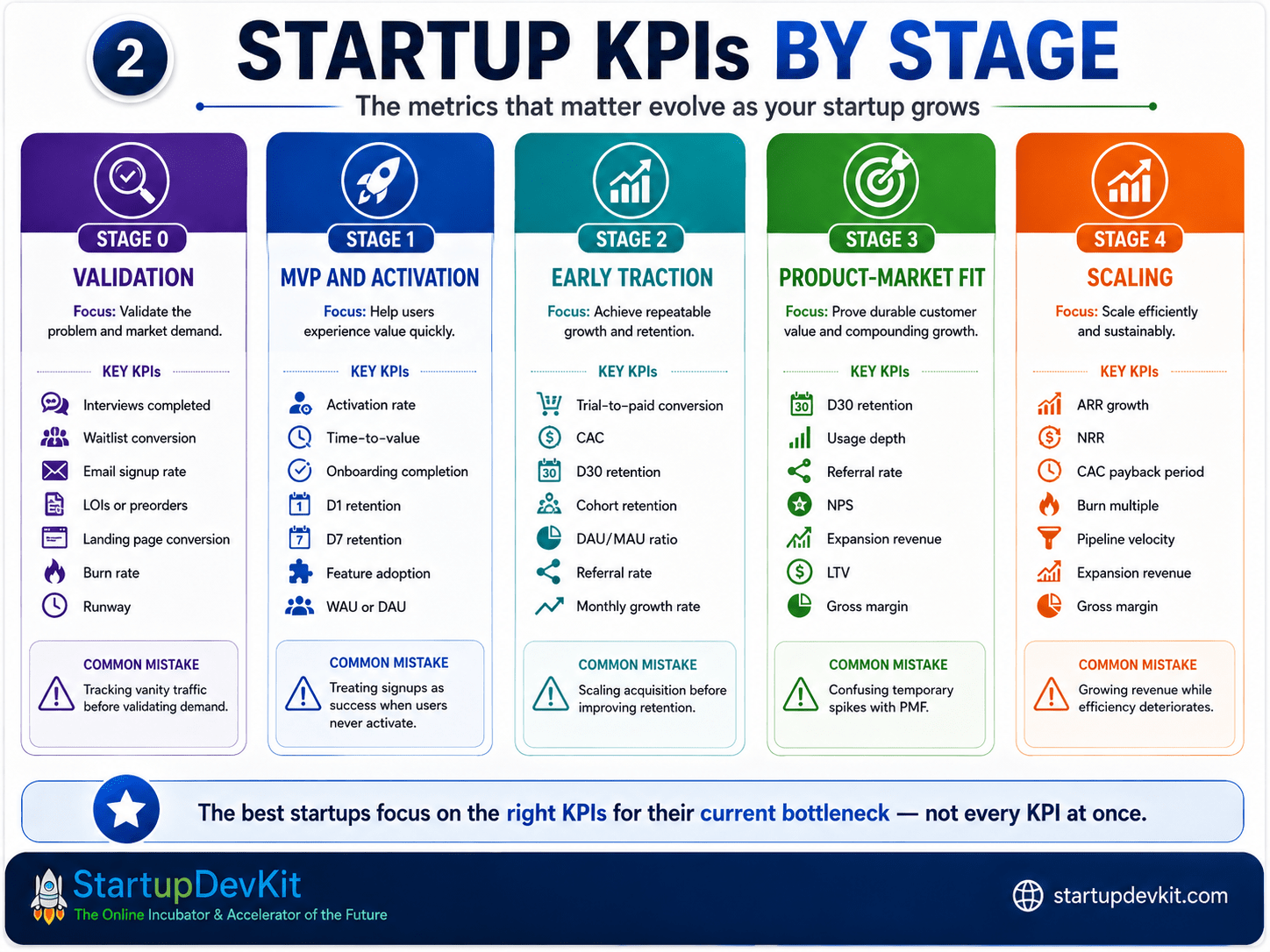
The metrics that matter change as a company grows. In the beginning, you aren't focused on revenue or profit. You're focused on learning. The "Startup KPIs by Stage" infographic shows this evolution clearly. Your work for the next six weeks is entirely in Stage 0: Validation.
Your goal is to answer a series of questions. Each question should be answered with data from a specific test, not just your opinion.
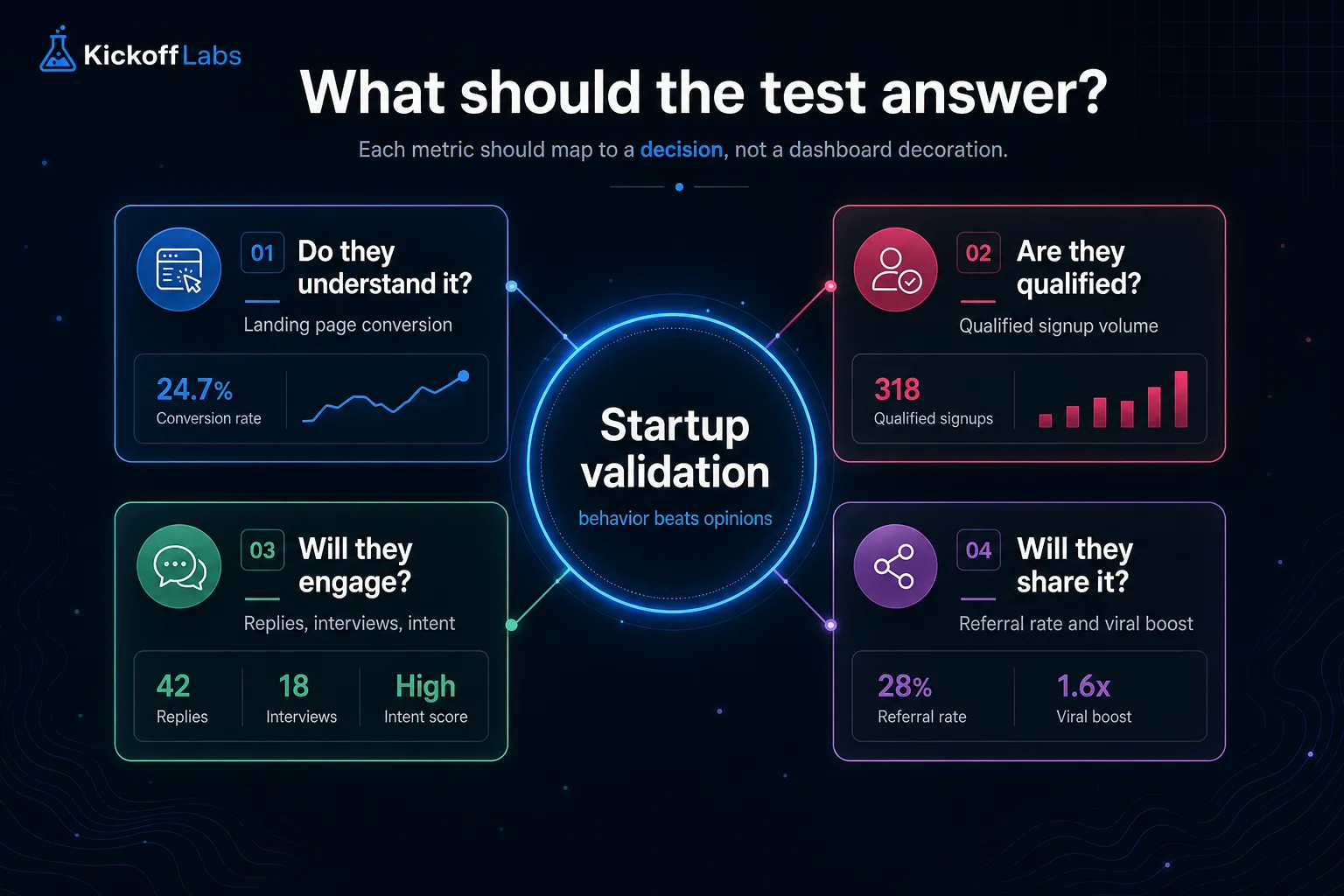
We will structure these questions and metrics into a logical sequence, like a funnel, that you can execute over the next six weeks.
Let's define the numerical target for each stage of this funnel.
Target 1: Customer Conversations (Weeks 1-2)
Your first task is not to pitch your idea, but to deeply understand the problem from a potential customer's perspective. The goal is to conduct interviews to find out if a problem is painful, how people solve it now, and what that costs them in time or money.
So, how many people do you need to talk to? The consensus among experienced founders is that patterns start to emerge after a certain number of conversations. In the following video, serial entrepreneur Rob Walling talks about his "2-20-200" framework. The "20-hour" step, which involves customer conversations, is where we'll focus.
Use This PROVEN Formula to Validate Your Next Startup Idea
Watch this video to understand the mindset behind validation and see real-world examples of how many "yeses" founders looked for before building.
Pay attention to the initial discussion on why validation isn't about 100% certainty. Then, listen to the concrete examples of how many conversations successful founders had. Finally, focus on his explanation of the "20-hour validation step" through warm and cold conversations.
As Walling mentions, successful founders like Jason Cohen (WP Engine) sought 40 "yeses," while he proceeded with 11 for his company, Drip. Based on this and other expert advice, a solid target is 15-25 interviews with people in a single, specific customer group.
This might sound daunting, but it's the most valuable work you can do right now. The following reading provides clear rules for these interviews and describes what good evidence looks like.
How to Test a Startup Idea: 7 Proven Methods Before You Build | Startup Ignition
This article explains the "rules" of conducting effective customer discovery interviews, emphasizing a focus on past behavior over future opinions.
Please read the section titled "Customer Discovery Interviews". Pay close attention to the four rules for conducting interviews, and review the bullet points under what good evidence looks like. This will help you distinguish a polite conversation from a genuinely validated problem.
Your 6-Week Target for Conversations: Complete 15-25 problem-focused interviews.
Target 2: Problem Validation (Weeks 2-3)
Once your interviews suggest you've found a real problem, the next step is to test if people will take a small action to solve it. Since you have a $0 budget and prefer visual tools, a simple landing page test is a perfect fit.
The page shouldn't describe a complex AI product. Instead, it should have:
- A clear headline stating the problem you solve and the outcome you provide.
- A brief description of the benefits.
- A single call to action: "Join the private beta" or "Get early access," with a field to enter an email address.
The key metric here is the visitor-to-signup conversion rate.
How to Test a Startup Idea: 7 Proven Methods Before You Build | Startup Ignition
This resource outlines how to build a landing page that acts as a real test, complete with numerical benchmarks for success.
Read the section "The Landing Page Test." Focus on the subsection Measuring Results to see what a strong conversion rate looks like. Note the key insight: the traffic source is the test. This means you need to share it with the target customers you've identified, not just friends.
A conversion rate of 5-10% is a good signal. If 100 people from your target audience visit the page and 5 to 10 of them give you their email, you have evidence that the problem is resonant.
Your 6-Week Target for Problem Validation: Achieve a 5-10% conversion rate on a simple landing page waitlist from at least 100 targeted visitors.
Target 3: Prototype Use (Weeks 3-5)
With a list of interested people, it's time to test your solution. But you won't build software yet. Instead, you'll run a Concierge MVP. This means you deliver the promised outcome manually for a handful of users.
For example, if your idea is an AI that summarizes long reports, you would ask a user to email you a report, and you would manually summarize it and email it back. This approach is free, fast, and gives you invaluable insight into what users actually need. The video below explains this concept as one of three key experiment types.
How to Use the Validation Board to Test Your Startup Idea
This video introduces the concept of a "Concierge" test as a way to deliver value and learn from customers with minimal technology.
Watch the segment explaining the three methods of experimentation, from Exploration, Pitch, and Concierge. Focus on the description of the Concierge test.
The target here isn't signups; it's engagement and retention. Are people coming back to use your manual service? Do they get value from it?
Startup Idea Validation: Prove Demand Before You Build
This article provides a table of different low-cost experiments, including a "WhatsApp Concierge MVP," and the signals that prove they are working.
In the table under "MVP Validation And Startup Idea Testing Experiments," look at the row for the WhatsApp Concierge MVP. The validation signal is key: "Users return weekly without reminders." This is a powerful indicator of value.
Your 6-Week Target for Prototype Use: Get 5+ users for your Concierge MVP who use the service at least once a week without you prompting them.
Target 4: Sales Attempts & Commitment (Week 6)
The ultimate test of demand is getting a customer to commit. Since you are starting with a $0 budget, this doesn't have to be money. A commitment can be their time, their data, or their professional reputation. This is the strongest evidence you can gather. Asking for it is scary, which is exactly why it's so valuable.
How to Test a Startup Idea: 7 Proven Methods Before You Build | Startup Ignition
This final reading explains the power of asking for a commitment before a product is built and provides clear thresholds for what success looks like.
Read the section on "The Pre-Sale Test." While it discusses pre-selling for money, the principle is about getting commitment. Focus on the numerical thresholds suggested. For a B2B product, "5-10 letters of intent or pre-paid contracts is strong."
For your zero-budget venture, you can adapt this. Instead of a contract, you can ask your most engaged Concierge users for:
- A signed, non-binding Letter of Intent (LOI) to become a pilot customer when the product is ready.
- A written agreement to participate in a 4-week pilot, committing 1-2 hours of their time.
- Access to a specific set of anonymized data that is crucial for building your AI.
Your 6-Week Target for Commitment: Secure 3-5 concrete commitments (e.g., signed LOIs, pilot agreements) from your Concierge MVP users.
Your Six-Week Scorecard
Setting these goals before you start is what turns this from a hobby into a serious experiment. This is your "minimum success criterion." If you hit these numbers, you have strong evidence to proceed. If you don't, you've saved yourself months of wasted effort and learned something valuable.
Here is your scorecard for the next six weeks:
| Week(s) | Activity | Target Metric | Minimum Success Threshold |
|---|---|---|---|
| 1-2 | Customer Conversations | # of interviews completed | 15-25 interviews |
| 2-3 | Problem Validation | Landing page waitlist conversion % | 5-10% from 100+ visitors |
| 3-5 | Concierge MVP Test | # of weekly active users | 5+ users returning weekly unprompted |
| 6 | Commitment Test | # of pilot/data agreements secured | 3-5 signed agreements |
Conclusion
In this lesson, we've translated your ambitious goal into a concrete, six-week experimental plan. You now have a scorecard with clear, numerical targets for the four critical validation activities: customer conversations, problem validation, prototype use, and sales attempts. These aren't just arbitrary numbers; they are evidence-based milestones that will tell you whether your idea has real potential. Chasing these metrics, not a premature valuation, is the first real step toward building a valuable company.
Now that you have your targets, the next question is how to execute this plan within your 2-hour daily time constraint. In our next lesson, we will break this six-week plan down into a practical daily and weekly schedule to ensure you can do the work and hit your numbers.